There is a specific moment we listen for when a trader first contacts us about a struggling account. It's not the number. The number is usually in the same band, five to ten thousand dollars floating on gold positions never meant to be held this long. The moment is the pause before they say it out loud. Because for most of them, this call is the first time they have admitted the figure to another human being. Not to their partner. Not to a friend. Sometimes not fully to themselves.
That pause tells you nearly everything about drawdown psychology. A drawdown is not just a financial event. It is a private, slow-motion crisis that the trader manages alone, usually badly, usually at two in the morning, staring at a phone screen showing XAU/USD ticking against them while the rest of the house sleeps. And the decisions made in that state (the hedge opened in panic, the stop quietly deleted, the position doubled to "get it back quicker") do more damage than the original losing trade ever did.
We run a desk that deals with this daily, so we have seen the pattern enough times to map it. The emotional arc of a deep drawdown is remarkably consistent from trader to trader, and each emotional stage produces its own characteristic account decision. Once you can see the map, you can locate yourself on it. That alone changes things. What follows are the four stages, the damage each one does, and a working protocol for each: not "stay disciplined" fridge-magnet advice, but concrete things to do with your platform, your risk, and your evenings.
Why drawdown breaks thinking before it breaks accounts
Here's a claim we'll defend: no account of reasonable size dies from a single bad trade. Accounts die from the sequence of decisions made after the bad trade, and those decisions are made by a brain that is no longer operating normally.
The mechanism is not mysterious. Loss triggers a threat response. Your body doesn't distinguish between a floating loss of $6,000 and a physical danger; the same systems fire either way. Cortisol up, working memory down, time horizon collapsing to the next tick. Remember the last time you sat in a heavy losing position and what your thinking actually felt like. Narrow. Fast. Repetitive. You checked the price, felt a jolt, made a plan, abandoned the plan, checked the price again. That loop, repeated for hours, is not a state in which anyone prices risk correctly.
Loss aversion makes it worse. Losses hurt roughly twice as much as equivalent gains feel good, which means a trader $6,000 down is experiencing something their brain weighs like a $12,000 event, while any plan to grind it back $300 at a time feels feeble in comparison. So the sensible plan feels wrong and the reckless plan feels proportionate. Read that sentence again, because it is the engine under almost every blown account we've examined: in deep drawdown, recklessness feels rational.
And gold amplifies all of it. XAU/USD can move $30 in an hour on a data print, which means a floating loss can visibly worsen while you watch. Watching is the problem. A stock investor down 20% checks a screen once a day and lives with a dull ache. A leveraged gold trader watches the wound open in real time, tick by tick, and the constant refresh keeps the threat response permanently lit.
There's also the maths, sitting under the psychology like rocks under water. Losses and gains are not symmetric. A 20% drawdown needs a 25% gain to recover; a 40% drawdown needs 67%; at 50% down you must double what remains just to get back to flat. We've broken the full arithmetic down in a separate piece on the recovery calculator, but the psychological point is this: somewhere in the back of every drawn-down trader's mind, that curve is whispering. They half-know the hole is deeper than it looks. And rather than making them careful, the whisper usually makes them hurry.
The four stages of drawdown psychology
Grief researchers gave us the famous stage models, and traders have borrowed the framing ever since, usually loosely. What we're describing here is not borrowed theory. It's an observed sequence, assembled from years of those first phone calls. The stages are: denial, bargaining, revenge, and paralysis.
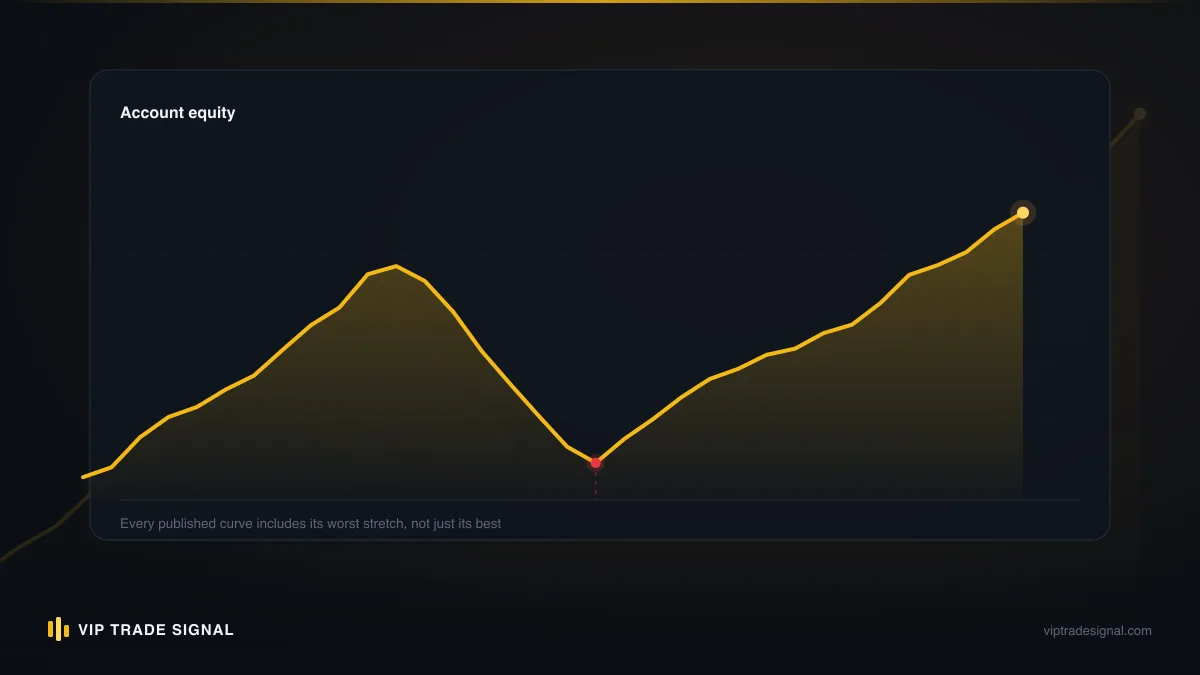
Three caveats first, because honest ones matter. First, not everyone hits every stage; some traders jump straight from denial to revenge and blow up before paralysis ever gets a look in. Second, the stages loop; a trader can cycle denial-bargain-denial for months. Third, and most usefully: each stage has a signature account decision, visible right there in the trade history. You can diagnose the psychology from the statement. We do it every week.
| Stage | The inner monologue | The signature account decision | Typical damage |
|---|---|---|---|
| Denial | "It's a pullback. Gold always comes back." | Removing the stop; stopping looking at the P/L | Small loss becomes structural |
| Bargaining | "If I hedge it, I can figure this out later." | Panic hedge; moved stop; "just this once" rules | Locked-in loss plus double spread and swap |
| Revenge | "One good trade gets it all back." | Position size jumps 3-10x; overtrading | The account-killer stage |
| Paralysis | "I can't even open the app." | No action at all; positions drift for weeks | Time, swap fees, and opportunity all bleed |
Denial: "it will come back"
Denial is the quiet stage, which is why it's underrated as a destroyer of accounts. Nothing dramatic happens. That's the problem.
Say you're long gold from 3,380 and it's trading 3,340. Call it 4% of a $10,000 account. Entirely survivable. The plan said stop at 3,355, but the level came and went during a news spike, and you told yourself the spike didn't count. Now the loss is bigger than the plan ever allowed for, and here denial performs its central trick: it converts a trade into a belief. "Gold always comes back." You've heard it, you may have said it. And over a long enough horizon gold has indeed tended to recover its dips, which is exactly what makes the belief so venomous. It is true enough to be believable and false enough to be fatal, because a leveraged position doesn't get a long horizon. It gets a margin level.
The behavioural signature of denial is subtraction, not action. The stop gets deleted "temporarily". The P/L column gets hidden; most platforms let you do this, and it is telling how many drawn-down traders know exactly where that setting lives. Chart-checking gets outsourced to hope: the trader stops doing analysis and starts doing vigils. One man we'll call Rashid told us he went three weeks without opening his terminal on a laptop, only on his phone, because the phone showed less information. Less information was the point.
What makes denial genuinely hard to self-diagnose is that it wears the costume of patience. Aren't we always told not to panic-close? Isn't conviction a virtue? Here's the difference: patience is holding a position that is following your plan. Denial is holding a position that has already broken your plan, while constructing new reasons after the fact. If your stop was hit and you're still in the trade, you are not being patient. You are being carried.
The cost of denial compounds quietly. On gold, a held CFD position pays swap most nights; a few dollars per lot per night sounds like nothing until you've held for eleven weeks. Worse, the loss grows past the size your risk rules were built for, so by the time denial cracks, the account is no longer facing a trading decision. It's facing triage.
Bargaining: the panic hedge and the moved stop
Denial ends when the loss gets too big to un-see. Maybe a margin warning arrives. Maybe gold drops $60 in a session and the floating figure jumps a digit. Whatever the trigger, the trader snaps out of not-looking and into frantic deal-making with the market, with fate. This is bargaining, and it has two signature moves.
The first is the panic hedge. Long two lots from 3,380 with gold at 3,320, the trader sells two lots "to stop the bleeding while I think". And in fairness, the bleeding does stop; the floating number freezes. But look at what has actually been purchased. The $6,000 loss is now locked in every bit as firmly as if the position had been closed; the hedge just relabels it. Meanwhile the trader is paying spread and swap on two positions, and has acquired a problem professional desks openly dread: exiting a hedge means timing the market twice, correctly, in sequence. Close the short too early and the long resumes bleeding. Close the long too early and the short bleeds instead. We have seen accounts where the hedge-management losses ended up exceeding the original drawdown. Closing would have been cheaper and kinder to the trader's sleep. But closing makes the loss real, and bargaining exists precisely to avoid that moment of realness.
The second move is the moved stop, and it deserves its own small autopsy. Moving a stop is never announced, even internally, as "I am abandoning my risk management". It is always framed as a one-off. Just below the next support. Just past the round number. Just this once. Each individual move sounds almost reasonable (that's the bargain), but chain four of them together and a trade that was supposed to risk $200 has consumed $2,100, with each extension pre-justifying the next. The stop no longer exists to protect the account. It exists to protect the trader from a feeling.
Bargaining also produces superstition dressed as strategy: closing exactly half the position, averaging down "to improve the entry", or promising yourself you'll close at breakeven, a promise broken within seconds of being tested, because at breakeven the trader who has suffered for weeks suddenly wants to be paid for the suffering.
If you recognise yourself here, one honest question cuts through most of it: if I had no position right now, would I open this one? Not "do I hope it recovers". Would you, flat, with fresh eyes, put this trade on at this price with this stop? If the answer is no, you are not holding a trade anymore. You're holding a grudge.
Revenge: sizing up to get it back
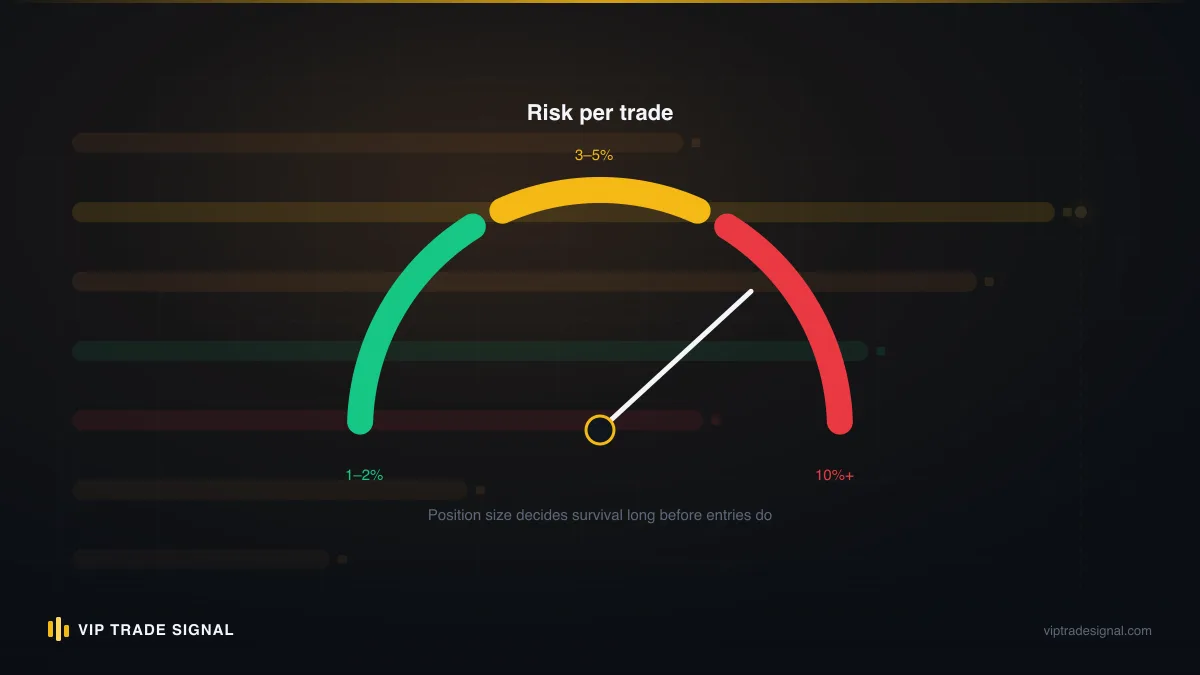
If denial is the quiet stage, revenge is the loud one. This is where accounts actually die, and the trade history from this stage is unmistakable: after weeks of 0.5-lot positions, suddenly there's a 3-lot trade. Then a 5-lot. The intervals between trades collapse from days to minutes. Entries stop correlating with any visible setup and start correlating with the previous trade's close.
The internal logic of revenge trading is arithmetic desperation. A trader $8,000 down on a $20,000 account calculates, correctly, that at their normal risk of $200 a trade, recovery will take forty consecutive wins, or realistically months of decent trading. Months feel unbearable. But one 5-lot gold trade catching an $80 move? That's $4,000. Two of those and the nightmare is over by Friday. The maths is real. What the calculation omits is the other side: one 5-lot trade catching an $80 move against you doesn't halve the problem, it doubles it, and you were already impaired enough to be sizing at 5 lots.
There is a physiological dimension here that traders don't like hearing but need to. The revenge state is chemically adjacent to gambling-on-tilt: the same dopamine loop, the same tolerance effect where each bet needs to be bigger to produce the same feeling, the same telescoping of time where a "quick check" of the charts becomes a six-hour session ending at 3 a.m. We are traders, not clinicians. But we will say plainly that a trader in full revenge mode is not trading. Same buttons, same platform, different behaviour. Trading tries to make money. Revenge trading tries to erase a feeling, and the market charges an appalling price for feelings.
The cruellest feature of revenge is that it sometimes works. Once. The 5-lot trade wins, half the hole gets filled in a day, and the lesson learned is exactly the wrong one: that oversizing is how strong traders recover. That trader will be back in a deeper hole within the quarter, because they now believe the fire extinguisher is filled with petrol. The traders who lose the first revenge trade are, in a bleak way, luckier. At least the market told them the truth on the first attempt.
One more marker worth knowing, because families spot it before traders do: revenge is the stage of secrecy. The Telegram groups go quiet. The spouse gets a vaguer answer than last month. If you have started managing what the people around you know about your account, take it as diagnostic. The concealment is the symptom; the sizing is merely where it shows up on the statement.
Paralysis: unable to close, unable to act
Revenge burns hot and cannot last. What follows, in the accounts that survive it, is the strangest stage of the four: paralysis. The trader stops trading — but doesn't close anything. Positions sit open for weeks. Margin drifts. Swap accrues nightly, a few dollars here and there, a slow leak nobody is watching because nobody can bear to watch. The platform sits behind a login the trader physically avoids. We have taken over accounts where the last deliberate action was forty days before the first phone call.
From outside, paralysis looks like laziness or even calm. From inside, it is the opposite: it's the state where every option has become intolerable at once. Closing the positions makes the loss real and final: unbearable. Holding means more nights of the ambient dread: unbearable. Adding is unthinkable after what revenge did. So the mind does what minds do when every door hurts: it stops opening doors. Psychologists have a tidy phrase for this, learned helplessness, and the laboratory version maps onto trading with uncomfortable precision. After enough shocks that nothing seemed to prevent, the subject stops trying to prevent shocks. Even when an exit is available. Even when the exit is one click.
The account damage in this stage is subtler than revenge but very real. Floating positions in paralysis are unmanaged risk: a Fed surprise or a geopolitical headline can move gold $50 in an evening, and nobody is at the wheel. Swap costs add up; we've seen a held gold short accrue over $900 in financing across three months, a whole extra loss nobody decided to take. And a trader in paralysis is out of the game entirely, learning nothing, rebuilding nothing, while the months pass.
Paralysis is also, quietly, the stage where drawdown psychology stops being a trading problem. The sleep goes. Appetite wobbles. The account becomes a presence in the house, unmentioned but felt, like a locked room. If that describes your last month (not your worst evening, your ordinary month), then some of what you need is not in this article or any trading article, and we'd rather say so directly than sell you a protocol for it.
Protocols for each stage
Generic advice fails in drawdown for a simple reason: "be disciplined" is an instruction to the exact faculty the drawdown has switched off. Useful protocols share three properties instead. They are mechanical, so they don't rely on in-the-moment judgement. They are small, so a depleted person can actually execute them. And they are pre-committed where possible, agreed with yourself or someone else before the state they're designed for arrives. Here is what we use.
For denial: force one honest measurement. Denial survives on not-looking, so the protocol is a single act of looking, made as small as possible. Tonight, write down three numbers on paper: account equity right now, account balance, and the gap between them. Don't analyse and don't open the charts. Just write the numbers and date the page. The gap between balance and equity is the figure denial works hardest to hide. It's the difference between the account you talk about and the account you have, and if that distinction is fuzzy for you, our piece on equity versus balance in drawdown exists precisely because it's fuzzy for most people. Then a second step, once, this week: reinstate a stop on every open position, even an absurdly wide one. A stop at any distance converts an unbounded problem into a bounded one, and bounded problems are the only kind human beings solve.
For bargaining: pre-commit, and price the hedge honestly. The moved stop can't be fought in the moment; it has to be made impossible in advance. Concretely: write the stop into a journal at entry, tell one other person the level, and treat any modification as requiring a written sentence explaining why, before the modification, not after. Friction is the whole mechanism. Most bargains dissolve when they have to be spelled out. For the hedge urge, run this arithmetic before opening the offsetting position: the hedge locks in exactly the loss that closing would realise, then adds spread on the new position, nightly swap on both, and the obligation to time two exits instead of zero. Write those four costs down with numbers attached. In our experience the hedge survives this exercise about one time in ten, and that tenth time (usually around a binary event like a rate decision) it's at least a decision rather than a flinch.
For revenge: cut the throttle, mechanically. Willpower is not a plan here; the state is faster than the resolve. What works is hard limits installed while calm: a maximum lot size set at the account level where your platform or broker allows it, a daily loss limit that ends the session (some brokers and prop-style tools will enforce this; use them), and our desk's blunt favourite, the 24-hour rule: after any loss beyond your normal per-trade risk, no new position for a full day, no exceptions, no "unless there's a setup". One day costs a revenge trader nothing except the feeling they're trying to outrun, which is precisely why it works and precisely why it will feel impossible. Do it anyway. And halve your size after any losing week. Not as punishment; as recognition that the person trading next week is measurably impaired and should be operating lighter machinery.
For paralysis: shrink the door. A paralysed trader cannot execute "sort out the account". The protocol is one action so small it slips under the dread: log in and close the single smallest position. That's the whole task. Not the biggest, not the plan for all of them. The smallest, today. Tomorrow, the next smallest. What this does is re-teach the nervous system the one thing learned helplessness deleted: that your actions still change outcomes. We've watched traders unwind a nine-position pile-up in nine days this way after forty days of total freeze. The first click is the treatment. Everything after it is just repetition.
The stop no longer exists to protect the account. It exists to protect the trader from a feeling — and the market charges an appalling price for feelings.
One protocol spans all four stages: get the decision out of your own head. Every stage of drawdown psychology is a private loop, and loops break on contact with another person. A trading friend, a mentor, a desk like ours, honestly even a written explanation addressed to nobody: the medium matters less than the act of externalising. A plan you can say out loud to another human is a plan. A plan you can only think is usually a mood.
Separating self-worth from equity
Under all four stages sits one load-bearing error, and until it's addressed the stages just recycle: the fusion of account value and self-value. It sounds like therapy-speak. It is actually the most practical topic in this article, because a trader who experiences a losing position as evidence about themselves cannot close it, because closing would mean confirming the evidence. Half the wreckage we've described exists to avoid one sentence: "I was wrong, and it cost me."
Watch the language, yours and others'. "I'm down eight grand" is fine, factual. "I'm getting killed" is closer to the bone. And "I'm a failure at this," said flatly at the end of a first phone call: that trader isn't describing a P/L anymore. The fusion is nearly universal among self-directed traders, because trading is one of the few pursuits where a number appears to score you, daily, in currency. No boss, no team, no market for your labour. Just you, your decisions, and a figure that goes up when you're "good" and down when you're "bad". Except it doesn't, and here is the practitioner's case, not the therapist's.
The figure scores your decisions plus variance, and in any single trade or single month, variance dominates. A sound process on gold might win 45% of the time with the winners twice the losers; that process makes money over a hundred trades and still, routinely, produces six or seven losses in a row. The trader who reads that streak as a verdict on their character will abandon the process at exactly the moment abandoning it costs the most. The trader who reads it as weather (unpleasant, expected, survivable) keeps the process and collects its edge. Same equity curve, opposite outcomes, and the only difference is what the red was taken to mean.
So the working discipline is this: judge yourself only on the parts you control. Entry criteria met or not. Stop honoured or not. Size within rules or not. Those are yours. The outcome of any given trade belongs to the distribution, and the distribution does not know your name. We'd go further, and this is opinion: a trader who feels roughly nothing on a rule-following loss and sharp discomfort on a rule-breaking win has the emotional wiring of a professional, whatever their account size. Getting there takes deliberate practice. Which brings us to how you practise it.
Rebuilding confidence with process metrics
Confidence after a big loss cannot be rebuilt with profits, and this is the mistake almost everyone makes. They wait to "feel like a trader again" once the money comes back. But money-based confidence is exactly the confidence that just failed: it inflated on the way up and evaporated on the way down, because it was indexed to the one variable you don't control. Rebuilding confidence after a big trading loss means re-indexing it to variables you do.
Concretely, we have traders coming out of drawdown score every trade on process, not outcome. A simple version, scored nightly, takes two minutes:
- Setup validity. Did the trade meet your written entry criteria? (If you have no written criteria, that's day one's task, before any trade.)
- Size compliance. Was risk at or under the planned percentage? A $5,000 account risking 1% has $50 per trade; the question is binary, was it $50 or under.
- Stop integrity. Was the stop placed at entry and never widened?
- Exit discipline. Did the trade end at the stop, the target, or a pre-defined rule, rather than a mood?
- Log completeness. Did you record it, including the screenshot, within the hour?
Five points per trade. Twenty trades makes a hundred-point fortnight, and that is the score you're allowed to care about. A fortnight at 90+ with a small monetary loss is a genuinely good fortnight; say it out loud until it stops feeling absurd. A winning fortnight at 60 is a warning dressed as a reward.
Two features make this actually rebuild the psychology rather than just decorate it. First, the score is fully controllable, so it delivers what damaged confidence needs most: earned wins that cannot be taken away by a headline. You did the reps or you didn't. Second, the score is honest early: process degrades before results do, so a slipping score flags trouble two weeks before the equity curve does.
Pair it with a mechanical sizing ladder for the comeback. Something like: return at one-quarter of normal size until you've logged twenty trades scoring 90+; move to half size for the next twenty; full size only after a losing streak has been experienced at reduced size without a single process violation. Slow? Deliberately. The ladder's job is not to maximise recovery speed; the recovery arithmetic is bleak enough that no responsible ladder can promise speed anyway. Its job is to make sure the trader climbing back is a different trader from the one who fell.
Support structures: journals, peers, professionals
Everything above works better with structure around it, because the defining condition of retail drawdown is isolation. Three structures, in ascending order of weight.
The journal is the cheapest and the most avoided. In drawdown, traders stop journalling at exactly the moment the journal matters, for the same reason they stop looking at the P/L: the page witnesses things they'd rather leave unwitnessed. So lower the bar until avoidance is impossible. One line per trade, plus one line per day about state; "slept badly, traded anyway" is a complete entry. Read a fortnight of entries in one sitting and the stages of this article will be visible in your own handwriting, which lands very differently from reading them in ours. The journal is also where the bargaining protocol lives: stops written at entry, modifications requiring sentences. One notebook, many jobs.
Peers break the privacy that every stage feeds on. Not a 4,000-member signal-room chat where everyone posts wins and vanishes on losses; that environment makes drawdown shame worse, and frankly most of those rooms are marketing funnels with a chart on top. What works is small and reciprocal: two or three traders who see each other's numbers, honestly, on a schedule. A weekly call where each person states equity, open risk, and process score takes fifteen minutes and makes concealment, the oxygen of the revenge stage, structurally difficult. If you have even one trading friend you'd trust with the real number, the highest-value move available to you this week is sending it to them.
Professionals are for the point where the account problem has become a person problem. We want to be plain here. We run a trading desk; you can read who we are and how we operate on our about page, and nothing about us qualifies us to treat what a clinician treats. If trading losses have brought persistent sleep disruption, concealment from a partner, gambling-loop behaviour you cannot interrupt, or thoughts that frighten you, a therapist familiar with gambling dynamics is not the admission of weakness the trading internet implies. It is the same move as every protocol in this article: taking the decision out of the impaired loop and handing it to a system that still works.
When handing over the account is the strong move
There's a version of trading culture (you've met it on YouTube) where the only honourable endings are triumph or ruin, and asking for help with a losing account sits somewhere below both. We think that's adolescent, and we'd think so even if we didn't run a recovery service, because we've seen where it leads: traders in month four of paralysis, bleeding swap, protecting their solitude like it's a position.
Here is the grown-up framing. Every serious operation on earth has a protocol for the moment the operator is compromised. Pilots hand over controls. Surgeons step out of theatres. Funds give risk officers authority to cut a trader's book without asking. The handover isn't the failure; the handover is the competence. Retail traders are the only market participants expected to be their own risk officer while impaired, at 2 a.m., alone.
Sometimes the right handover is simply to a flat account: close everything, take the realised loss, stand down for a month, rebuild on the ladder above. We tell people this often, including people who contacted us to buy something else, because it's frequently the best answer and it costs nothing. Full stop, no service required.
And sometimes the account genuinely has positions and complexity worth working with, and the trader is honest with themselves that they can't be the one to work it. For that case, our desk runs a drawdown management service for accounts floating roughly $5,000-$10,000 down. The mechanics, stated flatly because you should evaluate this like an adult: we trade on your own MT4 or MT5 account, you keep the master password and full withdrawal control, we record a baseline together, and we charge a flat 50% of whatever recovered profit we produce above that baseline. Fifty percent sits at the high end of the industry, we won't pretend otherwise; it's the price of low minimums and pay-as-you-go terms, and engagement starts with a $200 minimum advance, so weigh that against what the account is already bleeding in swap. And we will say the quiet part at normal volume: there is no recovery guarantee, from us or from anyone, and a service that offers you one has told you everything you need to know about them. Trading gold is high-risk; recovery trading of an already-damaged account is high-risk with the starting line moved back.
Whether that trade-off suits you depends on your situation, and we're not licensed to tell you it does; nothing here is personalised advice. But the decision framework is the article you've just read: which stage are you in, honestly? A denial-stage trader doesn't need us; they need tonight's three numbers on paper. A revenge-stage trader needs the throttle cut before anything else matters. It's the paralysis-stage trader, frozen for weeks with unmanaged risk drifting on the book, for whom a handover (to us, to another professional, or simply to the flat button) is most often the strong move rather than the surrender.
What to do tonight if you're deep in red
Long articles about trading psychology after a big loss have a failure mode of their own: they get read, nodded at, and filed, while the positions stay open. So let's close with the shortest possible version, sequenced, for tonight.
- Locate yourself on the map. Denial, bargaining, revenge, paralysis. Use the trade-history signatures, not your self-image; the statement doesn't flatter. Deleted stops say denial. A fresh hedge says bargaining. A size spike says revenge. Forty days of nothing says paralysis.
- Run that stage's protocol, only. Three numbers on paper. The hedge arithmetic. The 24-hour rule. The single smallest position. One mechanical act per stage; ignore the rest until tomorrow.
- Tell one human the real number. Tonight if possible. The stages are private loops, and this is the loop-breaker. It will be the hardest item on this list and it is the one that changes the slope.
- Decide what you're rebuilding on. If the answer is "profits, as fast as possible", you've just planned your next drawdown. Process scores, quarter size, twenty trades. Boring is the point.
- Know your handover line in advance. Write down the condition under which you'll stand down or hand over: a margin level, a number of frozen weeks, a second opinion. Deciding it now, calm, is the whole trick. You will not decide it well later.
The red on the screen is money, and the money matters; we'd never pretend otherwise. But the red is also, right now, running an experiment on your thinking, and the account's fate depends far more on that experiment than on gold's next hundred dollars. Traders survive drawdowns all the time. What they don't survive is becoming, for a few weeks, someone who shouldn't be holding the controls, without noticing the handover has already happened, to the worst possible pilot.
Notice it. That's the entire skill. Everything else in this piece is just scaffolding for that one moment of looking at the screen, then looking at yourself, and telling the truth about which one is actually in trouble.