Every conversation we have with a prospective account management client reaches the same moment. They've read the fee structure, they've looked at the track record, they're broadly convinced — and then there's a pause, and the real question comes out, usually phrased more politely than it deserves. What it means is: can a forex account manager withdraw my money and disappear with it?
It's the right question. Ask it early, ask it rudely, ask it of us and of everyone else you talk to. Because the answer separates the entire legitimate account management industry from the entire fraudulent one, and the line between the two is not charm, or track records, or how professional the website looks. The line is custody.
Here's the answer up front, and the rest of this article is the proof: in a correctly configured managed account, your manager cannot withdraw your money. Not "won't". Cannot. The withdrawal function is structurally walled off from the trading function at the broker level, and no amount of skill, malice or midnight typing gets a trader-permission login through that wall. Every managed-account horror story you have ever read — and we'll decode a few later — involves the client handing over something they should never have handed over, or sending money somewhere it should never have gone. The setup was broken before the theft happened.
The short answer: not if the setup is correct
A managed forex account, done properly, has exactly one structure. You open an account at a regulated broker, in your name, verified against your ID and your bank details. You deposit your own money into it. The broker then lets you create a second, limited set of login credentials — MT4 and MT5 call this the investor password's big brother: the trading password, as distinct from the master password. You give your manager trading access. You keep everything else.
From that moment the manager can open trades, close trades, and set stops and targets on your account. That's the whole list. They cannot see your bank details. They cannot change your registered email. They cannot request a withdrawal, and even if they somehow could, the money would land in your bank account, not theirs, because of a broker-side rule we'll spend a whole section on shortly.
So when someone asks us "can a forex account manager withdraw my money?", the honest answer has two halves. Half one: no, not in this structure, and the structure is not exotic — it's the default at every serious broker on earth. Half two: the structure only protects you if you actually use it, and a depressing number of people don't. They wire money to the manager directly. They share the master password because the manager asked nicely. They sign up at some unregulated "broker" the manager recommended, which turns out to be a website with the manager's cousin behind it.
The technology is not the weak point. You are. That's not an insult; it's the design brief for the rest of this piece. Once you understand why the wall exists and exactly where it sits, you can check your own setup in about five minutes and know — not hope, know — that your capital can't walk.
And if a manager's proposed arrangement fails that check, you don't negotiate. You leave.
Why withdrawals are structurally separate from trading
Brokers didn't build the trading/withdrawal separation to be nice. They built it because they're the ones holding the bag when things go wrong.
Think about what a broker actually is: a regulated financial firm holding client money in segregated accounts, answerable to a licensing authority (the FCA, ASIC, CySEC and friends), and legally required to return each client's funds to that client. If a broker paid out your balance to some third party who happened to know a password, the regulator wouldn't shrug and say bad luck. The broker would be liable. So brokers engineered the problem away, and the engineering has two layers.
Layer one is credentials. On MetaTrader, every account has a master password and an investor password, and on the broker's side there's a further distinction: the trading platform credentials versus the client portal login. The client portal — the web dashboard where you deposit, withdraw, upload documents and change personal details — is a completely separate system from MT4/MT5. Your platform password opens charts. It does not open the cashier. A manager holding trading credentials is locked inside a room that contains buy buttons and sell buttons and nothing else.
Layer two is identity. Withdrawals from the client portal don't just require the portal login; at any decent broker they require the request to originate from the verified account holder. That means the registered email gets a confirmation link, and any change to that registered email triggers its own verification dance, often with a document check. Some brokers add two-factor authentication on withdrawals specifically. The point of all this friction — which regular clients grumble about — is precisely to make "someone else got my money out" as close to impossible as software can manage.
Now, is any system unbreakable? No. If you hand over the portal login and access to your email inbox, you've dismantled both layers yourself, and no broker can save you from that. But notice what it takes: not one mistake, a chain of them. A correctly configured setup fails safe. You'd have to actively saw through two separate walls to expose your money, and nobody saws through walls by accident. They do it because someone persuasive asked them to, which is why the rest of this article is mostly about recognising the ask.
One more thing worth saying plainly. This separation is also why we can run our own account management service the way we do — we trade client accounts through trading credentials only, the client keeps the master password, and we structurally can't touch withdrawals even on a day a client owes us fees. We like it that way. It means nobody has to trust our character. They only have to trust the architecture, which is a much better bet.
The broker-side control most people don't know exists
Suppose the worst happens anyway. Suppose a manager somehow gets into your broker portal — you reused a password, your email got phished, whatever. They click withdraw. Where does the money go?
At every regulated broker: back to you. This is the control that surprises people, and it's arguably stronger than the password layer. It's usually called a closed-loop or return-to-source policy, and it says that withdrawals can only be paid to the same funding method the deposit came from, in the account holder's own name. Deposited by card? Refund goes to that card. Deposited by bank transfer? Withdrawal goes to that bank account, name-matched to your verified ID. The thief can press the withdraw button all day; the money lands in your bank.
This isn't broker generosity either. It's anti-money-laundering law. Regulators require closed-loop handling precisely so that brokerage accounts can't be used to launder or divert funds, and the happy side effect is that a compromised trading account is a lousy target for direct theft. A fraudster inside your portal can annoy you. They can't pay themselves.
Could they add a new withdrawal method in their name? At a properly regulated broker, no — new methods need to be in the account holder's verified name, and mismatched names get bounced to the compliance desk. This is exactly the kind of check the offshore no-questions-asked shops skip, which brings us to a rule of thumb worth tattooing somewhere: the annoying broker is the safe broker. Every document upload, every name check, every withdrawal delay that irritates you is a wall between a bad actor and your balance.
The corollary matters just as much: this protection only exists if the broker is real and regulated. The scam ecosystem knows the closed loop is unbeatable, so it doesn't attack it — it routes around it by getting you onto a fake broker where there is no loop, no compliance desk, and no segregated client money at all. There's just a database showing you a number, and a man who controls the database. Your "balance" there was never money you could withdraw; it was a screenshot with your name on it.
So the custody question always starts one level up from the manager. Before you ask what access the manager has, ask what the broker is. A recognisable, licence-checkable firm — the sort we plug into ourselves, the Exness and IC Markets tier — or a name you'd never heard of until this manager warmly recommended it? If it's the second one, stop reading about permissions. Permissions on a fake broker are theatre.
The three misconfigurations that break the guarantee
Everything above describes the correct setup. Practically every real theft involves breaking it in one of three specific ways, and it's worth knowing all three by name, because each one arrives wrapped in a plausible-sounding reason.
Misconfiguration one: sending money to the manager instead of the broker
This is the big one, probably behind most of the money ever lost to "account managers". The manager says: don't worry about opening a broker account, just send the funds to us — bank transfer, USDT, gift cards on the really shameless end — and we'll trade it on our "company account" and send back profits.
The moment your money leaves your name, custody is gone. There is no account, no broker, no regulator, no closed loop. There is a person who has your money and a chat window. Everything that follows — the screenshots of "your" profits, the small early payout to build trust, the eventual "pay a tax/fee to release your withdrawal" — is choreography. The theft already happened when you hit send.
No legitimate manager ever takes custody of client funds. Not for convenience, not for a better spread, not because minimums. If the money doesn't sit in a broker account in your name, walk. This is rule zero and it has no exceptions.
Misconfiguration two: handing over the master password
Subtler, because your money genuinely is at a real broker in your name. But the manager asks for the master password rather than trading-only access, usually with a reasonable-sounding excuse: the software needs it, it's simpler, trading access has some limitation.
It's rubbish. Every trading operation a manager legitimately needs — opening, closing, modifying, running an EA — works on trading credentials. The master password's extra powers are exactly the ones a manager should never have: changing passwords (including locking you out) and, at some brokers, deeper account-level settings. Master access doesn't usually let them withdraw directly, thanks to the portal separation, but it removes your ability to watch and intervene, and it's a reliable tell about intent. Someone who asks for more access than the job requires wants it for something the job doesn't require.
Should you give your account manager your master password? No. Ever. If they say the arrangement doesn't work without it, the arrangement you're being offered isn't account management.
Misconfiguration three: the manager's pet broker
The third pattern is being steered to a specific unregulated broker — often with an aggressive deposit bonus, always with a sense of urgency. Sometimes the "broker" is fake outright; sometimes it's a real but licence-free offshore shell where the manager collects kickbacks and the withdrawal desk answers to nobody. Either way, the protections in the previous section evaporate, because those protections were regulatory, and you've just left the regulated world.
A manager can reasonably say "we support brokers A, B and C" — we do, because our systems have to plug into something. What they can't reasonably do is insist on a single obscure venue and get twitchy when you propose a big regulated name instead. Twitchiness about the broker is twitchiness about the referee.
Custody, explained properly: who holds the money at each moment
"Custody" gets thrown around loosely, so let's be exact about who holds custody in a managed forex account at every stage, because once you can trace it, you can spot the moment any proposed arrangement goes wrong.
At deposit. You send money from your bank to the broker. The broker, if regulated, must hold it in a segregated client account — legally your money, ring-fenced from the broker's own operating funds. Custody: the broker, as regulated custodian, on your behalf. The manager hasn't appeared yet and never appears in this chain.
During trading. The manager opens and closes positions. Your balance goes up and down with results — and it can genuinely go down; leveraged gold trading can lose money fast, and anyone who tells you a managed account removes that risk is lying to you about the easiest thing to check. But notice what trading actually is, custodially: nothing. Wins and losses change the number in your segregated account. Not a cent moves to the manager or anywhere else. A losing manager can hurt you; they still can't take from you.
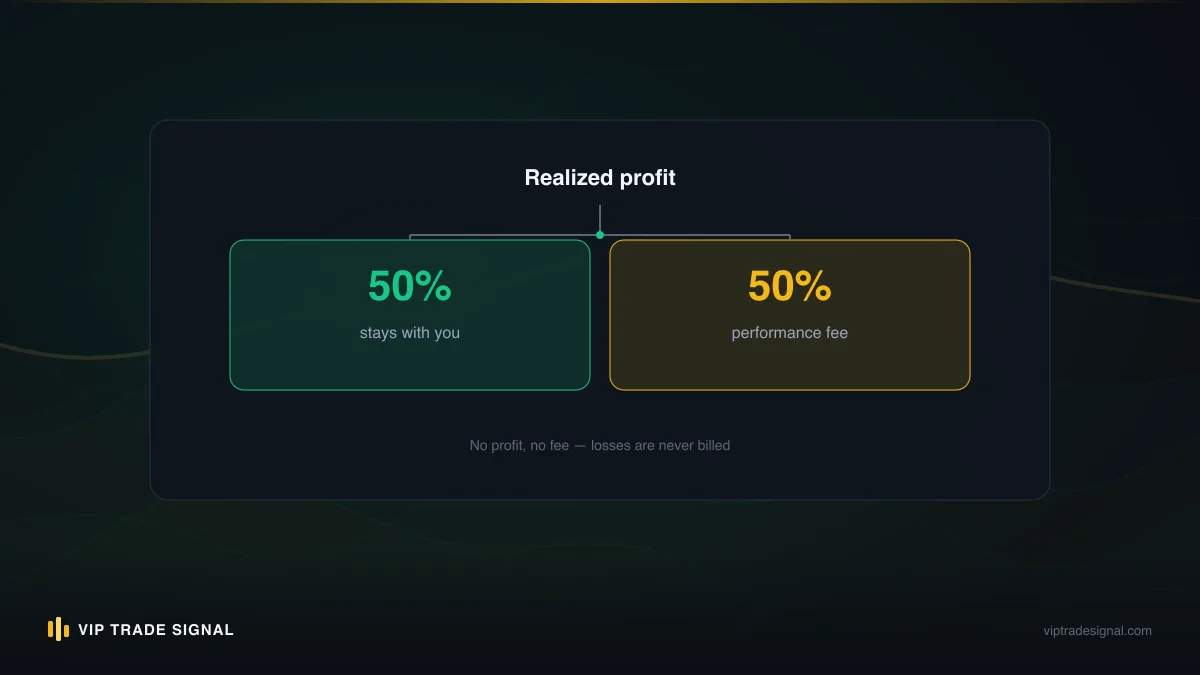
At fee time. Here honest services differ in mechanics but agree on principle: fees are paid by you, as a deliberate separate act, out of money that reaches you first. Our own model is a flat 50% of realized profit — steep, we know, and we've written elsewhere about why low minimums price that way — but the mechanics are the point here: profit lands in your account, you withdraw as you like, you settle the fee. The manager invoices; the manager does not reach in. Any arrangement where fees are "automatically deducted" by someone other than the broker deserves a very hard look, because a party that can deduct fees can deduct other things.
At withdrawal. You log in to the portal, you request, the broker name-checks and pays your original funding method. The manager isn't in this chain either — can't initiate it, can't redirect it, at most finds out about it afterwards when the equity drops.
Trace those four stages for any service you're considering. Funds stay in your own broker account for the entire journey, and the manager's role is confined to stage two. The moment a pitch has the money touching the manager at any stage — deposit "through us", fees "swept" by them, withdrawals "processed" by them — the custody chain is broken and you're not looking at account management any more. You're looking at a donation with extra steps.
How to audit your own setup in five minutes
If you already have a manager on your account, or you're about to, here's the check. It's genuinely about five minutes, and it converts "I think it's fine" into "I verified it's fine", which is worth more than any reassurance a manager can offer.
- Verify the broker's licence — from the regulator's side. Don't trust the badge on the broker's website; anyone can paste a logo. Go to the regulator's public register (the FCA, ASIC and CySEC registers are all searchable free) and look the firm up by name and licence number. Two minutes, and it kills the fake-broker scenario dead.
- Confirm the account is in your name. Log in to the broker's client portal — the web dashboard, not the trading platform — with credentials only you hold. Your name, your email, your documents. If you've never seen this portal because "the manager set it all up", that is your five-alarm finding right there.
- Confirm the password split. You hold the master password; the manager holds trading access only. Not sure what you gave them? Change the master password right now from the portal and see what breaks. If the manager can still trade, the split is correct. If they email asking why they're locked out of settings, you've learned something important at zero cost.
- Check the withdrawal path. In the portal, look at your registered withdrawal methods. Every one should be in your name and predate the manager. Anything unfamiliar — an added wallet, a changed bank — is a stop-everything moment: change passwords, contact the broker, revoke access.
- Do a test withdrawal. Pull out a small amount, even $50, and watch it land in your own bank. This single act verifies the entire chain end to end — portal access, identity checks, closed loop — better than any document. A manager who discourages test withdrawals ("it interrupts the strategy", "wait for the cycle to finish") is telling you the audit would fail.
Notice none of these steps requires the manager's cooperation, permission, or even knowledge. That's the definition of custody: what you can verify and do unilaterally. If any step does require asking the manager — for the portal login, for "approval" to withdraw — the audit has already returned its answer.
We tell our own clients to run exactly this list on us. Partly because it's good hygiene, and partly, frankly, because a client who has verified the architecture stops worrying about the architecture, and worried clients make bad decisions at exactly the wrong moments in a drawdown.
Revoking a manager's access, instantly and unilaterally
Here's a test question for any managed arrangement: if you decided at 3am on a Sunday that you were done, could you end it by yourself, immediately, without speaking to anyone?
In a correct setup, yes, and it takes under a minute. The manager's entire presence on your account is a set of trading credentials, and you control the credentials. Log in to the broker portal with your master access, change the trading password (or the master password, which at most brokers forces new platform credentials too), and it's over. The manager's terminal disconnects. No notice period they can enforce, no exit interview, no "release form". They can't reverse it, because reversing it would require the portal, and the portal is yours.
Three practical notes on doing it cleanly.
First, deal with open positions. Revoking access doesn't close trades; it freezes the manager out while positions keep running. So before you change the password, decide: close everything flat yourself (you can, from your own master login), or keep what's open and manage it. In an urgent situation — you've spotted something dodgy — flat first, revoke second, ask questions third. The spread you pay closing early is the cheapest insurance you'll ever buy.
Second, revoke properly if an EA is involved. If the manager ran software on a VPS logged into your account, the password change kills that session too — MetaTrader sessions die with the credentials. Change it at the broker portal level, not just inside the platform, so every copy of the old password everywhere becomes a brick.
Third, expect the relationship conversation, and have it after the revocation if trust is the issue. A legitimate manager will be irritated by an unannounced lockout and will say so, fair enough — but a legitimate manager also knows this power is yours and built their business assuming it. Ours does. Any contract clause that pretends to remove your right to revoke access to your own account is unenforceable theatre; the broker's systems don't read contracts. Though a clause like that in the paperwork is, again, a tell worth heeding before you sign, not after.
The deeper point: revocability isn't a nice extra, it's the enforcement mechanism behind everything else in this article. Managers behave well in structures where clients can leave in sixty seconds. The whole industry's honest end is honest partly because exit is instant.
What a manager still can do that hurts: the risk that's actually real
It would be dishonest to end the security discussion on a comforting note, because there's a danger the custody wall doesn't touch, and it's responsible for more real-world client losses than theft is. A manager who can't withdraw a cent can still trade your account into the floor.
Trading access is real power. A reckless or malicious manager can oversize positions, martingale into a losing streak, hold a levered gold position through a Fed announcement, or simply churn the account for volume if they're getting broker rebates per lot. None of that touches withdrawals. All of it can vaporise your balance in an afternoon, entirely within the permissions you granted. Gold is exuberant enough on a calm day; gold at 1:500 leverage in careless hands is a bonfire.
So your defences against the trading risk are different from your defences against the custody risk, and you need both:
- Watch the account yourself. You hold master (or investor) access, so use it — the investor password is read-only and safe to put on your phone. You should be able to see every position, live, any hour. Managers who ask clients not to watch ("it causes stress", "trust the process") are managing your attention, not your money.
- Agree risk limits in writing before the first trade. Maximum risk per trade, maximum open exposure, a drawdown level at which trading pauses and you talk. Ours get recorded at onboarding for exactly this reason. Numbers, not vibes.
- Understand the fee's incentive. Profit-share models (including ours) reward wins but don't feel losses, which tilts careless managers toward over-risking with your money. The counterweights are your limits, your monitoring, and a track record you can inspect — we keep every closed signal public, losers included, because a history with no red in it is a history that's been edited.
- Expect losing periods, because they're coming. Any managed account will have losing weeks and drawdowns; that's the cost of being in leveraged markets at all. The question is never "will there be losses" but "are the losses within the limits we agreed". If a manager promised you otherwise, that promise was the first misconfiguration.
We've gone deeper on vetting the trading side — track records, risk frameworks, the questions that make bad managers squirm — in our piece on whether you should let someone trade your forex account at all, and on the related choice between software and human management. Read those before you grant anyone access. Custody protects your principal from theft; only diligence protects it from bad trading.
Horror stories, decoded
Spend an evening in the r/Forex archives and you'll find the same tragedy retold a hundred ways: "my account manager stole everything". Read each one against the framework above, though, and something clarifying happens — every single story resolves into one of the misconfigurations, usually within the first paragraph. Let's decode the recurring three. Details invented, patterns painfully real.
"I sent him $5,000 and now he wants a $900 release fee." A trader we'll call Dan meets a manager on Instagram. Slick profile, screenshots of gains, warm DMs. Dan never opens a broker account; he sends USDT to a wallet address, "for the company account". Weeks of dashboard screenshots follow — Dan's $5,000 is now $23,400! — until Dan asks to withdraw and learns about the tax. Decoded: misconfiguration one. There was never an account, a broker, or a trade. Custody died at the first transfer, and the "release fee" is just the scam asking whether the victim has more. The forex content was set dressing; this is an advance-fee con wearing a chart.
"She had my passwords and locked me out." A retiree we'll call Margaret hires a manager who helpfully "handles the setup" — opens the broker account using Margaret's documents, keeps every credential, portal included, and emails her weekly statements. When Margaret finally wants money out, the statements stop. Decoded: misconfigurations two and three had a baby. Margaret never had custody for a single day; she had a correspondent. Whether there was ever real money at a real broker, she has no way to know, because she never once held the keys to check. The five-minute audit would have failed at step two, on day one.
"He didn't steal it. He traded it to zero in a week." Tom's setup was actually correct — his account, real broker, trading-only access. The manager, chasing a monthly performance figure, ran 8% risk per trade into a trending-against-him gold market and torched 90% of the account in six sessions. Decoded: not a custody failure at all. No rule in this article was broken except the ones from the previous section — no written risk limits, no monitoring, no drawdown pause. Tom's money wasn't stolen and he'll get no sympathy from a regulator. It was lost, legally, by a bad trader with valid permissions.
The pattern across all three: the disaster was visible before any money moved, to anyone holding this article's checklist. Which is the genuinely hopeful conclusion hiding in the horror-story genre — the custody failures are entirely preventable, boringly so, by refusing three specific requests. And the trading failures are limitable, if never fully removable. Nobody in these stories was outsmarted by a genius. They were each asked to break their own security, politely, and said yes.
Our custody arrangement, spelled out
Since we run an account management desk ourselves, it's only fair to put our own arrangement through this article's grinder, line by line, so you can see there's no gap between what we've argued and what we do.
Your money sits at your broker, in your account, opened by you and verified against your ID. We'll happily work on accounts at the big regulated names — Exness, XM, IC Markets, Vantage — and if a "manager" ever steers you somewhere you can't find on a regulator's register, including us, that's your cue to leave.
You give us trading access only. You keep the master password from day one; we never ask for it, and if anyone claiming to be us ever does, treat it as fraud and tell us. You can watch every position live through your own login the entire time.
Fees are 50% of realized profit — high, and openly so, because the $200 minimum advance means small accounts get the same desk as large ones, and there are no lock-ins subsidising anything. No profit, no performance fee. The fee is settled by you, not extracted by us; we structurally can't reach your balance, which we consider a feature of the deal rather than an inconvenience. And to be blunt about the other side of the ledger: profits are not guaranteed, losing periods will happen, and gold with leverage can and does lose money. Anyone in this business who says otherwise is selling something worse than a bad trade. The full mechanics, limits and onboarding steps are on the account management service page, the questions everyone asks are answered straight on the FAQ, and if you want to know who's actually behind the desk before granting anyone access to anything, the about page is where we introduce ourselves properly.
Withdrawals: yours, always, unilaterally. Test-withdraw on week one; we genuinely encourage it. And you can revoke our access with one password change, at 3am, without telling us — we'd rather you knew that and never needed it than the reverse. If the goal is to compound a small account over years rather than gamble it over weeks, this is the only custody arrangement worth compounding inside.
Where this leaves you
Back to the question you actually came with: can a forex account manager withdraw my money? In a correct setup — your account, a regulated broker, trading-only access — no. Not through skill, not through the master password they don't have, not even through a stolen portal login, because the closed loop pays withdrawals to you alone. The theft you're afraid of requires your participation, and now you know the three exact forms the invitation takes: send money to me, give me the master password, use my special broker.
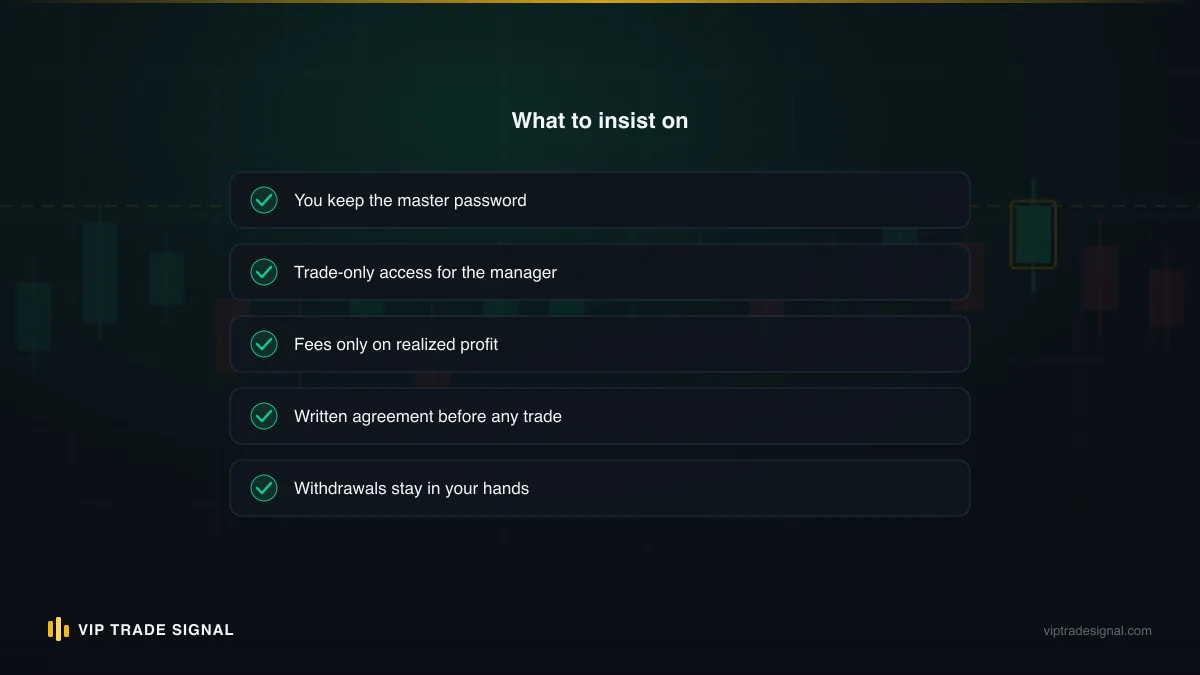
So here's the standard we'd hold anyone to, ourselves included. Money only ever in your own broker account at a firm you licence-checked yourself. Trading credentials for the manager, everything else for you. A test withdrawal in the first week. Written risk limits before the first trade, and your own eyes on the account after it. Sixty-second revocation, tested once so you know it works.
Any manager who accepts all of that without flinching has passed the only security interview that matters. Any manager who pushes back on even one line has answered your question — just not the way they intended. The custody problem in this industry was solved years ago by broker architecture. What's left is simply the discipline of refusing to unsolve it, and that part has always been yours.