Type "forex compounding calculator" into Google and you'll find a hundred pages that all do the same trick. You enter a starting balance, a monthly return, a number of years. The page draws a curve that starts flat and ends vertical, and somewhere below it a line of text tells you that $1,000 at 10% a month becomes $304,000 in five years. The maths is correct. The premise is fantasy.
I've been around retail forex long enough to have believed that curve once, and long enough to have watched what actually happens to accounts over five years — mine, clients', friends'. Compounding a forex account is real. It works. It is also slower, lumpier and more psychologically brutal than any calculator will ever admit, because calculators don't model losing months, drawdowns, fees, or the moment in year two when you look at your balance and wonder why you bothered.
This article is the version of the compounding story I wish someone had handed me at the start. We're going to run the honest numbers: what realistic returns compound to, what a losing streak does to the curve, what a profit split quietly costs over sixty months, and when you should stop reinvesting and start withdrawing. No hype, no $304,000. Just the arithmetic and the grind.
Why compounding calculators lie by omission
A compounding calculator doesn't lie about the multiplication. It lies about everything it leaves out.
The first omission is the return itself. Most calculators default to something like 5% or 10% per month, because those numbers make the curve look exciting. But a trader who averages 10% a month, every month, for five years, would be compounding at roughly 210% a year. Sustained. On growing capital. The best hedge funds in history — with teams of PhDs, prime brokerage, and information you will never have — celebrate 30% annual years. When a Telegram channel implies you'll do seven times that from your phone, the polite word is optimistic.
The second omission is variance. Calculators assume the same return every single month. Real trading returns arrive in lumps: +7% here, −4% there, three flat months, then a good quarter. The average might genuinely be 3% a month, but you never actually experience the average. You experience the sequence, and the sequence includes stretches that feel like the whole thing has stopped working.
The third omission is cost. Spreads, swaps, commission, and — if someone else trades for you — a performance fee. A 50% profit split doesn't just halve your gains in a given month; it halves the rate you compound at, which over five years costs far more than half the growth. We'll put exact numbers on that later, and yes, that includes our own fees.
And the fourth omission is you. No calculator models the month you withdraw half the account for a car repair, or the drawdown that scares you into pulling everything out at the exact bottom. Compounding is an unbroken chain by definition. Humans break chains.
None of this means compounding is a myth. It means the marketing version is. The genuine version survives all four omissions and still comes out ahead — just on a very different timeline.
The honest model: what goes into it
If we're going to simulate compounding a forex account properly, the model needs four ingredients that the calculators skip.
A defensible average return. For a disciplined trader or a competent managed account, somewhere between 2% and 4% a month gross is an ambitious but not absurd long-run average. Some months will be 8%. Some will be −5%. Plenty will be roughly zero. Anyone quoting you a reliable 10-15% monthly is either compressing one lucky quarter into a brochure or risking amounts that will eventually delete the account. Most retail accounts lose money over time — that's the industry's own regulated disclosure, not my pessimism — so even 2-4% average puts you well above the median outcome.
Losing months. Around one month in three, sometimes two in a row. A strategy with a genuine edge still loses regularly; the edge shows up in the average, not in every reading. If a track record shows no red months across years, the drawdown is hiding somewhere — usually in open floating losses that haven't been closed yet. It's one reason we publish every closed signal, wins and losses, at /signals/history: a record with no losses isn't a track record, it's an advert.
Drawdowns. Not just losing months, but clusters of them. A 15-20% peak-to-trough drawdown at some point over five years is normal for anything targeting meaningful returns. Your model — and your stomach — need to include one.
Fees and friction. Trading costs shave a little off gross returns continuously. Performance fees take a defined bite out of profitable periods. Both compound against you exactly as relentlessly as returns compound for you.
Put those together and the smooth exponential curve turns into something that looks more like a staircase built by a drunk: genuinely upward over time, but with steps of wildly different heights and the occasional stumble backwards.
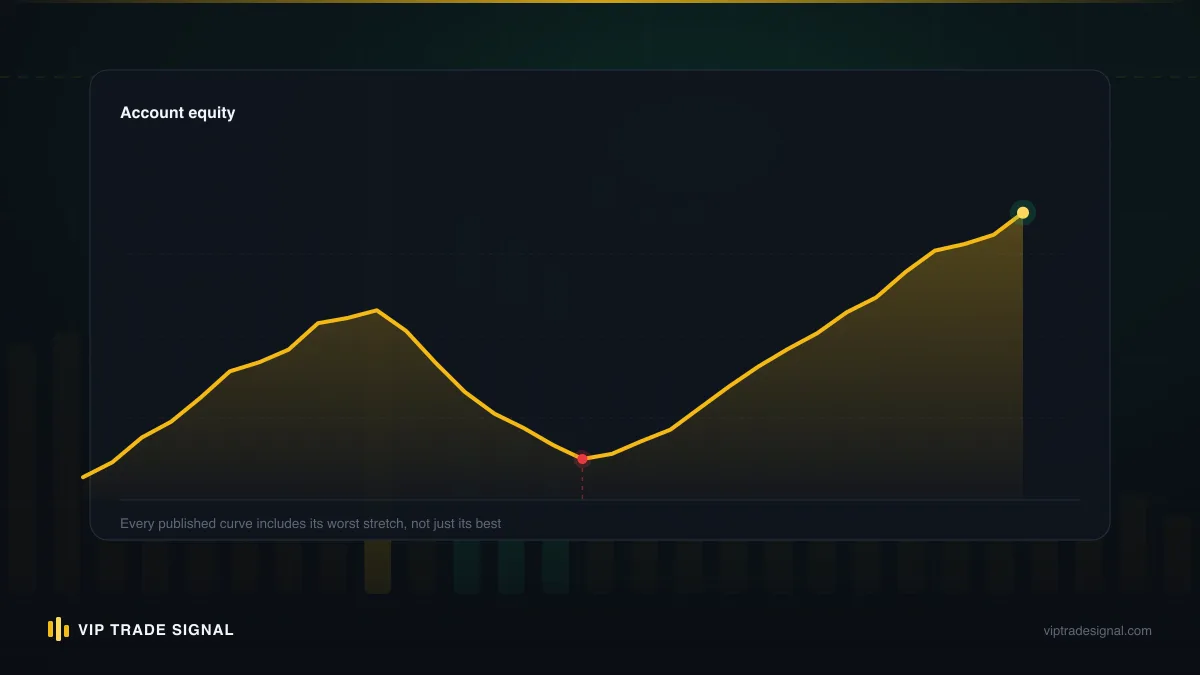
Compounding a forex account for five years: the $1,000 simulation
Let's run it. Say a trader we'll call Dana starts with $1,000 and manages a long-run average of 3% a month gross — which, to be clear, would make Dana genuinely good. First, the calculator version, then reality.
The calculator says: 1.03 to the power of 60 months is about 5.9. Dana finishes with roughly $5,900. Already a far cry from the six-figure fantasies, and we haven't touched fees yet.
Now the honest version. Suppose Dana pays away half of realized profits to whoever's generating them — a manager, a prop split, whatever. Net compounding rate: 1.5% a month. Over 60 months that's about 2.44x, so around $2,440. Add realistic variance — a couple of proper drawdowns, a flat year in the middle — and the plausible range widens to something like $1,800 on a rough run and $3,500 on a good one.
Here's the five-year picture at a few compounding rates, no deposits, no withdrawals:
| Net monthly average | Year 1 | Year 2 | Year 3 | Year 4 | Year 5 |
|---|---|---|---|---|---|
| 1% | $1,127 | $1,270 | $1,431 | $1,612 | $1,817 |
| 1.5% | $1,196 | $1,430 | $1,709 | $2,043 | $2,443 |
| 2% | $1,268 | $1,608 | $2,039 | $2,587 | $3,281 |
| 3% | $1,426 | $2,033 | $2,898 | $4,132 | $5,892 |
Sit with that table for a minute, because it contains the two most important truths about compounding a forex account.
First: the differences between rows are enormous by year five. The gap between 1.5% and 2% net looks trivial monthly — half a percentage point — and ends up being more than $800 on a $1,000 start. Rate matters more than almost anything else, which is exactly why fee drag deserves its own section.
Second: the early years are boring. Painfully so. At 1.5% net, Dana's first year produces $196. A weekend job would beat it hopelessly. Year two adds $234. It's not until years four and five that the curve starts doing what the calculator promised on day one — and most people never get there, because they quit during the boring part or torch the account trying to speed it up.
How long to grow a forex account to something meaningful, then? On honest numbers, a $1,000 account becomes a few thousand in five years, not a few hundred thousand. If that answer disappoints you, good — better to be disappointed by arithmetic now than by a blown account later.
Using a forex compounding calculator without fooling yourself
I'm not telling you to bin the calculators entirely. Used honestly, a forex compounding calculator is a decent planning tool — the trick is feeding it inputs from the pessimistic end of reality rather than the optimistic end of marketing. A workflow that keeps you honest:
- Take your actual average monthly return from your last twelve months of statements. Not your best month. Not your intended return. The real average, losses included. If you don't have twelve months of statements, use 1.5% net and consider yourself flattered.
- Knock off your all-in costs — spread, swap, commission, any performance fee — if they're not already reflected in the statement figures.
- Run the projection three times: at your real average, at half of it, and at zero. The half-rate run is your plausible bad case. The zero run tells you what your deposits alone build, which for small accounts is most of the story anyway.
- Treat the output as a ceiling, not a forecast. The calculator assumes an unbroken chain of average months; you will not get one.
Do that and the calculator stops being a slot machine and starts being a budget. The number it produces will be smaller and duller than the one the landing pages show you. It will also occasionally come true, which the landing-page number never does.
Sequence risk: when the order of returns starts to matter
Here's a fact that surprises almost everyone: if you never deposit or withdraw, the order of your returns doesn't change the final balance at all. Multiplication is commutative. A −20% month followed by four +8% months lands you in exactly the same place as the +8% months first and the −20% at the end. The maths genuinely does not care.
So why does every serious money manager bang on about sequence risk? Because the clean version of that fact assumes a robot is holding the account. The moment a human is involved — or the moment money moves in or out — sequence starts to bite, three ways.
Sequence plus withdrawals. Suppose you're drawing $50 a month from a $2,000 account. A bad run early means you're selling down a shrinking account to fund fixed withdrawals, and the capital that would have recovered during the rebound simply isn't there any more. Same average return, materially worse outcome. This is the classic pension problem wearing an MT5 badge, and it's why the withdraw-or-reinvest decision later in this piece depends heavily on account size.
Sequence plus deposits. The mirror image works in your favour. If you're adding money monthly, a rough first year means your fresh deposits buy in at the bottom of the equity curve. Painful to watch, quietly profitable in hindsight.
Sequence plus psychology. This is the one that actually kills accounts. A drawdown in month four, when you've seen no real gains yet and your conviction is running on fumes, feels existential. The identical drawdown in month forty, sitting on double your starting capital, is a Tuesday. The maths treats them the same. You won't. And most people who abandon a compounding plan do it in exactly that early-drawdown window — locking in the bad sequence permanently by leaving.
Compounding doesn't fail in the spreadsheet. It fails in month seven, at 11pm, when the curve has gone sideways for a quarter and quitting feels like prudence.
Let me make the withdrawal version concrete, because the numbers are starker than most people expect. Two accounts, both starting at $10,000, both drawing $150 a month, both averaging the same return over three years. Account A gets the good sequence: a strong first year, a wobble in year two, recovery in year three. Account B gets the mirror image: a 20% drawdown in the first eight months, then the strong run. Account A sails through — the early gains mean the $150 withdrawals are being paid out of profit, and the capital base barely notices. Account B spends its first year paying $150 a month out of a shrinking pot; by the time the strong run arrives, the base it's compounding from is materially smaller, and it finishes the three years around 8-10% behind Account A. Same trades, same average, different order — real money lost to nothing but timing.
Whatever plan you build, then, build it to survive a bad opening year. Because you don't get to choose your sequence, and the coin flip says roughly half of you will start with the ugly one. The defences are unglamorous: don't withdraw from a small account at all, keep withdrawals proportional rather than fixed once you do, and hold enough cash outside the account that a bad first year never forces your hand.
Fee drag: what a profit split really costs over sixty months
Time for the section where we turn the honesty rules on ourselves.
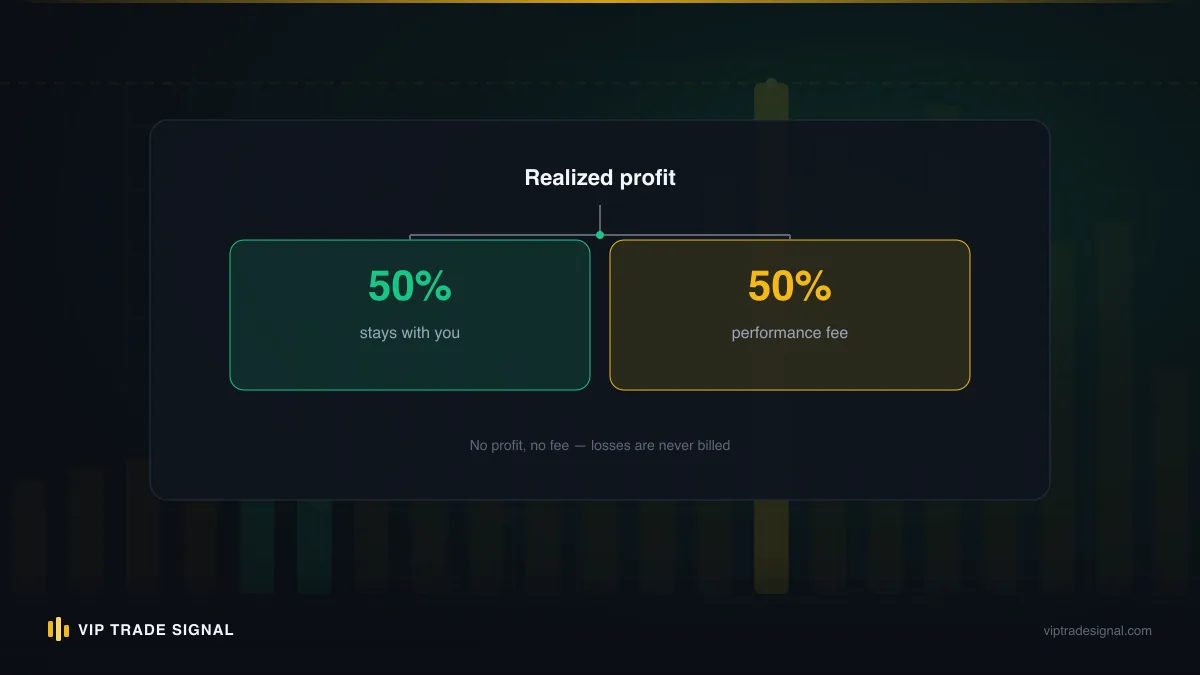
Our account management service charges a flat 50% of realized profit — you can see the full structure at /pricing. That is the high end of the industry. Hedge funds charge 20% (plus a management fee, mind). Plenty of retail account managers quote 30-40%. We charge more because the minimum to start is $200 rather than $50,000, there's no fixed fee bleeding you in flat months, and you keep the master password and control of withdrawals throughout. Whether that trade-off suits you is genuinely your call. But you should walk into it knowing exactly what 50% costs over time, because the answer is: more than 50%.
Here's the uncomfortable arithmetic. Gross compounding at 3% monthly turns $1,000 into about $5,890 over five years — $4,890 of growth. Net compounding at 1.5% produces about $2,440 — $1,440 of growth. The split didn't take half your growth. It took roughly seventy percent of it, because every dollar paid out in year one is a dollar that never compounds through years two to five. Fee drag is itself a compounding phenomenon; it just compounds against you.
Does that make profit splits a con? No — it makes them a price, and prices deserve comparison. The relevant question is never "what does the manager cost?" but "what's my realistic alternative, net of everything?" If your alternative is self-trading at a genuine 3% monthly, paying half of it away is plainly mad. If your honest alternative is self-trading at −2% a month — which is roughly where most retail accounts actually live — then 1.5% net is not drag, it's rescue. The fee comparison only makes sense against your own real track record, not against the trader you hope to become.
Two practical rules fall out of this. First, never pay performance fees on unrealized profit or on anything other than gains above a recorded baseline — the fee should only exist where new profit exists. Second, favour structures where a flat month costs you nothing. A 2% annual management fee looks tiny next to a 50% split, but it's charged in losing years too, and on a small account that certainty of drag can outweigh a larger contingent one.
Withdraw or reinvest: the framework
Reinvesting forex profits is the whole engine of compounding — every dollar withdrawn is a dollar that stops working. So the purist answer is: never withdraw, reinvest everything, let the exponential do its thing. The purist answer is also wrong for most people, and here's the framework I actually use.
Under about $5,000: reinvest everything, but for a specific reason. It isn't that small withdrawals are immoral. It's that they're pointless in both directions. Withdrawing $30 from a $1,500 account buys you a takeaway and costs the account 2% of its compounding base. Neither number changes your life. At this stage the account's only job is to get bigger and prove the process works. Touch nothing.
Roughly $5,000 to $25,000: withdraw a slice of profit, and do it deliberately. Somewhere in this range, a strange thing happens: the money starts being real, and real money you've never touched starts feeling fake. I've watched people run accounts up for two years, withdraw nothing, then panic-close everything in a drawdown — partly because the gains never became tangible. A standing rule like "withdraw 25% of each profitable quarter's gains, reinvest the rest" costs you some terminal value, sure. It also makes the project feel real, funds a little of your life, and — crucially — makes you far more likely to stay in the game for the years when compounding actually pays. A slightly slower curve you finish beats a perfect curve you abandon.
There's a tax wrinkle in this band too, and it varies enough by country that all I'll say is: find out how your jurisdiction treats trading gains before you build a withdrawal habit, because in some places realized withdrawals crystallise a liability that money left compounding doesn't. Ten minutes with an accountant beats a surprise in April. We're a signal and account management desk, not tax advisors, and this is one of those places where paying a professional a small fee protects a large balance.
Above $25,000 or so: withdrawals become the point. Past a certain size, the account stops being a growth project and starts being an income asset. The question flips from "how fast can this grow?" to "how much can this pay me without shrinking?" — and the sequence-risk rules from earlier take over. Fixed-percentage withdrawals (a share of realized profit) age far better than fixed-dollar ones, because they automatically shrink in bad runs instead of eating capital.
One rule sits above the whole framework: never reinvest money you'll need within a year. Compounding requires time and tolerance for drawdown; rent money has neither. The account should only ever contain capital that could halve without changing your week — high-risk products like forex and gold CFDs demand nothing less.
Compound growth in a managed account versus doing it yourself
The mechanics of compounding don't care who presses the buttons, but the realistic inputs change a lot depending on who does.
Self-trading gives you the full gross return — no split, no drag. It also gives you the full gross responsibility. The honest question isn't whether you'd like to keep 100% of 3% monthly; everyone would. It's whether your last twelve months of statements show anything like that. If they show a slow bleed — and for most retail traders they do — then keeping 100% of a negative number is not the bargain it sounds.
A managed account trades fee drag for (hopefully) a better and steadier gross return, plus one advantage that never appears in the fee comparison: it removes your fingers from the trigger. A large share of compounding failures are self-inflicted — revenge trades after a red week, doubling risk to "catch up" to the calculator curve, closing winners early in a drawdown out of fear. A structure where you physically can't interfere mid-month has saved more accounts than any indicator ever built. Whether the manager is human or software matters too, and matters differently than most people assume — we've written up the honest trade-offs in /blog/expert-advisor-vs-human-account-manager if that decision is live for you.
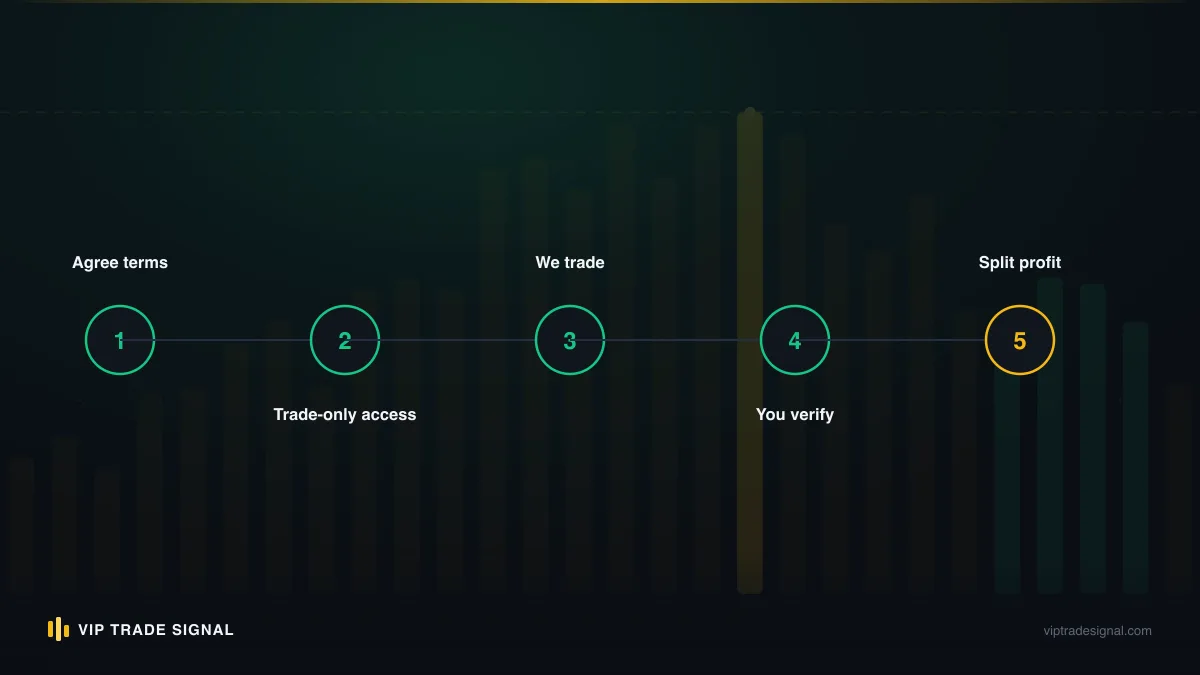
For what it's worth, the shape we run on our account management desk: you open the account at your own broker, we trade it under investor-style access, you keep the master password and the ability to withdraw at any moment, and the fee is 50% of realized profit with a $200 minimum advance. The compounding consequence of that structure is the one covered in the fee section — halve the rate, more than halve the terminal growth — so it only makes sense for people whose self-traded alternative is worse than the net. Plenty of people's is. Some people's isn't. Check your statements, not your feelings.
A word on the middle path, because plenty of readers will be weighing it: trading signals yourself rather than handing over the account. Following a signal service costs a subscription instead of a split — ours is $99 a month, or free through a partner broker with a maintained balance — which changes the compounding arithmetic completely at larger sizes. A flat $99 is a brutal 10% annual drag on a $1,000 account but a rounding error on $50,000, whereas a profit split scales up with the account forever. The catch is that with signals, the execution discipline is back on you: the compounding chain now depends on you taking every trade at the stated risk, including the ones that arrive during a losing streak when your conviction is at its lowest. Cheaper drag, more ways to break the chain. Know which failure mode is more likely to be yours.
Where you live shapes this decision more than people expect, too — regulation, broker access and the practicalities of handing trading authority to a desk differ a lot between, say, the UK and the Gulf, and if you're weighing managed compounding from that part of the world, /blog/forex-account-management-dubai covers the regional specifics.
Whichever route you take, get the terms in writing before a single trade happens — baseline balance, fee calculation, withdrawal rights, what happens in drawdown. The unglamorous paperwork is where compounding plans survive or die, and /blog/forex-account-management-agreement walks through exactly what a fair agreement contains.
When adding fresh capital beats waiting for compounding
Here's the dirty secret of small-account compounding: for the first couple of years, your deposits matter more than your returns. A lot more.
Run the numbers on Dana again. $1,000 compounding at 1.5% net reaches about $1,430 after two years — $430 of growth. Now suppose Dana also adds $100 a month from wages. Those deposits alone total $2,400, and with each one compounding from the month it lands, the account finishes near $4,290. Of the $3,290 gained, roughly $2,860 came from deposits and their growth. The trading contributed the minority. By a distance.
This flips the usual obsession on its head. Small-account traders agonise over squeezing another half-percent of monthly return — often by taking risks that eventually crater the account — when the same energy directed at their income would grow the account three times faster with zero added risk. If you can save $150 a month, you are, in effect, adding 15% monthly to a $1,000 account. No strategy on earth reliably beats that.
The crossover comes later, and it's worth knowing where yours is. Deposits dominate until the account's typical monthly gain exceeds what you can realistically save. At 1.5% net, a $10,000 account produces about $150 a month — so if $150 is your saving capacity, that's your crossover; beyond it, compounding gradually takes over as the main engine and your deposits fade into rounding.
The practical playbook, then, by stage:
- Years one and two: deposit aggressively, compound patiently, and judge yourself on process, not balance. The balance is mostly your deposits anyway.
- The crossover years: keep depositing, but expect the account's own growth to start matching your contributions. This is where the curve quietly changes character.
- Beyond crossover: deposits become optional. The account is now doing the heavy lifting, and your job shifts to not breaking the chain.
One warning shot: never deposit into a drawdown to "help the account recover" on emotion. Deposit on schedule, mechanically, whatever the curve is doing. Scheduled deposits into a drawdown are dollar-cost averaging; panicked deposits into a drawdown are how people end up throwing rent money at a strategy that's stopped working.
Milestone psychology: surviving the boring middle
Nobody warns you that the hardest part of compounding a forex account is not a market event. It's the middle. Years two and three, specifically — after the novelty has worn off, before the curve has started to bend.
The problem is that human motivation runs on visible progress, and compounding front-loads all the invisibility. In year one at 1.5% net, your $1,000 account earns less than $200 — less than most phone contracts cost. Anyone in your life who knows about the project will ask how the trading's going, and the honest answer, "up nineteen percent, so, about a hundred and ninety dollars," lands like a punchline. Meanwhile some lad on Instagram is posting a screenshot of a $4,000 week. Fake, probably, or one lucky week from a soon-to-be-dead account. Doesn't matter. It still stings.
This is the window where sensible people do senseless things. They triple their risk to make the curve interesting. They hop strategies every eight weeks, resetting the compounding clock each time. They quit entirely and tell everyone forex is a scam — which, given how they were playing it, had become true.
It helps to know that this middle-years dip is documented far beyond trading. People saving pensions hit it. People paying down mortgages hit it. Any long compounding process has a stretch where effort is high, feedback is low, and the finish line hasn't come into view — and the dropout curve peaks right there, not at the start and not near the end. You're not weak for finding year two hard. You're normal. The traders who make it through aren't more motivated; they've just arranged their lives so that continuing is the default and quitting requires effort, rather than the other way round.
A few things genuinely help. Measure in percentages, not dollars, until at least year three; "up 19% this year" is an excellent result and framing it that way keeps your brain honest. Compare yourself only to your own written plan, never to strangers' screenshots. Automate whatever can be automated — deposits, risk settings, the monthly review — so the boring years require decisions from you as rarely as possible. And pre-write, on an actual piece of paper, what drawdown you expect to hit at some point (15-20%, remember) so that when it arrives it reads as forecast rather than failure.
And know what you're waiting for, because it does come. There is a point — different for every account, but real — where a normal month's gain exceeds anything you could add from your salary, and the account audibly changes gear. Every long-term compounder I know describes the same arc: years of nothing, then a stretch where the balance starts doing things that feel faintly ridiculous. The people who got there are not the ones who found a better curve. They're the ones who didn't step off the boring one.
A realistic compounding plan, on one page
Everything above collapses into a plan you could write on an index card. Here's the template; fill in your own numbers.
- Starting capital: only money that could halve without touching your life. If that's $500, it's $500. Size honesty beats size ambition.
- Assumed net return: 1-2% monthly after all fees. Write it down. If your plan only works at 5%+, you don't have a plan, you have a lottery ticket with extra steps.
- Monthly deposit: the largest amount you can add without ever missing it, on a fixed date, regardless of what the curve did last month.
- Expected worst drawdown: 20%. In writing, dated, before it happens.
- Withdrawal rule: nothing below $5,000; a fixed slice of profitable quarters after that; income-mode past $25,000. Decided now, not in the moment.
- Review cadence: monthly, thirty minutes, against the plan — not daily, against your mood.
- Quit criteria: the one nobody writes. Define in advance what would actually falsify the approach (say, eighteen months below the plan's floor), so that quitting, if it happens, is a decision rather than a panic.
Run the arithmetic on your own card before you commit to it. A five-year projection at your assumed rate, with your deposits, minus your fees, gives you the number this plan realistically produces — and if that number underwhelms you, better to renegotiate with reality now than with a margin call later.
Where this leaves you
Compounding a forex account is one of the few honest promises in this industry, and it's been buried under a decade of dishonest calculators. The real deal looks like this: a few percent net on a good month, a losing month every quarter or so, a drawdown that tests you, deposits doing most of the early work, and a curve that spends three years looking broken before it starts looking inevitable. $1,000 becomes a few thousand in five years, not a Lamborghini. On the way it teaches you position sizing, patience, and exactly how much fee drag costs — lessons that scale to every account you'll ever run.
If you're going to do it yourself, do it with written rules and honest bookkeeping. If you'd rather someone else pressed the buttons, price the drag properly, keep control of your own withdrawals, and never accept a manager who won't show losses — ours are all public, alongside the wins, because a track record with no red in it is a work of fiction. Either way, the decision that matters most isn't the strategy, the broker or the manager. It's whether you can stay on a boring curve for long enough to reach the interesting part. Most people can't. The compounding goes to the ones who can.