Somewhere right now, a trader is staring at two browser tabs. One is a slick landing page for an EA promising "hands-free profits, 94% win rate, set and forget". The other is a page for a human account manager who wants half of whatever profit he makes on the account. Both tabs claim to solve the same problem. Both cannot possibly be telling the whole truth.
The expert advisor vs human account manager question gets asked on every forex forum, usually badly. The way it's normally framed, you're supposed to pick a side. Robots are emotionless and tireless. Humans are adaptable and wise. Cast your vote, place your deposit, hope.
We manage accounts for a living, so you'd expect us to argue for the human. We're not going to, or at least not cleanly. The honest answer is that this is a fight decided by market conditions, not by contestants. An EA that prints steadily for eighteen months can give it all back in a single Wednesday. A human manager with real judgement can also be a human manager with real ego, and the ego usually costs more. What we can do is show you exactly where each one wins, where each one dies, and why every professional desk we've ever seen up close, ours included, ends up running some blend of the two.
The real question: consistency vs adaptability
Strip away the marketing and the entire debate reduces to a single trade-off. An expert advisor is a promise of consistency. It will do the same thing, the same way, at 3am on a Tuesday and at 4pm on non-farm payrolls Friday, forever, without asking how you're feeling. A human account manager is a promise of adaptability. He can look at a market and say something no EA can say: "This isn't the environment my method was built for. I'm sitting out."
Both promises are valuable. Both are also fragile in opposite directions.
Consistency is worth a fortune when the market keeps behaving the way it behaved when the system was designed. It's worth less than nothing when the market changes character, because now the EA is consistently doing the wrong thing, at full size, at machine speed. Adaptability is worth a fortune at exactly those turning points. And it's a liability the other 90% of the time, because "adapting" is what a human calls it when he overrides his own rules after two losses.
So the real question you should be asking is not "which is better". It's this: what does the instrument I trade actually do, and how often does it change its mind? Gold, which is all we trade, is a genuinely awkward customer here. XAU/USD will spend six weeks in a beautiful, EA-friendly range and then produce a $90 candle on a Fed press conference that liquidates every grid bot on the planet before the presenter has finished his second sentence. That mix of long calm stretches and violent regime breaks is precisely why neither pure approach survives on gold for long.
Keep that frame in your head for the rest of this piece. Every section below is really just one question asked repeatedly: in this specific situation, do you want a machine's discipline or a human's judgement? The answer changes by section. That's the point.
How an expert advisor actually works
Before comparing, it's worth being precise about what an EA is, because the marketing fog around them is thick.
An expert advisor is a program, usually written in MQL4 or MQL5, that runs inside your MetaTrader terminal and trades your account according to coded rules. The rules can be anything: cross of two moving averages, a breakout of yesterday's high, an RSI reading, time of day, distance from a pivot. The EA watches price tick by tick, checks its conditions, and fires orders when they're met. No coffee breaks, no doubts, no memory of the last loss.
That's it. There is no intelligence in the everyday sense. The phrase "expert advisor" was a MetaQuotes branding decision, not a description. A typical retail EA is a few hundred lines of if-then logic. Some are genuinely clever pieces of engineering. Most are a moving-average cross wearing a suit.
Three things follow from this that matter for your money:
- An EA only knows what's in its code. If the coder never wrote a rule for "central bank surprise", the EA has no concept of one. It will trade through a rate decision exactly as if it were a sleepy Asian session.
- An EA is only as good as the assumptions baked into it. Every EA encodes a belief about how price moves. When that belief stops being true, the EA doesn't notice. It just starts losing, methodically.
- An EA can be tested against history. This is its one enormous, legitimate advantage over a human, and we'll spend a whole section on what that testing can and cannot prove.
There's a spectrum here worth acknowledging. At one end, big institutional desks run execution algorithms and systematic strategies with teams of quants monitoring them. At the retail end, you're buying a $199 file from a website with a countdown timer on it. Both get called "automated trading". They have roughly as much in common as a commercial airliner and a paper plane. When people ask us about automated forex account management, nine times out of ten they mean the retail end, so that's what we'll judge.
What a backtest can honestly prove
Every EA comes with a backtest, and the equity curve always goes up and to the right. It's worth understanding what that picture is actually evidence of, because the answer is: less than you think, but not nothing.
A backtest replays historical price data through the EA's rules and records the trades it would have taken. Done honestly, on good tick data, with realistic spread and slippage assumptions, a backtest proves one thing: the strategy would have worked on that specific past. That's a real finding. A strategy that can't even survive its own history is dead on arrival, and backtesting kills thousands of bad ideas cheaply. Respect it for that.
What a backtest cannot prove is that the strategy will work next month. And the retail EA industry has perfected the art of making sure it won't, through a process called curve-fitting. Here's how it works, and it's almost embarrassingly simple. Take any strategy with, say, six adjustable parameters: a stop distance, a take-profit, two indicator periods, a trading-hours filter, a day-of-week filter. Run the optimiser over ten years of data and let it try thousands of combinations. The optimiser will find the one combination that happened to dodge every historical loss. Ship that version. The backtest is now spectacular, because you've effectively memorised the past rather than learned anything about the market.
A trader we'll call Dan bought an EA like this a few years back. Backtest: 34% a year for a decade, maximum drawdown 9%. Live: it made 4% in two months, then lost 31% in six weeks when gold's volatility roughly doubled and every stop that history had carefully stepped around got hit in sequence. The vendor's support desk suggested he "re-optimise the settings". Which is a polite way of saying: memorise the newer past, and hope harder.
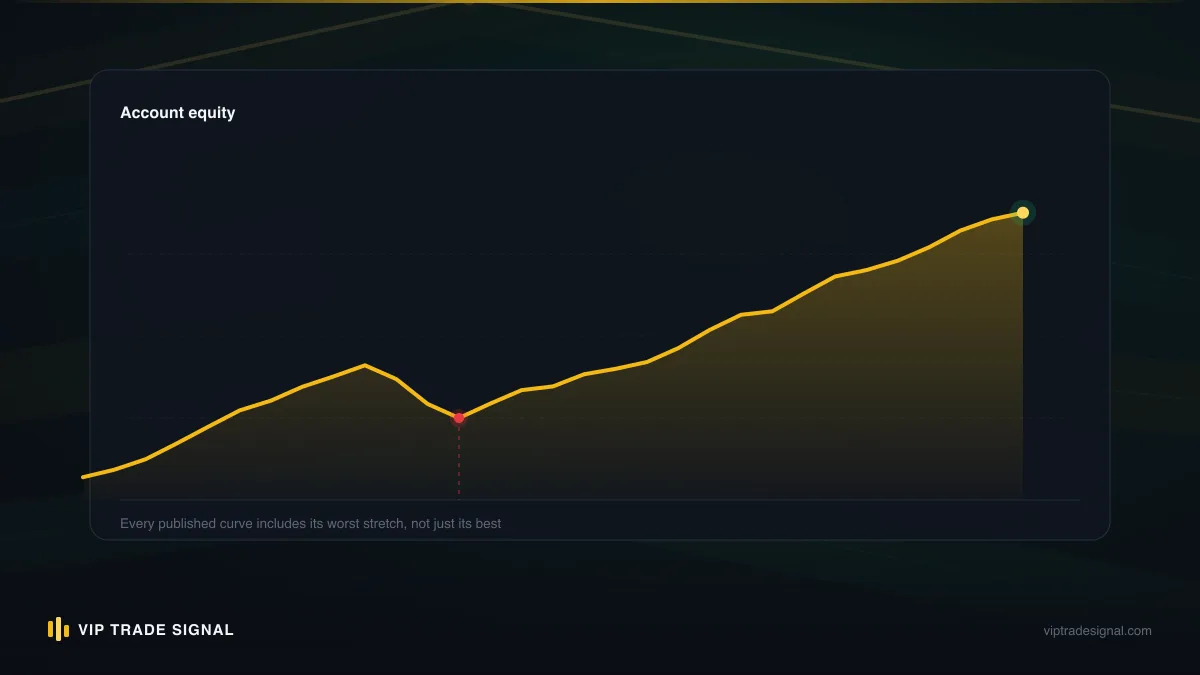
The honest tells are learnable, though. A credible systems developer shows out-of-sample results: the strategy built on 2015–2021 data, then tested untouched on 2022–2024. They show results across a range of parameter settings, not one magic combination. They report performance in different volatility environments separately. If a vendor shows you a single glorious ten-year curve and no out-of-sample split, you're not looking at research. You're looking at an advert.
Where EAs win: discipline, speed, and no revenge trading
Now the case for the machine, and it's a strong one, because the machine is immune to the exact failures that empty most retail accounts.
Go and read any honest post-mortem of a blown account. It's almost never the strategy. It's the fourth loss of the day, followed by a doubled position to "get it back". It's moving a stop because this time the trade will surely turn. It's skipping the valid setup after two losers, then chasing the one after it from a worse price. We've written before about how much of signal trading is really a psychology problem wearing a strategy costume, and the same applies tenfold to self-directed trading.
An EA does none of this. It cannot revenge trade because it doesn't experience revenge. It takes trade number five with exactly the same parameters as trade number one, even though trades two through four all lost. Over hundreds of trades, that blank indifference is a genuine, measurable edge, because it means the strategy you tested is the strategy you're actually running. With a discretionary human, those are never quite the same thing.
The machine's other wins are more mundane but real:
- Coverage. Gold trades nearly 24 hours, five days a week. A human manager sleeps. An EA on a decent VPS watches every tick of every session and never misses the 2am setup because it was, well, 2am.
- Execution speed. An EA reacts to its trigger in milliseconds. By the time a human has seen the breakout, confirmed it, and typed the order, the price is often 30 cents away. On a scalping approach, that difference is the whole edge.
- Sizing arithmetic. An EA calculates position size to the second decimal instantly, every time. Humans round up when confident. Confident is when humans are most dangerous.
- Auditability. Every EA decision has a reason you can inspect in code. Ask a discretionary trader why he took a trade and you'll get a story. Stories are unfalsifiable.
In a stable, trending or cleanly ranging market, a well-built EA is honestly hard for a human to beat. It does the boring thing correctly ten thousand times in a row, and most of trading profitably is exactly that: the boring thing, done correctly, ten thousand times in a row. If markets never changed character, this article would be one section long and we'd be out of a job.
But markets change character. Which brings us to the graveyard.
Where EAs die: regime change and news landmines
Every EA that has ever blown an account died the same death, at bottom. The market stopped being the market it was optimised for, and the EA didn't know.
Traders call these shifts regime changes. A regime is just a market's prevailing personality: quiet range, grinding trend, high-volatility chop, panic. Strategies are almost always regime-specific, whether the coder realises it or not. Mean-reversion approaches, the "buy the dip in a range" family, mint money in quiet conditions and get destroyed by breakouts. Trend-followers feast on directional runs and bleed to death by a hundred false starts in a range. There's no shame in this. It's true of human strategies too. The difference is what happens at the transition.
A human notices. Maybe late, maybe grudgingly, but a competent human eventually looks at three straight weeks of losses and says the conditions have changed. An EA never has that conversation with itself. It was told the rules, and it follows the rules, and if the rules now lose money it follows them anyway, at full speed, around the clock. The very discipline that made it brilliant in the old regime makes it relentless in the new one. A machine doesn't tilt, but it also doesn't blink.
Then there are the landmines: scheduled and unscheduled news. Gold is the most headline-sensitive instrument in retail trading. CPI prints, FOMC pressers, jobs numbers, and the genuinely unscheduled stuff, wars and bank failures and surprise interventions, can move XAU/USD $30 to $80 in minutes. A human manager knows Wednesday is Fed day and flattens or reduces beforehand. Plenty of retail EAs have no news filter at all, or a crude one that reads a calendar and misses everything unscheduled. In March-style panic weeks, spreads on gold can balloon from 20 cents to $2 or worse, stops fill with brutal slippage, and an EA calibrated for normal spreads walks straight into it because nothing in its code says don't.
An EA's discipline and an EA's blindness are the same feature. It cannot break its rules to hurt you, and it cannot break its rules to save you.
The forex robot vs human trader debate usually skips this part, because backtests skip this part. The historical data smooths over the moments of maximum danger: the requotes, the frozen platforms, the ten-second gaps in the feed. Precisely when the market is most dangerous, the backtest is most fictional.
The human edge: context, discretion, and the art of sitting out
So what exactly does a human account manager bring that justifies his existence, and his fee?
Not speed. Not stamina. Not arithmetic. On every mechanical dimension, the machine wins and it isn't close. The human edge lives in one place only: judgement about context. And it shows up in three specific behaviours.
The first is reading the regime, which we've covered. A good manager is constantly asking whether today's market is the market his method wants. When gold is compressing into a wedge ahead of CPI, he knows the range-trading playbook is about to expire, before the losses arrive rather than after. That anticipation is not magic. It's pattern recognition across thousands of hours of screen time, plus the humility to act on it.
The second is weighing information that will never be in a data feed. An EA sees price and maybe a calendar. A human sees that the calendar event is a Powell presser after a hot inflation print with a bank wobbling in the background, and understands those three facts multiply each other. He reads positioning chatter, notices that the last three rallies died at the same level for no obvious technical reason, remembers that gold has a habit of running stops above round numbers before reversing. Fuzzy inputs, all of them. Also real ones.
The third, and honestly the most valuable, is the willingness to do nothing. The single most profitable decision a manager makes in a bad month is the trade he doesn't take. Sitting in cash through a week of untradeable chop feels passive, looks passive on a statement, and quietly preserves the capital that funds the good weeks. No retail EA sits out for a week because things feel wrong. It has no wrong to feel. On our own desk, the no-trade day is a routine tool; anyone who has followed our gold signals for a while has seen quiet days where nothing goes out because nothing was worth risking money on.
Notice what all three behaviours have in common: they're defensive. The human edge is mostly about losing less at the moments when losing big is easiest. That's not a glamorous pitch. It's also where long-term returns actually come from, because the maths of drawdowns is cruel: lose 50% and you need 100% just to get home.
The human weakness: every bias in the book
Now the other side of the ledger, and we'll be blunt because we watch ourselves do these things and have to build guardrails against them.
Humans are walking catalogues of trading bias. Loss aversion makes a manager cut winners early and let losers breathe, the exact inverse of what works. Recency bias makes the last five trades feel like destiny, so he sizes up after wins and freezes after losses. Overconfidence arrives on schedule after every good month. Sunk-cost thinking whispers that the losing position has been held this long, so it deserves a little more room. And revenge trading, the account-killer itself, is not a beginner's disease. Experienced managers feel the pull too. The experienced ones have just built procedures around it.
There's also plain physiology. A manager who slept four hours makes worse decisions and doesn't know it. A manager going through a divorce trades differently in ways no client can see from the statement. A machine has no bad days. Every human has them, and the honest question is not whether your manager has weaknesses but whether his process contains them.
Which is why, when you're evaluating a human, you're really evaluating a process. The questions worth asking any prospective manager, ours included, are process questions. Is there a fixed risk cap per trade, and what enforces it? What happens after three consecutive losses, specifically? Is there a daily or weekly loss limit that forces a stop? Who reviews the trades, and how often? A manager who answers "I just know when to stop" is telling you the account's safety rests entirely on his mood. We'd keep walking. When we take on an ea managed account refugee, someone arriving after a robot blew up their balance, this is the conversation we have first, because they've usually swung from trusting a machine blindly to wanting a human they can trust blindly, and blind trust was the actual problem both times.
A structural point belongs here too: incentives shape behaviour more than character does. A manager paid a percentage of profit only, as we are, eats what he kills and starves when he loses, which concentrates the mind wonderfully. A manager paid on volume or on a management fee regardless of results has every incentive to trade a lot and lose slowly. Before you compare humans to robots, compare fee structures to fee structures. Half the "human error" in this industry is really compensation design working exactly as built. It's one reason we tell people to read the management agreement line by line before reading anything else.
Why "fully automated" ads usually conceal a martingale
Here's the section the EA marketing industry would rather you skipped.
Search any social platform for automated forex account management and you'll drown in screenshots: months of green days, win rates above 90%, equity curves smooth as an airport travelator. Occasionally these are fabricated outright. More often, and more dangerously, they're real. Real results, produced by a real robot, running some version of the oldest trap in gambling: the martingale.
The mechanics are simple. The EA opens a small trade. If it loses, or just goes underwater, the EA opens another in the same direction at a bigger size, then another, and another, each one lowering the average entry so that a modest bounce brings the whole basket back to profit. Variants get called grid trading, cost averaging, recovery zones, "smart hedging". The family resemblance is always the same: losses are never taken, only enlarged and deferred.
Understand what this does to the statistics, because it's genuinely elegant in an awful way. Almost every trade sequence eventually gets rescued by a bounce, so the win rate looks superb, 90%-plus for months. The equity curve is a smooth staircase upward, because losses aren't being realised, they're accumulating silently as floating drawdown between the screenshots. The strategy manufactures precisely the evidence that sells it. And then one day the market trends hard without bouncing, the basket doubles and redoubles into the move, and the account meets its margin call. On gold, with its habit of running $150 in a week when it means it, the wait is rarely long. Every experienced trader has watched a "two years profitable" gold grid bot delete itself in an afternoon.
Some tells that a fully automated miracle is a martingale in a dress:
- Win rates above 85% paired with tiny average wins and rare, enormous losses
- Multiple open positions in the same direction at escalating lot sizes
- The phrase "no stop loss needed, the system manages risk dynamically"
- Floating drawdown never mentioned anywhere in the results
- Monthly returns weirdly smooth for a leveraged product, 8% every month like rent
None of this means automation is a scam. It means the specific automated products marketed hardest at retail traders are disproportionately martingales, because martingale statistics are the best-looking statistics money can buy, right up until the end. The robot's discipline, remember, cuts both ways: a human running martingale sizing at least gets scared. The robot doubles down with a steady hand all the way to zero.
Verifying results: forward tests beat backtests, always
Whether you're vetting a robot or a human, the verification problem is the same, and the solution is the same: insist on forward evidence, on a live account, over a meaningful period, verified by someone other than the seller.
For a forex robot verified real results means, at minimum, a live account tracked by an independent service, Myfxbook or FX Blue or similar, with the track record privileges enabled so history can't be quietly edited. A demo account is better than a screenshot but still not real; demo fills ignore slippage and spread widening, which is exactly where fragile strategies hide their fragility. And the duration matters more than the return. Three live months tells you almost nothing; sixty trades of a high-win-rate system can look brilliant by pure luck. Twelve live months spanning at least one nasty market, a CPI shock, a trending quarter, tells you something.
Here's a rough hierarchy of evidence, weakest to strongest:
| Evidence offered | What it actually proves |
|---|---|
| Screenshot of results | Someone owns image-editing software |
| Backtest, single optimised curve | The past has been memorised |
| Backtest with out-of-sample split | The developer is at least honest |
| Demo forward test, 3+ months | The logic runs; costs still fictional |
| Live verified account, under 6 months | Promising, could still be luck |
| Live verified account, 12+ months incl. drawdowns | The only row worth your deposit |
Note what sits at the top: a live record that includes drawdowns, shown willingly. Anyone whose track record contains no losing periods is either lying or about to have their first one at your expense. It's the same standard we hold ourselves to; every closed signal we've issued, the losers very much included, is public at /signals/history, because a record that only exists in marketing copy isn't a record.
Apply the identical logic to human managers. A human's "backtest" is his story about his experience, and stories are cheap. Ask for the live, third-party-verified history. Ask specifically about the worst month and listen to whether the answer is a number or a speech. A manager who says "we had a 14% drawdown in the spring, here's what caused it and what we changed" is worth ten who say they rarely lose. And a word of context if you're shopping in the offshore hubs where account management is marketed most aggressively: the sales polish there runs well ahead of the verification culture, something we've covered in our piece on account management in Dubai.
The hybrid reality: how professional desks actually run
Now the part the versus-framing hides completely: at every professional desk we've seen from the inside, the answer to "EA or human?" is yes.
Walk into any serious trading operation, bank, prop firm, or a small desk like ours, and you won't find a room of humans clicking mice on gut feel, and you won't find an unattended server printing money. You'll find layers. Machines do what machines do well: scanning, calculating, executing, enforcing. Humans do what humans do well: deciding whether today is a day the machine should be running at all.
On a typical hybrid desk the division of labour looks something like this. The systematic layer generates candidate setups, screens hundreds of conditions no human could watch, and handles execution mechanics: precise entries, correctly sized positions, stops placed at the intended level rather than the level a shaky hand clicked. The human layer sits above it with veto power. Is there a landmine on the calendar? Is liquidity normal? Has the regime shifted since the system's assumptions were set? Are we near a weekly loss limit? The machine proposes and executes; the human governs. Discipline where discipline pays, judgement where judgement pays.
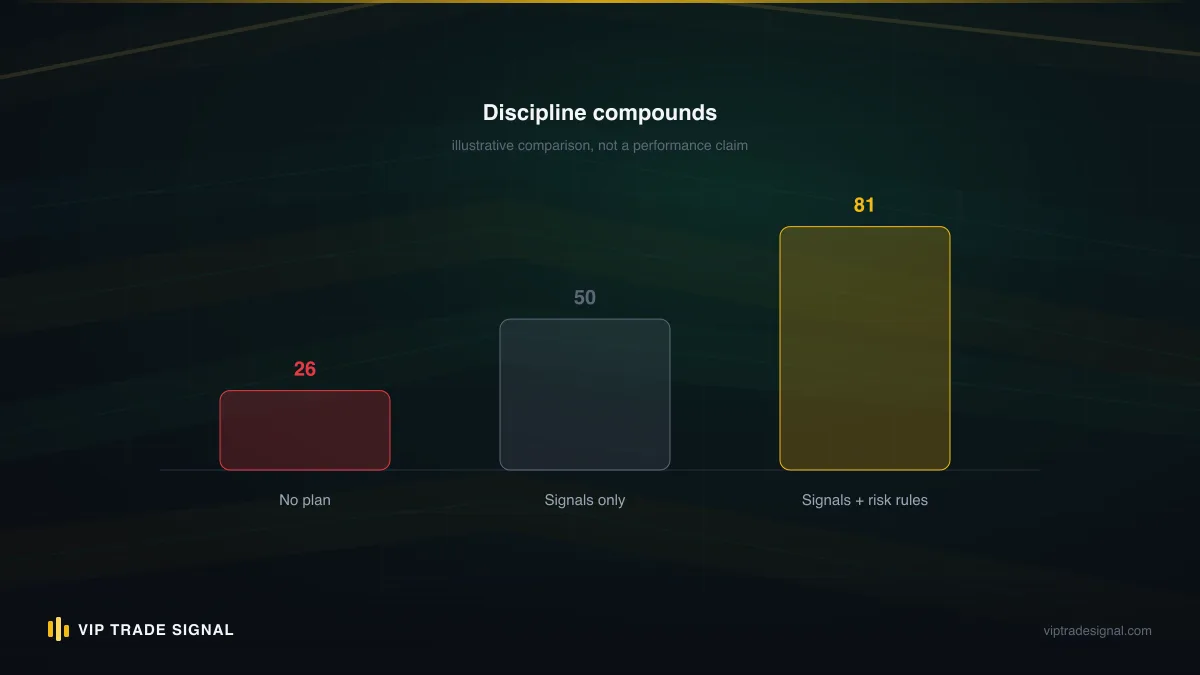
Risk enforcement gets the same treatment, in the other direction. The best use of automation on a discretionary desk isn't finding trades. It's policing the humans. Hard-coded maximum lot sizes, automated daily loss cut-offs, forced flat-before-news rules that don't care how confident anyone feels this morning. The machine holds the human to the human's own sober rules, made when nobody was tilted. That is, quietly, the strongest single argument for automation in the whole debate, and it has nothing to do with signal generation.
Our own desk runs this way, and we're a small operation, not a bank; you can see who we actually are on the about page. Screening and alerting on XAU/USD is systematic, because eyes get tired and code doesn't. Trade selection and the sit-out decision are human, because gold's regime breaks have burned every pure system we've ever tested. Risk limits are mechanical and boring on purpose. When someone hands us an account to manage, they're not choosing human over machine. They're choosing a particular blend, with a human accountable for it. That accountability is the bit no EA vendor sells: when a robot loses your money, the licence agreement says it was never advice; when we lose money on a managed account, we take zero fee and answer for it in plain English, because 50% of nothing is nothing.
Choosing for your account: a decision checklist
Enough theory. You have an account and a decision. Here's how we'd actually make it, as a sequence of questions rather than a verdict.
1. How much can you afford to have wrong? Not invested, wrong. Either path can lose. If the account is $500 and losing it would sting but not wound, you can afford an experiment. If it's $20,000 of savings, your bar for evidence needs to rise with it, and the martingale-flavoured miracle products should be off the list entirely regardless of size.
2. Do you understand what the strategy actually does? For an EA: can you state, in one sentence, when it buys, when it sells, and what it does when it's losing? If the vendor can't or won't tell you, the answer is usually "adds to losers". For a human: can he explain his method without mysticism? "I read the market flow" is not an explanation. "I trade breaks of the Asian range with stops behind the sweep, and I stand down on Fed days" is.
3. Is the evidence live, long, and third-party verified? Twelve-plus months, real account, drawdowns visible, per the hierarchy above. This single filter removes about 95% of what's marketed to you, robot and human alike. Good. It was supposed to.
4. Who controls the money? Whatever you choose, the account should be yours, at your broker, in your name, with withdrawals only you can make. An EA gets attached to your platform. A human gets trading access only. On our managed accounts you keep the master password and we trade through investor-level access, and we'd tell you to demand the same structure from anyone, us included. Anybody who needs you to deposit into their account has ended the conversation.
5. What's the exit? For an EA: a hard equity floor at which you switch it off, decided now, written down, honoured later. For a manager: notice terms, and a fee structure that doesn't punish you for leaving. If you're paying performance fees, understand the baseline they're calculated from before a single trade goes out.
6. Are you temperamentally suited to your choice? This one gets skipped and it decides everything. Running an EA means watching it lose for a fortnight without touching the settings, because a fiddled system is an untested system. Hiring a manager means not phoning him after every red day. If you know you'll interfere, and most people interfere, then the honest options narrow: either trade signals yourself where intervention is at least your own responsibility, or pick a manager whose process you trust enough to leave alone, and prove it by leaving him alone.
Work through those six and the robot-versus-human question mostly answers itself for your situation. Small account, mechanical temperament, verified system, hard off-switch: an EA is a reasonable experiment. Larger account, no appetite for babysitting software through regime changes, and a verified human whose incentives you've read line by line: management makes sense. No verified evidence either way: neither. Keep the money.
Expert advisor vs human account manager: the verdict
If you forced us to score the fight, here's the card. On discipline, execution, coverage and cost, the EA wins clearly. On regime change, news, judgement and knowing when to stand aside, the human wins clearly. On honesty of marketing, both corners should be ashamed of their industries. And on the only metric that actually matters, long-run survival of your capital, the winner is neither contestant but the referee: whatever layer of process, human or coded, is enforcing risk limits while the clever stuff happens elsewhere.
Which is why we don't really believe in the fight. The best robot on a gold account still needs a human to switch it off the week the world changes. The best human still needs mechanical rules to protect the account from his own confident mornings. Fifteen years of watching this market has left us sure of very little, but sure of this: accounts aren't usually destroyed by a lack of intelligence, artificial or otherwise. They're destroyed by a lack of governance.
So don't shop for a robot or a human. Shop for a system of accountability, and check who's inside it. Ask the EA vendor where the human oversight lives. Ask the human manager where the mechanical limits live. The good ones, in both camps, will have a specific answer ready, because they've already built it. The rest are selling you one half of a desk and calling it the whole thing.
And if the half-desk pitches keep landing in your inbox anyway, with their travelator equity curves and their 94% win rates, you now know exactly which question ends the conversation: show me the live, verified, twelve-month record, losses included. Silence, in this business, is also an answer.