It's usually around midnight when people type this question. You've spent months trying to trade forex yourself, or you've watched a friend do well, or you simply have a demanding job and a bit of capital sitting idle, and the thought lands: can someone trade my forex account for me? Someone who actually knows what they're doing, while the account stays mine?
The short answer is yes. Legally, practically, and with the right setup, safely. People have been paying professionals to trade on their behalf for as long as markets have existed, and retail forex is no exception. There is a whole layer of the industry built around exactly this, from regulated money managers running pooled structures down to individual traders managing a handful of client accounts on MT4 and MT5.
But here's the thing the midnight search never surfaces properly. The question that matters is not whether someone can trade your account. It's how you give them access. Get that one decision right and the worst realistic outcome is losing money on trades that didn't work out, which is a normal trading risk you can size and survive. Get it wrong, specifically by handing over your master password, and the worst outcome is your entire balance leaving the account while you sleep. Almost every account-management horror story you'll ever read traces back to that single mistake. So this article answers your actual question first, then spends most of its length on the part that decides whether the arrangement ends well.
Yes, someone can trade your forex account for you — here's the honest version
Let's be precise about what "yes" means, because vague reassurance is how people get burned.
Yes means: your broker's platform supports giving a third party the ability to open and close trades on your account. Yes means: most brokers explicitly permit it, either informally for trade-only access or formally through a document called a Limited Power of Attorney. Yes means: there are legitimate professionals, ranging from regulated firms to skilled independents, who do this for a living and get paid from the results.
Yes does not mean guaranteed profit. Anyone who tells you otherwise is lying to you, and you should treat "guaranteed monthly returns" as a red flag roughly equivalent to a stranger asking for your bank card and PIN. Trading forex and gold on leverage is high risk. A competent manager can lose money over a month or a quarter. A great one can too. What separates a legitimate arrangement from a scam is not the promise of profit, it's the structure: who holds what access, how the manager gets paid, and how fast you can pull the plug.
Yes also does not mean passive in the way a savings account is passive. You still have jobs to do. You choose the person. You control the money flow. You check in on the account, weekly at minimum. Think of it less like buying a fund and more like hiring a contractor to work inside your house: you don't do the plumbing yourself, but you'd be mad to leave the country and hand them the deeds.
One more piece of honesty before we get practical. Most retail traders lose money, and that statistic doesn't magically improve just because the person clicking the buttons is someone else. Handing your account to a random Telegram "account manager" with a screenshot of a Lamborghini is statistically worse than trading it yourself. Handing it to a vetted professional under a sane fee structure, with your capital protected by trade-only access, is a genuinely different proposition. Same question, wildly different outcomes, and the difference is entirely in the setup.
Who actually offers this service (and who pretends to)
The market for "trade my account for me" splits into four rough tiers, and it pays to know which one you're talking to.
Regulated asset managers and hedge funds. The top tier. Proper licences, audited results, compliance departments. Also minimums that start around $50,000 and often run into the hundreds of thousands, plus a strong preference for pooled structures where your money sits in their fund rather than your own account. If you have serious capital, this is a fine road. If you have $2,000 and a dream, they will not return your email, and that's not snobbery, it's regulation and economics.
PAMM and MAM programmes. Many brokers, including Exness and several others, run Percentage Allocation Management Module systems where a master trader's positions are mirrored proportionally across investor accounts. The broker sits in the middle, handles the allocation and the fee split, and the manager physically cannot withdraw your money. Structurally sound. The catch is quality control: broker PAMM leaderboards are full of managers running lottery-ticket risk to climb the rankings, and the top of the table this month is often the blown account of next month. The mechanism is safe; the manager still needs vetting.
Independent account managers. Individual traders or small desks who trade client accounts directly on MT4/MT5 using trade-only credentials. This is the tier where most retail-sized accounts actually end up, and it's the tier we operate in ourselves. Quality varies enormously, from genuinely skilled people with years of verifiable history to chancers who learned a strategy from YouTube last winter. Everything in the vetting section below exists because of this tier.
The pretenders. Instagram and Telegram "account managers" who DM you first, promise 20 to 50 percent per week, show screenshots of profits and luxury goods, and, crucially, ask for either your master password or a deposit sent to them directly rather than to a regulated broker. This is not a lower tier of the same industry. It is a different industry, called fraud, wearing the vocabulary of this one. The moment someone messages you unprompted offering to grow your account, the conversation is over. Real managers have more demand than capacity and do not cold-DM strangers at 2 a.m.
A useful sorting question for anyone you're considering: "How do you get access to my account, and can you withdraw from it?" A legitimate operator answers instantly and specifically, because the answer is the foundation of their business. A pretender gets vague, or asks why you don't trust them.
The three legitimate permission mechanisms, compared
So how do you give someone permission to trade your forex account without giving them your money? There are exactly three mechanisms worth knowing, and every legitimate arrangement in retail forex uses one of them.
1. Trade-only access (the investor-becomes-trader setup). MT4 and MT5 accounts ship with two passwords: a master password that controls everything, and a second password with reduced rights. On most brokers you can configure things so the manager receives credentials that allow opening, closing and modifying trades, and absolutely nothing else. No withdrawals. No password changes. No changing the account's email or linked payment methods, because the manager never touches your broker portal at all, only the trading platform. You keep the master password and the broker login to yourself, forever. This is the simplest mechanism, it works at nearly every MT4/MT5 broker on the planet, and it's what we use for our own account management service.
2. Limited Power of Attorney (LPOA). A formal document, lodged with your broker, that authorises a named third party to trade your account. The word doing the heavy lifting is "limited": a properly drafted LPOA grants trading authority only, and explicitly excludes withdrawals, which remain payable solely to the account holder's own verified bank or wallet. Brokers like this route because it creates a paper trail, and some require it before they'll pay performance fees to a manager through their systems. It's a step more formal than trade-only passwords and a step more annoying to revoke, since cancellation goes through the broker rather than through you clicking a button.
3. PAMM/MAM allocation. As above: the manager trades a master account, the broker's software copies positions into yours proportionally, and fees are calculated and split automatically. You never hand over any password at all. The trade-off is flexibility. You're getting the manager's one-size-fits-all risk applied to your balance, you usually can't ask for adjustments to suit your account specifically, and joining or leaving often works on fixed intervals rather than instantly.
| Mechanism | What the manager can do | What they can't do | Revoking access | Best for |
|---|---|---|---|---|
| Trade-only access | Open, close, modify trades on your account | Withdraw, change passwords, touch your broker portal | Change your passwords yourself, instant | Individual managed accounts, small to mid capital |
| LPOA | Trade under a broker-lodged authorisation | Withdraw to anywhere but your own verified account | Written notice to broker, hours to days | Formal arrangements, broker-managed fee splits |
| PAMM/MAM | Trade a master account you're allocated to | See or touch your credentials at all | Detach via broker portal, often at set intervals | Hands-off investors happy with pooled risk |
Notice what all three share: in every single one, withdrawals can only go to you. That is the load-bearing wall of the whole arrangement. A manager operating under any of these structures can lose your money by trading badly, which is a real risk you manage with position sizing and drawdown limits. What they cannot do is steal it. And that brings us to the mechanism that isn't on the list.
The one method that causes almost every disaster: master password sharing
Here is the sentence this entire article exists to deliver. Never, under any circumstances, for any reason, give a manager your master password or your broker portal login.
Not "be careful about it". Never. There is no legitimate account manager on earth who needs your master password to trade your account, because trade-only access exists and does the entire job. So the request itself is diagnostic. Anyone who asks for it is either dangerously ignorant of the tools of their own supposed profession, or they intend to do something the trading password wouldn't let them do. There is no third option, and neither of the two is someone you want inside your account.
What does the master password actually expose? Everything. With it, a stranger can change your trading password and lock you out of your own account mid-trade. With your broker portal login, it gets worse: they can attempt withdrawals, add or "verify" new payment destinations, change the email on the account so the broker's alerts go to them instead of you, open additional accounts under your profile, and max out leverage settings you'd deliberately kept low. Even where broker security catches the withdrawal attempt, and to be fair, verification checks often do, you're now in a support-ticket war for control of your own money while someone with full access holds open positions in it.
The typical horror story runs like this, and we've heard versions of it more times than we can count. A trader we'll call Dan gets DM'd by a confident "manager" with beautiful screenshots. The manager says the platform's permission system is "too restrictive for my strategy" and asks for full login details, just to make things smooth. Dan sends them. For two weeks the account grows, sometimes genuinely, sometimes via the old trick of a few reckless high-leverage wins. Then either the balance is martingaled into the floor in one bad afternoon, or Dan wakes up to a changed password and a withdrawal request pending to a payment method he's never seen. Every step of that story becomes impossible the moment Dan says "you get trade-only access, that's the offer" on day one. The real manager says fine, because it is fine. The fraud disappears to find someone else.
The master password request is not a red flag to weigh against other factors. It is the whole verdict, delivered early.
If you take one thing from this piece, take that. The rest is optimisation. That one rule is survival.
How to grant trade-only access on MT4/MT5 in practice
The good news: giving someone safe permission to trade your forex account takes about ten minutes, and you do all of it from your own broker portal without the manager touching anything.
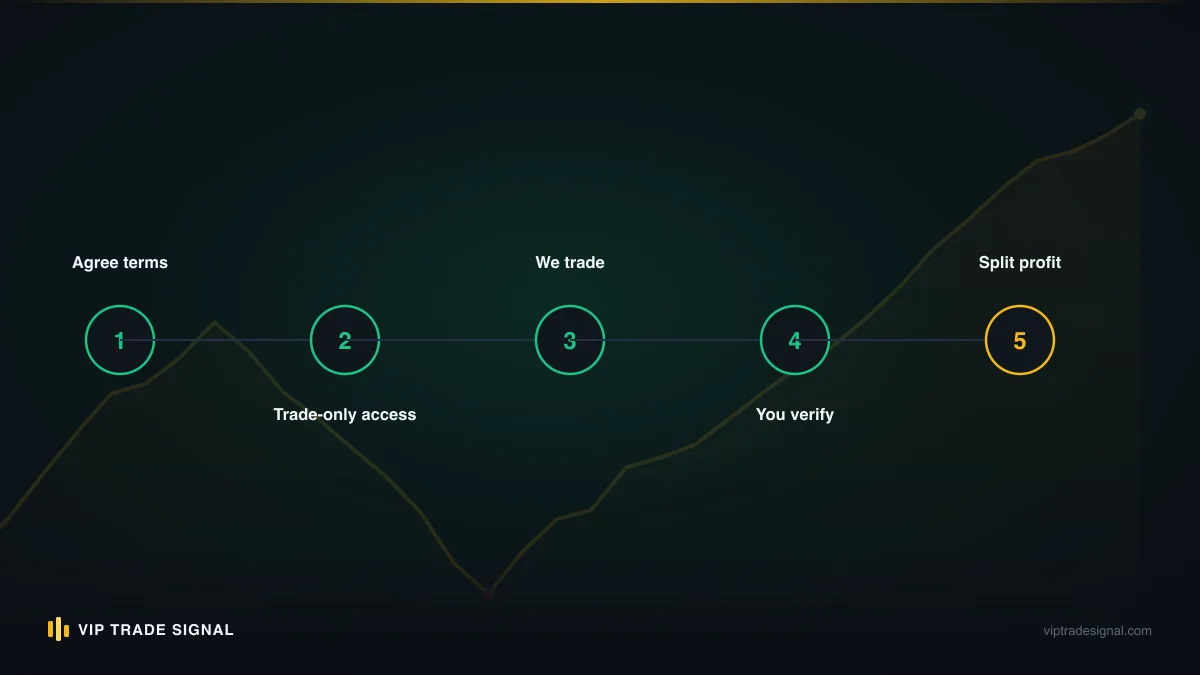
The exact menus vary by broker, but the shape is the same everywhere:
- Open a dedicated account for the arrangement. Most brokers let you run multiple accounts under one profile. Open a fresh MT4 or MT5 account just for the managed arrangement, so the manager's activity is cleanly separated from anything you trade yourself and the history is unambiguous. Fund it with the amount you've decided to allocate, and only that amount.
- Set or reset both passwords yourself. In the broker portal (or on the platform via the password-change dialog), set a strong master password that you record privately, and generate the secondary trading password. On MT5 some brokers label this second credential differently in the portal, but the platform distinction is the same: one password rules the account, the other only trades it.
- Sanity-check the trading password before sharing it. Log in to the platform yourself using the trading credentials. Confirm you can see and place trades. Then confirm what you can't do: the password-change function and anything account-administrative should be unavailable or rejected. Two minutes of checking, full certainty about what you're handing over.
- Send the manager three things and only three things. Account number, trading password, and the broker's server name (something like "Broker-Live04", shown on your platform login screen). That is the complete set. They need nothing else. Not your portal email, not your date of birth, not a copy of your ID "for their records", nothing.
- Set your own eyes on the account. Install the mobile app with your credentials so you can watch positions in real time, and turn on whatever trade notifications your broker offers. You're not going to interfere with live trades, that's a separate conversation to have with the manager, but you should never be more than one glance from knowing exactly what's open.
If the arrangement instead goes the LPOA route, the broker will supply their own form; read the scope clause carefully and make sure it grants trading only, names the manager specifically, and states that withdrawals go solely to you. And if it's PAMM, the broker portal handles allocation entirely; you'll never share a credential at all.
A small practical note from our side of the desk: when clients set up with us, this permission conversation happens before money is discussed in any detail. Any manager who rushes past the access question to get to funding has their priorities exactly backwards.
What it costs to pay someone to trade your forex account
Now the second question people actually type: can I pay someone to trade forex for me, and what does it cost? The industry runs on three fee models, often blended.
Performance fees. The manager takes a percentage of the profit they generate, commonly somewhere between 20 and 50 percent of gains. This is the dominant model at the retail scale and the one we'd argue is healthiest, because the manager eats only when you do. The critical detail is realized profit: fees should be calculated on closed trades, not on floating paper gains that can evaporate. A related concept worth knowing is the high-water mark, standard in the fund world: the manager only earns on profits above the account's previous peak, so they can't lose you 20 percent, recover 10, and charge you for the recovery. Not every retail arrangement uses one, and it's a fair thing to ask about; the honest arrangements we've seen either use a high-water mark or settle frequently enough on realized results that the question mostly takes care of itself.
Management fees. A flat percentage of assets per year (the classic "2 and 20" pairs a 2 percent management fee with 20 percent performance) or a fixed monthly retainer. Common at the regulated end, rarer at retail scale. Be wary of arrangements that are only a flat fee with no performance component: a manager paid the same whether you profit or not has weaker incentives than one paid from results, though to be fair, a flat fee also removes the temptation to over-trade for performance fees.
Spread and commission kickbacks. The quiet one. Some "free" management is paid for by routing you to a specific broker where the manager earns a rebate on every lot traded. That incentive rewards trade volume, not trade quality, and volume-hungry management is how accounts get churned to death. Free management is rarely free; you're paying through the spread and the trade count.
For context on where we sit: our own account management runs a flat 50 percent of realized profit, with a $200 minimum advance and no other fees. That 50 is at the high end of the range, and we say so plainly rather than hiding it. The trade is that the minimum is genuinely low, there's no management fee bleeding the account in flat months, and if there's no realized profit there's nothing to split. Whether that trade suits you depends on your account size; someone with $150,000 should negotiate a lower percentage somewhere, and we'd tell them that to their face. How the fee mechanics get written down properly is its own topic, and we've covered it in detail in our piece on what belongs in a forex account management agreement.
Whatever the model, insist on two things in writing: fees calculated on realized results, and fees paid by you as a separate transaction, never "deducted" by someone with access to withdraw. If a manager can pay themselves directly from your account, you've broken the load-bearing wall from earlier without noticing.
The legal side: do brokers and regulators allow it?
Short version: yes, having someone trade your forex account is legal in essentially every jurisdiction where retail forex itself is legal. But the details are worth five minutes, because they affect who you can hire and how.
From the broker's side, third-party trading is a known, catered-for activity. That's why LPOA forms exist, why PAMM/MAM infrastructure exists, and why platforms ship with a trade-only credential in the first place. Some brokers formally require an LPOA on file before a named third party trades your account; many others are indifferent about informal trade-only arrangements between you and a manager. Read your broker's terms, and if it matters to you, ask their support directly: "Do you permit third-party trading on my account via investor/trade-only credentials, and do you require an LPOA?" You'll have an answer in writing within a day.
From the regulator's side, the rules mostly bind the manager, not you. In many jurisdictions, managing other people's money as a business requires a licence: an investment management authorisation in the UK and EU, CTA registration in the US, an AFSL in Australia, and so on. In practice, a large share of retail-scale account management happens through offshore brokers and unlicensed independents, and the honest thing to say is that this is a spectrum of risk rather than a bright line. A licensed manager gives you a regulator to complain to and, sometimes, a compensation scheme behind them. An unlicensed independent gives you neither, which means your protection is entirely structural: trade-only access, withdrawals only to you, and an agreement you'd be willing to show a lawyer. We're an unlicensed desk ourselves and we're straightforward about what that means: nothing we do is personalised investment advice, we make no recovery or profit guarantees, and the structure of the arrangement is your protection, which is precisely why we're fanatical about the structure.
Two more legal notes. First, taxes: profits in your account are generally your taxable event, not the manager's, regardless of who clicked the buttons. Keep your statements, and if the sums get meaningful, spend an hour with an accountant. Second, US readers face the tightest regime; many offshore managers and brokers won't take US clients at all, and the compliant route usually runs through NFA-registered entities. If that's you, your shortlist is smaller and more formal from the start.
Your kill switch: how to end it in sixty seconds
Every managed arrangement should be built so that you can shut it down completely, unilaterally, in about the time it takes to make tea. This is the part people forget to plan until the day they need it.
With trade-only access, the kill switch is beautiful in its simplicity: change your passwords. Log in to your broker portal, reset the master and trading passwords, done. The manager's credentials die instantly, mid-session if they happen to be logged in. No permission needed, no notice period, no conversation. They cannot open another trade on your account ever again unless you choose to re-share. If positions are open at that moment, they're now yours to manage or close, so glance at the terminal before you pull the handle rather than after.
With an LPOA, revocation goes through the broker: written notice, typically effective within hours to a couple of business days. Fine for a planned exit, slower than you'd like in an emergency, which is one honest argument for preferring trade-only access at retail scale. If you're on an LPOA, know your broker's revocation procedure before you need it. With PAMM/MAM, you detach or submit a withdrawal through the portal; check whether your broker processes detachment instantly or at rollover intervals.
When should you actually pull it? Our take: immediately and without negotiation if you see any of these three. Risk suddenly ballooning beyond what was agreed, say positions sized at triple the documented per-trade risk. Any request, however politely framed, for more access than trade-only. Or the classic tell of a manager in trouble: open losers being held and averaged into while the explanation keeps changing. You can always have the conversation after access is revoked. A good manager will understand a nervous client protecting their capital; a bad one's reaction to losing access tells you everything about what they were planning to do with it.
And on the money itself, remember that withdrawal rights never left you. If the arrangement is ending badly, you can also simply withdraw the balance to your own bank, which no legitimate structure can prevent. Password change stops the trading; withdrawal ends the exposure. Sixty seconds, both handles pulled.
Vetting whoever you're about to authorize
The mechanisms above protect your capital from theft. They do nothing to protect it from bad trading, and bad trading is far more common than theft. So before you hire a forex account manager, any manager, us included, run them through a filter with real teeth.
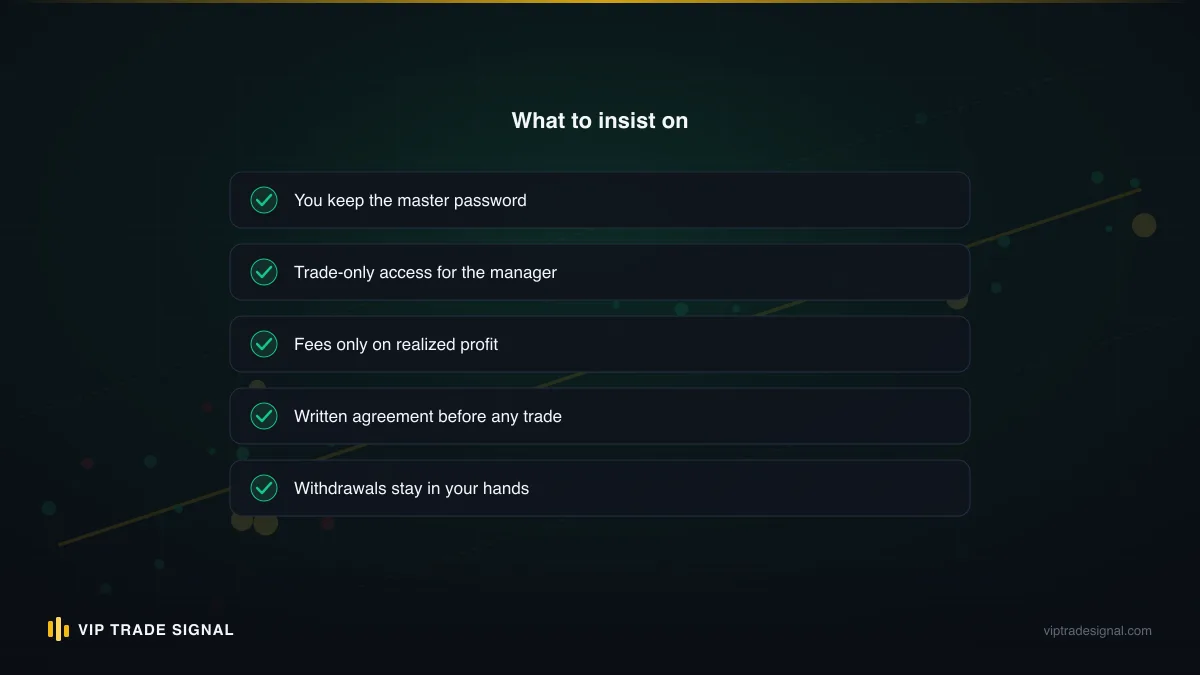
Demand a verifiable track record, not screenshots. Screenshots are worthless; they're editable in thirty seconds. What counts is third-party verification (Myfxbook or FX Blue linked to a live account with the investor-access verification intact), a broker-generated statement you can cross-check, or a full public history including losses. Our own signal results, for instance, sit publicly at /signals/history with every losing trade on display, and we'd hold any manager to the same standard of showing the ugly months. A track record with no losing periods isn't a great track record. It's a fake one.
Interrogate the drawdown, not the return. "80 percent last year" is meaningless without knowing the account was 60 percent underwater in March. Ask directly: what's your maximum historical drawdown, what's your risk per trade, and what happens when the account is down 15 percent? A professional answers in numbers without flinching. Someone who pivots to talking about profit potential has just told you they either don't measure risk or don't want you to.
Ask what happens in a losing month. Not if. When. Every strategy has losing stretches; the question reveals whether the manager plans for them (reduced size, a hard stop-trading threshold, a scheduled review with you) or whether their plan is hope. While you're at it, ask whether their trading is discretionary or automated, because "I run an EA on your account" is a completely different service with different failure modes; we've written up that comparison in expert advisor versus human account manager if you want the long version.
Get the agreement in writing before any access. Fee model and calculation basis, risk limits per trade and per account, drawdown level at which trading pauses, reporting frequency, termination terms. One page can cover it. A manager who resists writing things down is planning to rely on your memory being negotiable later.
Check how they handle your questions now. The vetting phase is the best behaviour you will ever see from this person. If they're evasive, pushy about deposit timing, or dismissive of the access question before they have your money, extrapolate. Our own FAQ answers the awkward questions in public precisely because we think manager-vetting should be easy; anyone worth hiring can survive twenty minutes of pointed interrogation.
None of this guarantees results. Nothing does, and a vetted, structured, honest manager can still hand you a losing quarter. Vetting doesn't buy certainty; it buys you the real probability distribution instead of a marketing one.
Sensible first steps with small capital
Suppose the vetting went well and you're ready to try it. Here's how we'd tell a friend to start, and it's deliberately unexciting.
Start smaller than feels proportionate. If you have $5,000 you're willing to allocate, start the arrangement with $1,000 to $2,000 and let the rest sit out the probation period. The first two or three months of a managed arrangement are an audition, and auditions should be cheap. You're not primarily watching the return during this window; you're watching behaviour. Does the risk per trade match what was agreed? Do the reports arrive when promised? When a trade loses, is the explanation the same strategy you were sold, or a new story? A manager who's disciplined with $1,500 has shown you something real. One who complains that the account is too small to trade properly has also shown you something real.
Fund only what you can watch go to zero without changing your life. Yes, the permission structure means it can't be stolen, and yes, sane risk limits make a total wipeout unlikely. Unlikely is not impossible, leverage cuts both ways, and money you need for rent has no business in any leveraged trading arrangement, managed or not.
Resist the urge to interfere, but never stop watching. Checking the app daily is healthy. Messaging the manager every time a position goes 30 pips against you is not; you hired a process, so let the process run over a fair sample. Somewhere between fifty and a hundred trades is where a strategy starts showing you its true face, which conveniently matches a two-to-three-month probation on most trading styles.
And decide in advance what happens with profits. Withdraw them monthly? Let them ride? Compounding a managed account can be quietly powerful over a year or two, but it also concentrates ever more capital under someone else's decisions, and there's a sensible middle path of skimming a portion while compounding the rest. We've run the actual numbers on this in our piece on compounding a forex account, and the honest summary is that the maths is glorious and the discipline is the hard part.
Scale only on evidence. Three months of behaviour matching the agreement, drawdown inside stated limits, reporting honest through a losing patch: that's when adding the next tranche makes sense. Not after one lucky fortnight.
The answer you came for, one more time
Can someone trade my forex account for me? Yes. Legitimately, at retail scale, with your capital structurally protected, and possibly to your considerable benefit if you pick the right person. The industry that does this properly is real, and it's reachable with a few thousand dollars, not just a few hundred thousand.
But you now know the question underneath the question, so let's put the whole thing in six lines. Access is everything: trade-only credentials, an LPOA, or PAMM, and never, ever the master password. Withdrawals go to you and only you, always, under every legitimate structure. Fees come from realized profit or agreed retainers, paid by you, never self-served from your balance. The kill switch stays in your hand: one password change and it's over. Track records are verified or they're fiction. And losses are part of the deal even when everything above is done right, because this is leveraged trading, not a deposit account.
Print that paragraph if you need to. It is the entire difference between the people who try managed forex and shrug about a strategy that didn't work out, and the people who end up in a subreddit thread explaining how their "account manager" vanished with everything.
If you get to the point of shortlisting managers, we'd obviously suggest our own account management desk makes the list: your MT4/MT5 account at your broker, trade-only access, you keep the master password and every withdrawal right, and we take a flat 50 percent of realized profit with a $200 minimum advance, high at the high end and structured so we only earn when you do. Grill us the same way you'd grill anyone else, through contact or the FAQ, and compare us against two or three alternatives with the checklist above. Whoever you choose, choose them slowly, give them nothing but a trading password, and keep your hand resting lightly on the kill switch. That's not paranoia. That's just how professionals let other professionals near their money.