You wake up on a Monday, open MT5 with your coffee, and your account balance reads -$1,842. Not zero. Negative. There is a special kind of silence that follows that number, and if you have ever sat in it, you already know the question this article answers. If you haven't, good. Let's make sure you never do.
So, can a forex account go negative? Yes. Genuinely, mechanically, yes. Not through broker theft, not through a glitch, but through ordinary market physics: price sometimes jumps over your stop, over the broker's stop-out level, over everything, and the loss that lands is bigger than the money you had in the account. The interesting questions are the ones underneath: how often does this actually happen, whose problem is the shortfall, and does anyone come knocking for the difference?
The honest answers are: rarely but not never, it depends on where your broker is regulated, and sometimes. That last one surprises people. There are traders who received invoices from their broker for tens of thousands after one Thursday morning in 2015, and there are traders who lost the same trade with a different broker and had their balance quietly reset to zero. Same market, same move, wildly different outcomes. The difference was fine print they'd never read. Let's read it together.
Can a forex account go negative? The short answer and the long one
The short answer, once more: yes, a forex account can go below zero, and whether you owe the broker the negative amount depends almost entirely on regulation and your account agreement.
The long answer needs three concepts, so let's define them cleanly because half the confusion around negative balances comes from mixing them up.
Balance is the cash in your account after all closed trades. It only moves when a position closes or you deposit and withdraw. Equity is balance plus the floating profit or loss on your open positions, the live, breathing number. Margin is the deposit the broker ring-fences to hold your positions open, and margin level is equity divided by margin, expressed as a percentage.
Your broker watches that last number like a hawk, because it's their risk too. When your margin level falls to a threshold (100% at some brokers, 50% at many, 20% at a few), the platform starts force-closing your positions, biggest loser first. That's the stop-out, sometimes called forced liquidation, and it exists for one reason: to close you out while there's still something left, so that neither you nor the broker ends up holding a loss bigger than your deposit.
Notice the assumption buried in that design. Stop-out works by closing your position at the current market price when the threshold is breached. It assumes there is a current market price reasonably close to the threshold. Most of the time there is. The whole subject of negative balances is about the minority of the time when there isn't.
A negative balance is what you get when the market's next available price is so far beyond the stop-out point that closing you there produces a loss larger than your entire equity. The broker's safety mechanism fired. It just fired into a hole in the price ladder. Equity went from positive to negative without ever passing through the numbers in between. Traders call this negative equity; your statement calls it a debit balance; your stomach calls it something else entirely.
How stop-out normally prevents this
Before we get to the failures, it's worth respecting how well forced liquidation works on a normal day, because it shapes what traders wrongly assume about the abnormal ones.
Say you have $2,000 in the account and you're long one mini lot of gold: 0.10 lots, roughly $1 per pip of movement at typical XAU/USD pricing where a "pip" is a 10-cent move. Your broker requires, at 1:100 leverage, about $330 of margin for that position with gold around $3,300. Your margin level starts around 600%. Comfortable.
Gold sells off. Every dollar gold drops costs you $10. Down $50 in gold, you're down $500, equity $1,500, margin level about 450%. Still fine. Down $150, equity $500, margin level around 150%, and your platform is probably flashing a margin call warning at you. At a 50% stop-out level, the broker force-closes when equity hits roughly $165. You've lost about 92% of the account: brutal, self-inflicted, but bounded. You cannot lose the last $165 on that position because the mechanism closes it first.
On a liquid market during normal hours, this works with boring reliability. Gold ticks down through $3,285.40, $3,285.30, $3,285.20 (a nearly continuous stream of prices) and somewhere in that stream your stop-out executes within a few cents of the threshold. Continuous prices are the load-bearing wall of the whole system.
And most retail traders go their entire (usually short) trading careers without ever seeing that wall fail. Which is exactly why, when it does fail, almost nobody has planned for it.
Gaps and slippage: when the mechanism fires too late
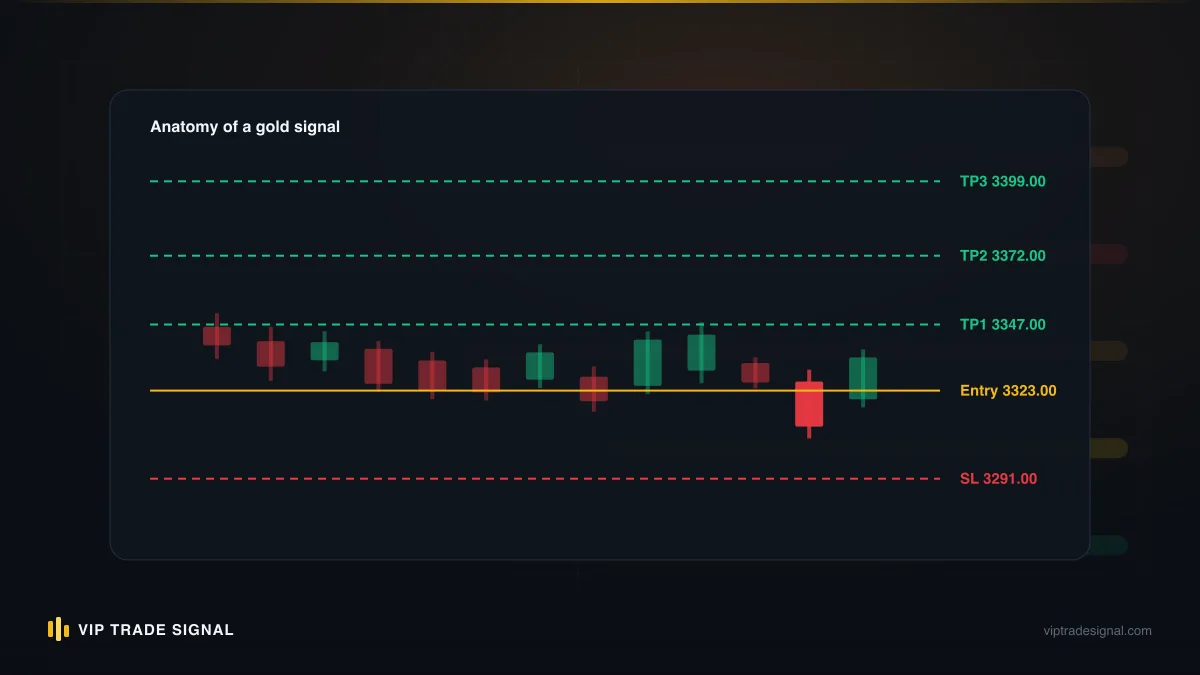
Prices are not actually continuous. They're a sequence of trades, and between any two trades there can be a gap. Small gaps happen every minute and nobody notices. Big ones happen for three reasons that matter to your account.
Weekend and session gaps. Forex closes Friday night and reopens Sunday evening (broker server time varies, but the shape is the same). Gold does the same, with an additional daily pause. Anything that happens in between, whether it's an election result, a military strike, a central bank surprise or a credit event, gets priced into the very first quote at the open. If gold closed Friday at $3,310 and the weekend brought serious news, Sunday's first price might be $3,270 or $3,360. There were no tradeable prices in between. None. Your stop at $3,295 fills at $3,270-ish, and if your position was big enough, so does everyone's stop-out.
News spikes. Around a major release (US CPI, non-farm payrolls, an unscheduled central bank statement), liquidity providers pull their quotes for a few seconds. The order book goes thin. Price can jump 30, 50, 100 pips between one quote and the next even though the market never "closed". Your stop-loss becomes a market order that fills at the next available price, which may be nowhere near your stop level. That's slippage, and during genuine shocks it can be enormous.
Liquidity vacuums. The rarest and worst: an event so violent that market makers step away entirely for minutes at a time. Price doesn't gap once; it free-falls through a zone where almost nothing trades. This is the 2015 franc scenario, and we'll get to it properly in a moment.
Here's the arithmetic that turns a gap into a negative balance, using our $2,000 gold account but with the position sized the way people actually size when they're overconfident: 1.0 lot instead of 0.10. Now every $1 move in gold is $100. Margin at 1:100 is about $3,300, more than the account, so say the broker offers 1:500 and margin is $660. Friday, gold closes at $3,310 and you're long from $3,305, up $500, feeling clever. Over the weekend, something breaks in the world in the wrong direction. Sunday open: $3,282.
Your loss on the reopening print is $23 per ounce times 100 ounces: $2,300. Equity: $2,000 minus $2,300 = -$300. The stop-out fires on the first tick, but the first tick already implied a loss bigger than the account. Your stop-loss at $3,295? Filled at $3,282, same as everything else. A 0.85% move in the underlying. That's all it took, because at that position size you were leveraged roughly 165 times your equity.
That's the entire phenomenon in one paragraph. Nothing exotic. A gap, a large position, and arithmetic.
Case study: the Swiss franc, 15 January 2015
If you only ever learn one market-history event, make it this one, because every serious conversation about negative balance protection traces back to that morning.
For three years the Swiss National Bank had pinned EUR/CHF above 1.20, publicly and repeatedly committing to defend the floor with "unlimited" intervention. Traders treated the floor as a law of physics. A hugely popular retail trade was to buy EUR/CHF near 1.20 with a tight stop just below: tiny downside, they reasoned, because the central bank itself was the buyer of last resort. Some brokers even marketed reduced margin on the pair because it was so "stable".
At 9:30 London time on 15 January 2015, the SNB abandoned the floor without warning. No leak, no gradual signalling. The floor simply ceased to exist mid-morning on a Thursday, in what was supposedly one of the most liquid currency pairs on earth.
EUR/CHF didn't decline. It ceased to have a price. Quotes vanished. When trades started printing again, the pair was passing through levels around 1.04, and it spiked lower still before stabilising: a move of nearly 20% in minutes, in a major currency pair, with essentially no tradeable prices through the middle of it. Stops set at 1.1950 filled at 1.05 or worse. Stop-outs computed at 50% margin level executed at prices implying losses of 500%, 1,000%, more.
The damage list from that one morning reads like a war memorial. Alpari UK, a well-known retail broker, went insolvent within a day. FXCM, then one of the largest retail brokers in the world, disclosed that clients owed it roughly $225 million in negative balances and needed an emergency $300 million loan to survive. Smaller firms across Europe and Asia folded quietly. And thousands of retail traders discovered, some via polite emails and some via debt-collection letters, that their four-figure accounts had become five-figure liabilities.
Whether individuals ended up paying varied enormously. Some brokers forgave retail negative balances outright, judging that chasing thousands of small debts across borders would cost more in fees and reputation than it recovered. Others pursued the larger debts hard, particularly from professional and corporate clients. UK courts saw cases. The one universal lesson: on that day, the answer to "can a forex account go negative" stopped being theoretical for a very large number of ordinary people, and regulators noticed.
Almost everything protective in today's rulebooks, from the leverage caps to the mandatory negative balance protection in Europe and the UK, is scar tissue from that Thursday.
Case study: gold weekend gaps
The franc was a once-a-decade event. Gold gaps are a regular feature of the calendar, which is exactly why we bang on about them so much. Our whole desk trades XAU/USD and nothing else, so weekend risk isn't a footnote for us; it's a standing agenda item.
Gold is the market where the world's fear gets priced, and the world doesn't schedule its fear for market hours. Escalations in the Middle East, surprise sanctions, a bank wobbling somewhere. These have a habit of landing on Saturdays. When they do, gold reopens Sunday evening wherever the news says it should, and the gap can easily run $20-$50, occasionally worse. On a metal trading around $3,300, a $33 gap is one percent. Harmless at sensible size. At 1:500 leverage with a full-margin position, a one percent adverse gap is instant negative equity.
Run the honest numbers on a scenario we've watched play out in various forms. A trader (call him Sam, because we always call him Sam) has $1,500 and holds 0.50 lots of gold short into a Friday close at $3,290, because the chart looked heavy and he didn't fancy paying the spread twice. Saturday brings a geopolitical shock. Sunday open: $3,338, a $48 gap against him. His loss on the open is $48 × 50 = $2,400. Equity: -$900. His stop at $3,305 is irrelevant; the market's first price was $3,338 and that's what everything filled at. Forced liquidation happened exactly as designed, at the first available price, and the first available price was catastrophic.
The frustrating part is that Sam's trade idea might have been fine. On a Wednesday afternoon, that same short with that same stop loses him $750. Painful, survivable. The thing that destroyed him wasn't direction. It was holding size into a market closure, which converts a stop-loss from a hard limit into a polite suggestion.
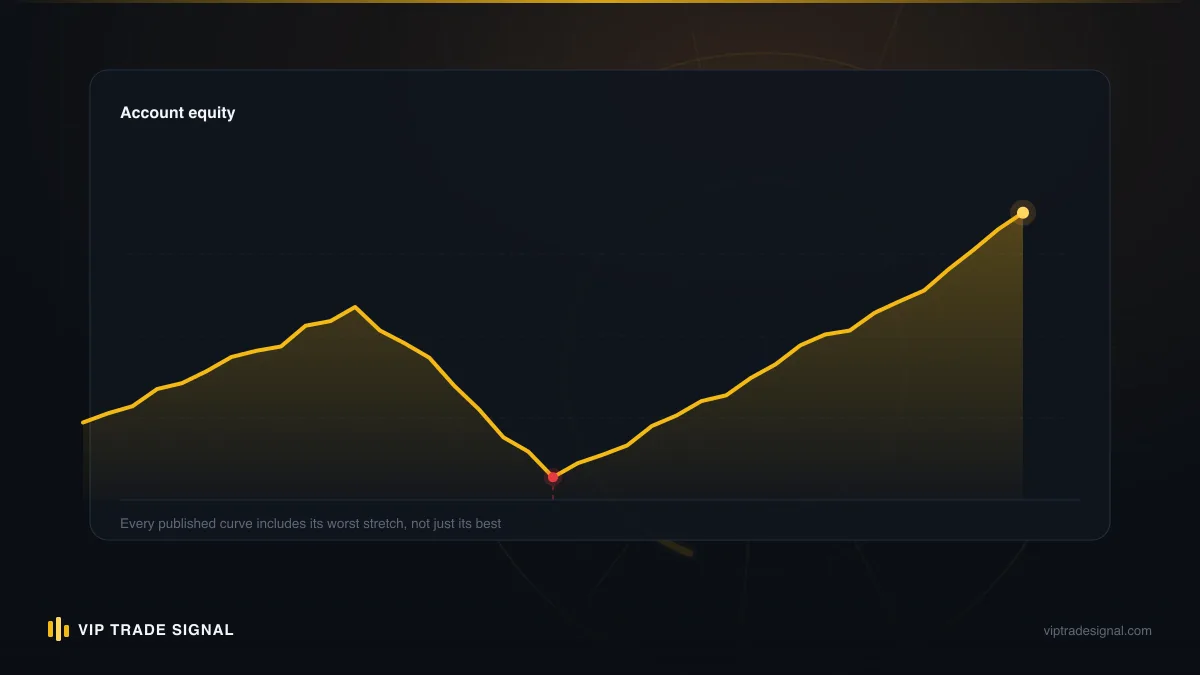
This, incidentally, is why we tell subscribers to treat Friday position reviews as non-negotiable, and why every one of our closed signals sits publicly at /signals/history, winners and losers alike, including any that got gapped. A signal service that won't show you its bad exits is telling you something.
Negative balance protection, regulator by regulator
Here's where the fine print earns its keep. Whether a negative balance is your debt or the broker's write-off depends on the regulator stamped on your account: not the broker's brand name, but the specific regulated entity your agreement names, because most large brokers operate several.
FCA (United Kingdom). Since 2019, negative balance protection is mandatory for retail clients on CFDs, on a per-account basis. If your account with an FCA-regulated entity goes negative, the broker must bring it back to zero. You cannot owe more than you deposited. Retail leverage is also capped (1:30 on major FX, 1:20 on gold), which itself makes gap-driven negative equity far less likely. Professional clients waive these protections, which matters more than people realise; we'll come back to it.
ESMA / CySEC and other EU regulators. Same story, same origin. ESMA's 2018 intervention measures, made permanent by national regulators including Cyprus's CySEC (where a huge share of retail brokers are licensed), mandate negative balance protection per account for retail clients, with the same 1:30 / 1:20 leverage caps.
ASIC (Australia). Australia held out longer but fell in line in 2021: retail CFD clients get negative balance protection and the same style of leverage caps. Before that, Australian-regulated accounts at 1:500 were a favourite of leverage tourists worldwide. That door is shut for retail clients.
Offshore regulators, honestly assessed. Seychelles (FSA), Mauritius (FSC), Belize, Vanuatu, St. Vincent, the various FSCA-adjacent structures: these jurisdictions generally do not mandate negative balance protection. Leverage of 1:500, 1:1000, even 1:2000 is on offer. Many offshore entities of reputable broker groups voluntarily offer negative balance protection as a policy, and to be fair, the big names honour it routinely, because zeroing a $700 debit is cheaper than a reputation. But read the clause. Voluntary policies usually carry carve-outs: the broker may reserve the right to withhold protection during "abnormal market conditions" or "force majeure". Which is to say, precisely the conditions that create negative balances. A protection that can be suspended during the only events where you'd need it deserves your scepticism.
| Regulator | NBP for retail | Typical max leverage (gold) | Can you owe the broker? |
|---|---|---|---|
| FCA (UK) | Mandatory | 1:20 | No (retail); yes if professional |
| CySEC / EU | Mandatory | 1:20 | No (retail); yes if professional |
| ASIC (Australia) | Mandatory | 1:20 | No (retail); yes if wholesale |
| Offshore (Seychelles, Belize, Vanuatu, etc.) | Not required; often voluntary | 1:500-1:2000 | Depends entirely on the account agreement |
Two traps in this table are worth naming out loud.
First, the same broker is several entities. Open an account with a well-known brand from London and you're likely under the FCA entity: protected, low leverage. Open with the same brand from Dhaka, Lagos or Hanoi and you're almost certainly under the Seychelles or Mauritius entity: high leverage, protection by policy rather than by law. The platform looks identical. The legal reality is not.
Second, "professional client" status quietly deletes your protection. Brokers invite active traders to upgrade: higher leverage, fewer restrictions, a form to sign. Buried in that form is your waiver of negative balance protection. If you've ever accepted a professional reclassification to get 1:200 instead of 1:20, you have also accepted that a franc-style event can leave you in real debt. Most people who sign it never register that trade-off.
What actually happens when your balance goes negative
Mechanically, the sequence is mundane. The gap prints. The stop-out routine closes everything at the first available prices. Your balance settles at a negative figure and the platform will happily display it, margin level frozen, everything flat. Then one of four things happens, roughly in order of likelihood for a retail account at a mainstream broker:
- Automatic reset. Under FCA/CySEC/ASIC retail terms, or a voluntary policy working as advertised, the broker credits the shortfall within hours to a few days. Balance back to zero. Nothing to do, nothing owed, though your money is of course gone.
- Reset on request. Some brokers, especially offshore, zero negative balances only when the client asks or on their own review cycle. If you're staring at a debit balance, email support and request a negative balance adjustment; plenty of firms grant it as routine even where nothing compels them.
- Offset against your other accounts. Read your terms for a set-off clause. Many broker agreements allow them to cover a negative balance on one of your accounts using funds from your other accounts with the same entity. Your hedged second account is not as separate as you think.
- The broker pursues the debt. Rare at retail size, real at scale. A debit of $400 will almost never be chased across borders; a debit of $40,000 from a professional client under an enforceable agreement very well might be, as the post-2015 court cases showed.
While this resolves, expect friction: withdrawals frozen on the affected account, positions blocked, sometimes a request for documents if the broker suspects the gap was gamed (more on that in a second). Keep every email. If you're under a regulator with mandatory protection and the broker drags its feet on zeroing a retail account, a written complaint citing the rule, then an escalation to the ombudsman or regulator, tends to concentrate minds quickly.
One thing brokers watch for and you should know about: gap trading abuse. Opening deliberately oversized opposite positions on two accounts (or two brokers) into a likely gap, keeping the winner and defaulting on the loser's negative balance, is a known scheme. Terms of service name it, and brokers refuse negative balance credits, and close accounts, when they detect it. If your negative balance came from ordinary trading, say so plainly and you're in a different category from the people running that play.
Do you legally owe the money?
The lawyerly answer: your account is a contract, and a debit balance is, by default, a debt under that contract, unless a statute or a term of the agreement says otherwise. So the question decomposes cleanly.
Retail client under FCA, EU or ASIC rules? The regulation overrides everything. You cannot owe more than your account, full stop, and any attempt to collect would itself be a breach.
Retail client offshore with a written negative balance protection policy? You have a contractual shield, subject to its carve-outs. If the broker honours it (usual), you owe nothing. If they invoke an abnormal-markets exception, you're into a dispute where the leverage (sorry, the bargaining power) is mostly theirs, though their appetite for chasing small retail debts internationally is close to nil. Cross-border collection on a $900 debt costs more than $900. They know this. In practice, small offshore negative balances overwhelmingly get written off even when the paper says they needn't be.
Professional, wholesale or corporate client anywhere? You likely owe it, genuinely and collectably, and 2015 established that brokers will litigate when the sum justifies it. If you trade serious size under a professional classification, negative balance risk belongs on your risk sheet next to everything else, and it's one more reason we're allergic to overleveraged "pro" accounts even for experienced traders.
None of this is legal advice, obviously: jurisdictions differ and the facts of a specific gap matter. But as a decision rule for choosing where to hold your money, it compresses to one line: know which entity you signed with, and whether the words "negative balance protection" appear in a regulation, a policy, or nowhere.
A stop-loss is a request. A stop-out is a mechanism. Neither is a guarantee, because both need a price to execute at, and gaps are the market's way of skipping the prices you were counting on.
Leverage and lot size set your gap exposure
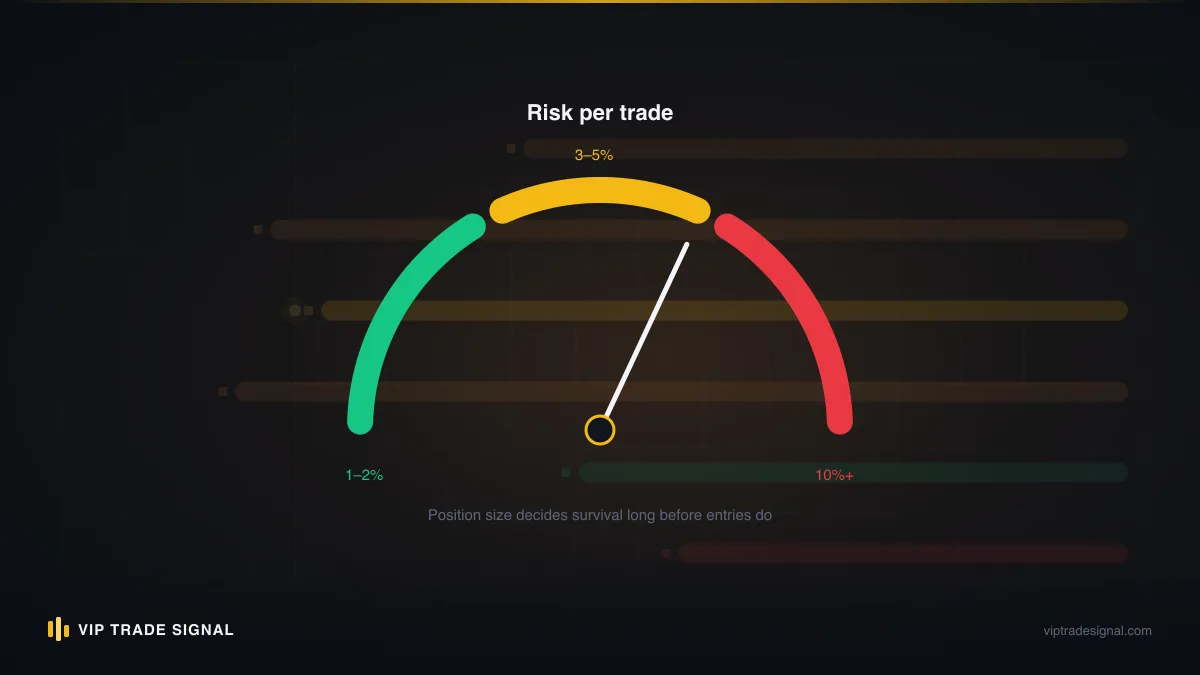
Here's the reframe that makes all of this practical. You cannot control whether gaps happen. You completely control how much a gap of a given size costs you. Gap risk is not a market property; it's a position-sizing property wearing a market costume.
The exposure maths is almost embarrassingly simple. In gold, one standard lot is 100 oz, so each $1 of movement is $100 per lot. Your worst-case gap loss is just: expected nasty gap × $100 × lots. Decide what "nasty" means (for gold, a $50 weekend gap is a sensible planning number; rare, but it's the rare ones that do this) and you can compute the largest position that survives it.
| Account | Lots held over a gap | $50 gap costs | Result |
|---|---|---|---|
| $2,000 | 0.05 | $250 | Bad day, 12.5% down |
| $2,000 | 0.20 | $1,000 | Half the account gone |
| $2,000 | 0.50 | $2,500 | Negative $500 |
| $10,000 | 0.50 | $2,500 | Painful, 25% down, alive |
| $10,000 | 2.00 | $10,000 | Wiped to zero, or below |
Read the third row again. Half a lot on $2,000 feels normal to a lot of retail gold traders. It's what 1:500 leverage invites you to do, and on a quiet Tuesday it works. The table says that position is one bad Saturday from negative equity. Not from a franc-grade catastrophe. From a $50 gold gap, the kind that shows up every year or two.
And notice what leverage actually does in this story. Leverage never causes a negative balance — position size does. What high leverage does is remove the guardrail that would have stopped you holding that size. At 1:20, the margin requirement physically prevents a $2,000 account from holding 0.50 lots of gold. At 1:500 it's easy. The regulators who capped retail leverage after 2015 weren't being paternalistic about maths; they were being realistic about behaviour. Offered 1:500, enough people will use it that the gap events become broker-solvency events.
Overnight and weekend financing plays a quiet role too. Positions held for weeks accumulate swap charges that eat into the equity buffer protecting you from exactly these gaps, a detail people managing deep floating losses know intimately, and one reason we cover holding costs at length in our drawdown management playbook.
The drawdown connection nobody talks about
There's a pattern in almost every retail negative-balance story, and it isn't recklessness on day one. It's an account already deep in floating drawdown whose owner has stopped managing risk and started praying.
It goes like this. A position moves against you. You don't close it, because closing makes the loss real, and the human brain will do almost anything to avoid that (we've written about why in the psychology of drawdown, and if you recognise yourself in this paragraph, honestly, start there). So you hold. Maybe you average in, which doubles the size. Your equity buffer shrinks. Margin level drifts down toward the danger zone. And now you're carrying a large position with a thin cushion. Which is, precisely, the configuration that turns an ordinary gap into a negative balance. The account wasn't destroyed by the gap. It was destroyed by the six weeks of hoping that positioned it under the gap.
If your account is currently in that state, with a big floating loss, an oversized position and a margin level that's uncomfortably low, the negative balance question stops being trivia and becomes urgent. The decision of whether to close the losing trade or wait it out has a gap-risk dimension most people never price in: every weekend you hold, you're re-rolling a dice you can't see. Sometimes the answer is a structured recovery rather than a coin-flip hold. That's the exact situation our drawdown management service exists for: accounts floating roughly $5k-$10k down, where we work the position back against a jointly recorded baseline and charge a flat 50% of recovered profit above it. And we'll say the uncomfortable part ourselves: no recovery is guaranteed, ever, by us or anyone. Anyone who promises to guarantee your way out of a drawdown is describing a service that cannot exist.
Choosing a broker with gaps in mind
Since protection lives at the entity level, broker choice is where most of your negative-balance risk gets decided before you place a single trade. The checklist we'd actually use:
- Identify the exact legal entity on your account agreement, not the brand. Search the entity name in the regulator's public register (FCA, CySEC, ASIC all have one). If the entity is Seychelles/Belize/Vanuatu, you're in voluntary-protection territory; act accordingly.
- Find negative balance protection in writing. In the client agreement or an official policy page, not a sales page or a chat agent's reassurance. Note any abnormal-market carve-out.
- Check the stop-out level. 50% is common; 20% leaves you closer to the cliff before the mechanism even fires. Higher is safer.
- Ask how weekend margin is handled. Some brokers raise margin requirements before weekends and major events, which forcibly shrinks the oversized positions that get people hurt. It's mildly annoying and genuinely protective.
- Prefer boring plumbing over exotic leverage. If the main selling point is 1:1000, the target customer is someone planning to hold positions that can't survive a 1% gap. Don't be the target customer.
For what it's worth, the partner brokers we work with (Exness, XM, IC Markets, Vantage) all publish negative balance protection policies for retail clients, which is part of why they made the list. Subscribers holding $250+ with one of them get our gold signals free instead of paying the $99/month; details on the FAQ. But the entity point still applies to them like everyone else: check which one your account actually sits under. We can't do that bit for you.
Protecting yourself before the next gap
Everything above compresses into habits. None are clever. All of them work, and the traders who've been around a decade do most of this without thinking.
Size for the gap, not the stop. Your stop-loss defines your loss on a normal day. Your position size defines your loss on an abnormal one. Before holding anything overnight, and especially over a weekend, ask what a $50 adverse gold gap costs at your size, and whether the account survives it with room to spare. If the answer requires optimism, the position is too big.
Respect the Friday close. Flat over the weekend is a position too, and it's free. If you hold, hold small enough that a headline can't hurt you, and accept that your stop is decorative until Sunday evening. We routinely close or trim signal positions into Fridays for exactly this reason, and yes, occasionally that costs us a gap that would have gone our way. We'll take that trade every time. Missing a favourable gap is a bruise; catching an unfavourable one at size is a funeral.
Keep margin level boring. If your normal operating margin level is under 300%, you're running the account hot. Chronic low margin level is the tell of an account positioned to go negative; it means your whole equity is committed and your buffer against discontinuous prices is thin.
Don't sign away protection for leverage. The professional-client upgrade email will come. Unless you have a specific, sized, hedged reason to need it, the extra leverage buys you nothing a smaller account of ambition can't, and it silently repeals the one law standing between you and a debit balance.
Know your broker's script in advance. Five minutes with the client agreement now (set-off clause, NBP clause, abnormal-markets carve-out, stop-out level) beats five weeks of arguing with support later.
Where this leaves you
The fear version of the question (could I wake up owing my broker money?) has a genuinely reassuring answer for most readers: if you're a retail client under FCA, EU or ASIC regulation, no, you can't, by law. If you're offshore at a reputable broker, almost certainly not in practice, though you're relying on policy rather than statute. The scary outcomes are concentrated among professional clients, offshore accounts at thin brokers, and people running schemes.
But we'd push you to sit with the mechanics version instead, because it's more useful. An account goes negative when position size, an equity buffer, and a discontinuous price meet in the wrong combination. Two of those three are entirely yours. The market owns the gaps; you own everything else. A trader who sizes gold positions so a $50 gap costs single-digit percent, keeps weekends light, and knows which legal entity holds their money has essentially retired the question, not because the market got kinder but because they stopped offering it a target.
So this week, three concrete moves. Pull up your account agreement and find the negative balance clause, or confirm it isn't there. Work out, in dollars, what a $50 gold gap against your current open position would cost. And look honestly at whether your typical size could survive the ugliest open you can imagine. If any of those three answers makes you wince (and if you're carrying a heavy floating loss right now, one of them will), that wince is the cheapest warning you'll ever get. The market's version costs considerably more.