There is a specific kind of quiet that settles over a trading account in trouble. The chart keeps moving, the numbers keep updating, but you've stopped doing anything. You're just watching a percentage fall. First it turns your platform's account bar red. Then, some time later, positions start vanishing on their own.
Those are two different events, and the difference between them is the subject of more confusion than almost anything else in retail forex. Margin call vs stop out gets treated as one blurred concept, "the thing that happens when you lose too much", when in reality one is a warning you can still act on and the other is your broker acting for you. The warning costs you nothing. The execution can cost you everything, and not evenly: the order in which your broker closes positions during a stop out can turn a carefully hedged book into a one-sided disaster in about ninety seconds.
We manage drawn-down accounts for a living, which means we spend a lot of time doing forensics on statements where this exact sequence played out. The pattern is almost always the same. The trader knew, roughly, that margin calls existed. They did not know their broker's exact stop out level, did not know which position would be closed first, and did not know that closing one leg of a hedge re-exposes the other leg at the worst possible moment. So let's fix all three of those gaps properly.
Two thresholds, two very different events
Everything here hangs off one number: margin level. It's your equity divided by your used margin, times 100. If you have $2,000 of equity and your open positions require $500 of margin, your margin level is 400%. Comfortable. If your floating losses drag equity down to $500 while used margin stays at $500, you're at 100%. Not comfortable.
Your broker sets two thresholds on that percentage.
The first is the margin call level. Cross it and the broker warns you. On MT4 and MT5 the account line in the terminal turns red; some brokers also email you or fire a push notification. Nothing closes. You can still trade, still deposit, still make decisions. It's a smoke alarm.
The second is the stop out level, always set lower. Cross that one and the platform starts closing your positions automatically, without asking, and keeps closing them until your margin level climbs back above the threshold or you have nothing left. That's not a smoke alarm. That's the sprinkler system going off over your open laptop.
A typical regulated broker runs margin call at 100% and stop out at 50%. So there's a corridor between the two, a stretch of falling equity where you've been warned but not yet liquidated. How you behave inside that corridor decides whether the account survives. Most traders, in our experience, spend it hoping. Hoping is not a margin management strategy, but we'll get to that.
One more framing point before the detail. A margin call is information. A stop out is an execution, with fills, slippage and an ordering algorithm. You can ignore information. You cannot negotiate with an execution.
Margin call vs stop out: where the confusion comes from
The phrase "margin call" is doing a lot of historical baggage-carrying. Decades ago it was literal: your broker telephoned you and asked you to wire more money or reduce positions, and if you didn't, they closed you out manually. The call and the closing were the same conversation. In stock margin accounts that's still roughly how it works, which is why articles written from an equities perspective muddy the water for forex traders.
In retail forex the two halves got separated and automated. The "call" became a passive alert at one threshold. The closing became an automated routine at a second, lower threshold, and picked up its own name: stop out. But traders still say "I got margin called" when they mean "my positions were force-closed", and brokers don't rush to correct them, so the terms smear together.
Here's the clean version, the one worth actually memorising:
- Margin call = a warning threshold. Equity is getting thin relative to the margin your positions require. Nothing is closed. Typically set at 100% margin level, sometimes 120%, sometimes 80%.
- Stop out = an action threshold. The platform force-closes positions, one at a time, biggest loser first on most platforms, until your margin level recovers above the stop out line. Typically 50% at regulated brokers, often 30% or 20% offshore.
And what happens when margin level hits 100 percent exactly, since that's the question people actually type into search bars at 2am? At 100%, your equity equals your used margin. Every spare dollar in the account is pledged as collateral for positions that are currently losing. On most brokers you can no longer open new positions, because there's no free margin to fund them. You can still close positions, and you can still deposit. That's it. It's the platform's way of saying the account is fully committed and the next move is yours, briefly, before it becomes the platform's.
The warning phase: what a margin call actually gives you
Treat the margin call as a gift of time, because that's all it is. How much time depends entirely on how fast the market is moving against you and how much leverage you're carrying.
Say you're long two lots of gold from 3,340 on a $5,000 account with 1:100 leverage. Used margin is roughly $6,680 at that price... except it isn't, because you couldn't open that on $5,000. Make it more honest: 1:500 leverage, used margin about $1,336. Gold drops $18 against you. Two lots means $200 per dollar of movement, so you're floating a $3,600 loss. Equity: $1,400. Margin level: about 105%. You are a whisker above margin call, and every further dollar of downside pulls the percentage down about 15 points. At that rate a routine $2 wobble takes you from "warned" to "well inside the corridor" in the time it takes to make tea.
That's the real character of the warning phase. It is not a leisurely review period. On an overleveraged account it can last minutes. And it arrives precisely when you're least equipped to think clearly, because it only ever arrives mid-drawdown.
There are exactly three rational responses to a margin call, and you should decide which is yours before it happens, not during:
- Close something. Reducing positions cuts used margin and realises part of the loss. Margin level jumps immediately. This is almost always the right answer and almost never the one people choose, because it means admitting the loss is real.
- Deposit. Adding funds raises equity. Sometimes correct, if the position thesis is genuinely intact and the sizing was the only error. Usually it's throwing good money after bad sizing, and the market takes the new deposit too.
- Do nothing, deliberately. Accept that the stop out will do what your discipline didn't, and let it happen. Grim, but it's at least a decision. It beats option four.
Option four, the popular one, is doing nothing while telling yourself the market is about to turn. We've read hundreds of statements from accounts that came to us for drawdown management, and the corridor between margin call and stop out is nearly always visible in them as a dead zone: no closes, no deposits, no new orders. Just a trader watching. The market does not care that you're watching.
The execution phase: how a stop out actually runs
Now the mechanical part, because this is where the details stop being trivia and start being money.
When your margin level touches the stop out threshold, the platform runs a loop. On MT4 and MT5 it works like this:
- Find the open position with the largest floating loss, measured in account currency.
- Close it at the current market price. Not at a price you chose. At whatever the market is showing, minus whatever slippage the moment inflicts.
- Recalculate margin level with that position gone and its loss realised.
- Still at or below the stop out level? Go back to step one and close the next-largest loser.
- Repeat until margin level is back above the threshold, or the account is flat.
Notice what that loop is optimising for. It is not trying to preserve your strategy, your hedge structure or your best entries. It's a solvency routine. The broker is protecting itself from your account going negative, and closing the biggest loser first is simply the fastest way to free margin and stop the bleeding per position closed.
This is forced liquidation, and the phrase deserves its ugliness. Nobody at the broker looks at your account. No human weighs whether your short hedge was protecting your long. A server process, running the same loop it runs on thousands of accounts, closes your trades in strict order of how much they're losing, and each close is a market order fired into whatever liquidity happens to exist at that exact moment.
Two properties of this loop matter enormously and get almost no coverage.
First, it's iterative, not instantaneous. Positions close one at a time, with recalculation between closes. In a fast market, the price keeps falling between iterations, which means positions that weren't the biggest loser at the start of the cascade can become the biggest loser by iteration three. The cascade eats the account in sequence, and the sequence itself is moving.
Second, realising a loss can make margin level worse before it makes it better. Closing a losing position frees its margin, yes, but it also converts a floating loss into a realised one, cutting equity permanently. On a badly structured book, particularly a hedged one, the first forced close can drop margin level further instead of rescuing it, which triggers the next close immediately. That's not a malfunction. That's the loop doing exactly what it says, on an account whose structure was hiding its true risk.
Typical levels by broker and regulator
The thresholds aren't universal, and the differences are big enough to change outcomes. In 2018 ESMA pushed through rules for retail CFD accounts in the EU that standardised close-out at 50% of required margin, and the UK's FCA carried the same standard through after Brexit. Offshore, it's a free-for-all in both directions.
| Broker type | Typical margin call | Typical stop out | Notes |
|---|---|---|---|
| EU/UK regulated (retail) | 100% | 50% | 50% close-out is a regulatory floor, plus negative balance protection |
| Australia (ASIC, retail) | 100% | 50% | Aligned with the European standard since 2021 |
| Offshore, mainstream (Seychelles, Mauritius etc.) | 100% or 80% | 30% or 20% | More rope, harder landing |
| Offshore, aggressive | 50% or none | 10%, even 0% | An account can ride to near-total loss before closing |
| Professional-status accounts | Varies | Often 20-50% | Regulated protections largely waived |
Read that last offshore row again. A 0% stop out means the broker lets your equity run all the way to nothing before intervening. Traders sometimes seek this out deliberately, reasoning that more room means more chance for a trade to come back. What it actually means is that when the account dies, it dies completely, and in a gap it can go past zero. Whether you owe the difference depends on whether the broker offers negative balance protection voluntarily, because no regulator is making them.
Why do the offshore numbers run so much lower? Partly marketing. "Stop out 10%" sells to traders who've been closed out at 50% elsewhere and blame the threshold rather than the sizing, the way a driver blames the guardrail. Partly it's the business model: an offshore broker running a book against its clients has no particular incentive to interrupt a losing account early. And partly it's honest flexibility for strategies, grid systems mostly, that genuinely ride deep floating drawdowns as a design feature. We think those strategies are a slow-motion account funeral anyway, but they exist, and low stop outs are built for them.
There's a second-order effect worth chewing on too. The gap between the two thresholds sets the width of your decision corridor. At a regulated broker, 100% down to 50% is a wide band; you'll usually get real time inside it unless you're absurdly leveraged. At an offshore broker running 50% and 10%, the band is narrower in percentage terms but each percentage point takes longer to lose, because by the time you're at 50% most of the equity is already gone and the remaining positions have shrunk relative to what's left. In practice both setups produce the same trap: the wide corridor breeds complacency, the deep one breeds false hope. Neither threshold arrangement saves a mis-sized account. They just choose the tempo of the ending.
A lower stop out is not broker generosity. It's the broker pricing in that your total loss is acceptable to them. The 50% standard at regulated brokers exists precisely because regulators watched retail clients ride accounts into the ground and decided the industry couldn't be trusted to pull the ripcord on its own.
The honest caveat: these are typical figures, and your broker's actual numbers live in their terms and your account settings, not in a blog table. We'll cover how to check in a minute.
A stop-out cascade, minute by minute
Let's build one, with generic round numbers, because the abstract loop only really lands when you watch it chew through an account. Call the trader Sam. Everything about Sam is invented; the mechanics are not.
Sam has $4,000 at an offshore broker: margin call 100%, stop out 20%, leverage 1:500. It's a Wednesday evening and Sam is trading gold around a US data release, which is the classic setting for this story. Sam is long 1.5 lots from 3,352, and earlier hedged badly by shorting 0.5 lots at 3,344, so the book is net long 1.0 lots with both legs open. Used margin, with the broker charging margin on the net exposure, is about $670.
20:29. Gold at 3,347. The long floats -$750, the short floats -$150. Equity $3,100, margin level around 463%. Sam feels fine.
20:30. The data prints hot. Gold drops $11 in forty seconds to 3,336. Long: -$2,400. Short: +$400. Equity $2,000, margin level about 299%. Uncomfortable, not critical.
20:33. Follow-through selling. 3,329. Long: -$3,450. Short: +$750. Equity $1,300. Margin level 194%. Sam is now doing the thing. Watching.
20:36. 3,325. Equity $900, margin level down near 134%. Sam closes the profitable short to "bank the win", pocketing $950 of realised profit. This feels prudent. It is the single worst move available. The account is now naked long 1.5 lots into a falling market, and because the netted exposure just went up, used margin rises to about $1,000. Equity still $900, but margin level: 90%. Sam has margin-called himself.
20:39. 3,321. The long floats -$4,650 against the original entry; equity $300 counting the banked profit. Margin level 30%. The corridor has taken three minutes to cross.
20:40. 3,320.30. Margin level touches 20%. The platform closes the long at market, filling at 3,319.40, ninety cents of slippage in the thin post-news book. Realised loss on the leg: $4,890. Account balance: roughly $60.
Total elapsed time from "feels fine" to "sixty dollars": eleven minutes. And notice where the fatal decision sat. Not at the stop out. At 20:36, inside the corridor, when Sam closed the winning leg and left the loser running, which is what frightened traders do almost every single time because closing a winner feels like taking action while closing a loser feels like surrender. The stop out didn't kill this account. The corridor did.
Which positions close first, and why it matters
So, the question almost nobody covers properly: when the loop fires on a multi-position account, which positions close first at stop out?
On MT4 and MT5, the standard answer is largest floating loss first, in account currency. Not the largest position, not the oldest, not the one using the most margin. The biggest loser. If you're carrying six positions and the stop out triggers, the platform sorts them by open loss and starts executing from the top of that sorted list, re-sorting after every close.
cTrader does it differently, and the difference is worth knowing if you trade there. Its "Smart Stop Out" targets the position consuming the most margin and closes it partially, shaving off just enough volume to bring the account back over the line, rather than executing whole positions. That's genuinely gentler: you keep more of your book, and the routine takes the smallest bite it can. Some cTrader brokers configure the traditional fair stop out instead, so even within one platform you have to check.
A few consequences of loss-first ordering that don't occur to people until they've been through it:
- Your best trade survives longest, your worst dies first. Sounds fine, except "worst" is measured at that instant, in a moving market. A position that's down heavily because you held it through a retracement, but sits right at genuine support, gets executed before a smaller loss that has no thesis at all.
- Position size multiplies loss, so big positions go early. A 2-lot trade down 40 pips shows a bigger dollar loss than a 0.2-lot trade down 300 pips. The loop reads dollars, not pips, so your size mistakes are executed first. Fitting, in a brutal way.
- You cannot set the order. There is no setting, no priority flag, no "close this one last". Traders who structure books assuming they'll get to choose what goes are assuming a control that does not exist.
- Pending orders go too. MT4 and MT5 delete pending orders that no longer have margin backing during the process, so the recovery limit orders Sam left below the market don't survive the event they were waiting for.
If you take one operational rule from this section: never carry a position so large that it would be the automatic first casualty of a cascade unless you'd genuinely be happy to see it closed at market in the worst minute of the session. Because that is precisely the fill it will get.
How a stop out breaks a hedged account asymmetrically
Here's where the ordering rule turns from interesting to expensive. Hedged accounts, meaning a long and short open on the same instrument simultaneously, feel safe. The floating P/L barely moves as price moves, since the legs offset. Many brokers reinforce the feeling by charging little or no margin on the hedged portion.
But watch what the stop out loop does to that structure. Suppose you're long 1 lot of gold from 3,350 and short 1 lot from 3,310, opened on the way down, locking in a $4,000 floating loss you couldn't face realising. Price now 3,310. The long floats -$4,000, the short floats zero. Your equity is pinned; nothing moves. Feels stable, like a photograph of a car crash.
Now something else drains the account. Swap charges on both legs, grinding away nightly. Or another trade elsewhere in the account losing. Margin level sags toward the stop out. The loop fires and asks its one question: which position has the largest floating loss? The long, at -$4,000. Closed, at market.
And in that instant the photograph becomes a car crash again. The $4,000 loss is realised, so equity takes the full hit at last. Worse, you are now naked short 1 lot, and if the broker was charging reduced margin on the hedge, required margin on the surviving leg jumps at the exact moment equity fell. Margin level, post-close, can be lower than it was before the "rescue". The loop fires again and closes the short too, possibly at worse prices, and an account that showed a stable floating loss for weeks goes to near-zero in under a minute.
That's the asymmetry. A hedge is only a hedge while both legs exist, and the stop out routine is structurally incapable of respecting that, because it evaluates positions one at a time. It will always break the hedge by closing the losing leg first, and breaking the hedge is the most damaging single action available on that account.
We see this constantly in accounts that arrive for recovery work, usually alongside a martingale grid that produced the locked loss in the first place; the two failure modes travel together, and we've written about why the grid half of it is so corrosive in our piece on martingale risks. The lesson isn't "never hedge". It's narrower and more useful: a locked hedge carrying a large floating loss is not a resolved situation, it's a deferred stop out with a swap bill attached, and the deferral ends on the platform's terms unless you end it on yours.
Slippage: forced liquidation never fills where you hope
Every close in a stop out cascade is a market order. Your stop-losses, at least, sit at levels you picked in advance, often at sensible spots. The stop out fires wherever the equity math says so, which correlates almost perfectly with the moments when spreads are widest and books are thinnest: news spikes, session opens, weekend gaps, flash moves.
So the fills are bad, and they're bad in a correlated way. The same volatility that dragged your margin level down is the volatility your forced closes execute into. In gold, a spread that's 20 cents in a calm London afternoon can be $1.50 or more in the seconds after a Fed statement, and a market order for multiple lots into that book walks through the quotes. Sam's ninety cents of slippage in our reconstruction was polite. We've seen statements where the stop out fill on a gap open sat several dollars beyond the last quoted price of the previous week, because there was simply no market in between.
That's also how accounts go negative. If price gaps from one side of your stop out threshold to far beyond your equity, the close happens at the first available price, and that price may imply a balance below zero. At an EU, UK or Australian regulated broker with retail classification, negative balance protection means the broker resets you to zero and eats the difference. Offshore, read the terms, because "we may seek recovery of negative balances" is a sentence that appears in more of them than you'd think.
The practical takeaway is short. Any risk plan whose maths only works at the prices on your screen isn't a risk plan for the conditions that actually cause stop outs. Assume the forced fill is meaningfully worse than the threshold price, size so that even the ugly version survives, and treat gap risk over weekends and major news as a reason to reduce, not a lottery ticket.
Check your broker's exact levels before you need them
You'd be amazed how many traders discover their stop out level from the trade history, afterwards, in the row labelled "so" or "stop out" in the comment field. The information takes five minutes to find in advance.
Here's the checklist, and it's worth doing today rather than filing under later:
- MT4 and MT5: open the terminal, right-click your account under Navigator, choose the account details, or simply check the specification your broker publishes for your account type. Margin call and stop out are listed as percentages. On MT5, the journal also logs both values on login.
- Broker website: account comparison pages list stop out per account type. Standard, cent, raw-spread and professional tiers at the same broker frequently carry different levels.
- Ask support in writing. Two questions: "What is the margin call level and stop out level on my account type?" and "How does your platform charge margin on hedged positions?" The second answer determines whether the asymmetric hedge break we described above applies to you at full force.
- Check the negative balance policy. Regulated retail accounts in the EU, UK and Australia include protection by rule. Everywhere else, find the sentence in the terms.
- Recheck after any account change. Switching account type, requesting professional classification or moving to a different entity of the same broker (the .com entity vs the EU entity, say) can silently change all of these numbers.
While you're in the terms, note the leverage tiering too. Many brokers cut leverage on large positions or ahead of weekends, which raises required margin, which drops your margin level with no price movement at all. More than one trader has been stopped out on a Friday evening by a leverage change rather than a chart. If margin level itself is still fuzzy as a concept, our margin level walkthrough builds it from scratch with worked numbers, and it pairs naturally with this piece.
And a small plug where it's honestly relevant: every signal we publish at VIP Trade Signal is gold-only and comes with a defined stop, sized so a sensible account never gets near either threshold, and every closed one, wins and losses alike, is public at /signals/history. If a signal provider can't show you their losers, their relationship with risk is decorative. Ours are on the page.
Staying out of the corridor between the two
Everything above is anatomy. This section is prevention, and it rests on one blunt idea: the margin call and the stop out are the last two alarms in a long series, and a trader who hears them has already slept through the earlier, cheaper ones.
A margin call is not where your risk management failed. It's where you find out it failed a week ago.
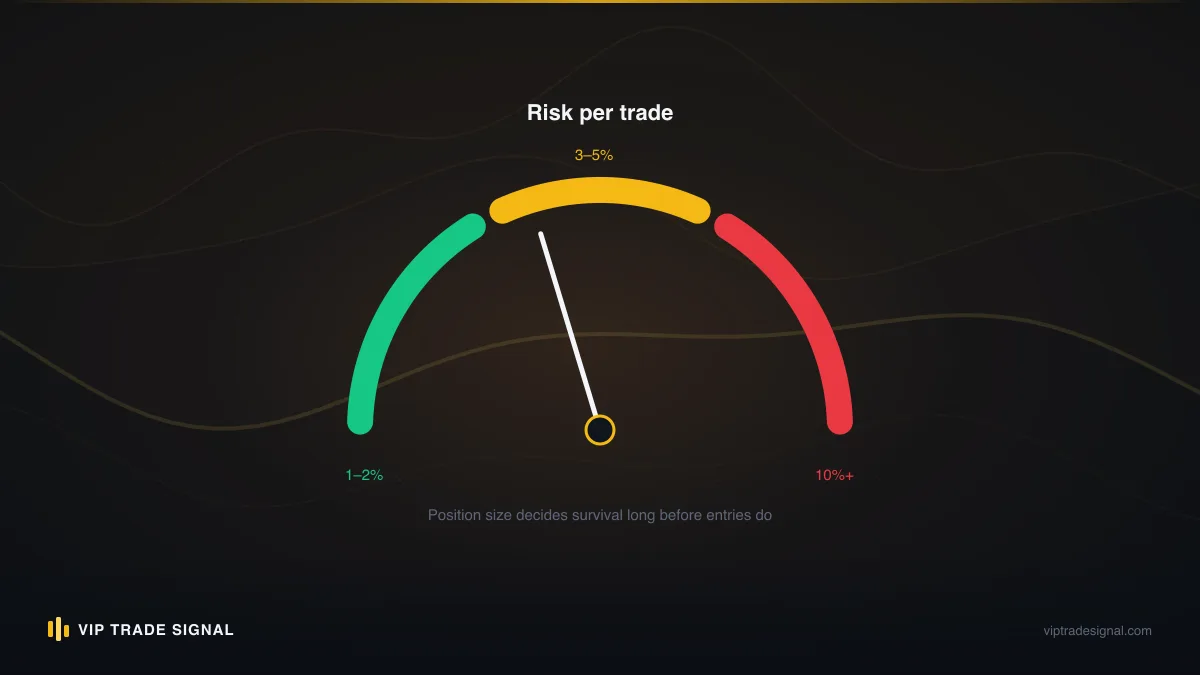
The failure happened earlier, at position sizing. An account risking 1-2% per trade with stops actually placed does not visit 100% margin level. It mathematically can't get there without a pile-up of simultaneous outsized positions, which is itself a sizing failure. When we analyse blown accounts, the margin level history is a staircase: fine for weeks at 800%+, then one oversized trade or one removed stop, and the account starts living between 300% and 150%, where a single bad session can reach the corridor. Nobody who's honest calls that bad luck.
So here are the working rules we'd give a friend, in order of importance:
- Set your own alarm far above the broker's. Treat 300% margin level as your personal margin call. If you touch it, you reduce, that session, no debate. The broker's 100% warning should be a level you never see.
- Size from stop distance, not from margin available. "How many lots can I open" is the wrong question and the platform will cheerfully answer it. The right question is "what size makes my stop equal 1% of the account". On a $5,000 account with a $8 stop in gold, that's about 0.06 lots. Yes, it feels small. It's supposed to.
- Always have a hard stop on every position. Your stop-loss executes at a level you chose in calm conditions. The stop out executes at a level the maths chose in chaos. Given the option, take the first every time.
- Never bank the winning leg of a hedge under pressure. If you must reduce a hedged book in a hurry, close both legs together or close the loser. Closing the winner alone is the move that converts a locked loss into a cascade, as Sam demonstrated.
- Respect the calendar. Reduce size before top-tier news and weekends. The corridor is crossed fastest exactly when spreads are widest.
- Know your numbers cold. Broker's margin call level, stop out level, hedged margin policy, negative balance policy. Five minutes, once, per account.
There's also the question of what "too much drawdown" means well before margin mechanics enter the picture, because an account can be nowhere near stop out and still be strategically dead; we've put numbers on that in what counts as a good maximum drawdown.
Where this leaves you
Strip everything back and the distinction is almost embarrassingly simple. The margin call is your broker telling you there's a problem. The stop out is your broker solving the problem, for themselves, using your positions as the material. Between them lies a corridor measured in percentage points of margin level and, in a fast market, in minutes of clock time.
Inside that corridor you still have every option: close, reduce, deposit, restructure. The moment you exit its lower end, you have none, and the liquidation that follows is executed loss-first, hedge-blind and at market, which is the most expensive possible combination for exactly the account structures frightened traders build.
If you're reading this with a healthy account, the assignment is boringly practical. Look up your broker's two levels today, set a personal floor of 300%, and re-size your standard position off stop distance. Twenty minutes of admin that makes this entire article something you read once and never lived.
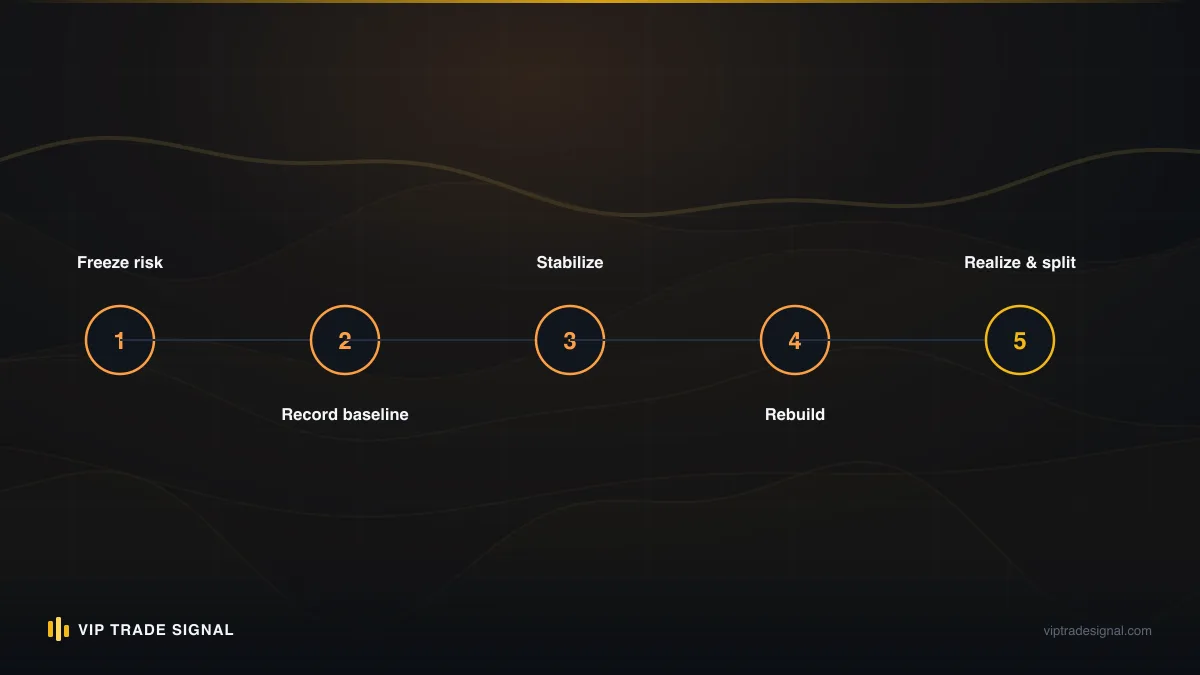
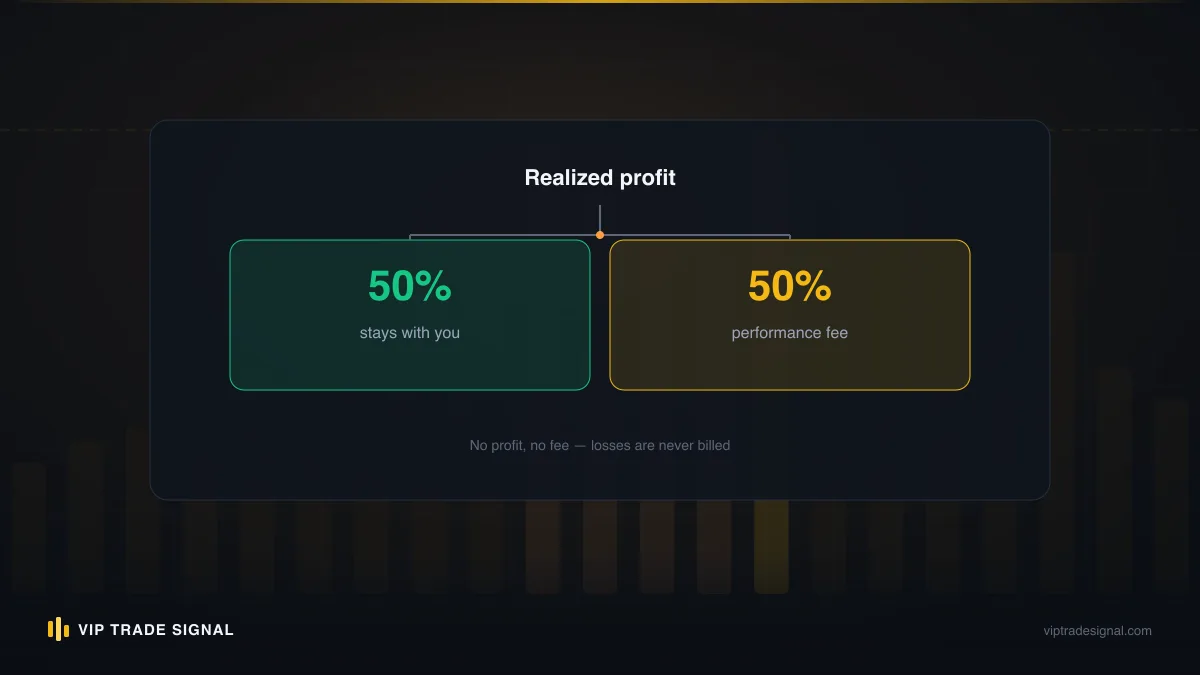
If you're reading it with an account already deep in the corridor, or locked in a hedge you can't face unwinding, be honest about what the platform will do to it if you keep waiting, because now you know the loop line by line. Realising a controlled portion of the loss on your terms nearly always beats the market-order version on the platform's terms. That's the work we do daily in drawdown management, on your own account with your own passwords, paid only from what's actually recovered above a recorded baseline, and with no guarantees offered because in this business honest and guaranteed don't fit in the same sentence. The broker's questions and ours are answered plainly in the FAQ.
Two alarms, one falling account. The first one is the only one you get to answer. Make sure you never hear it.