Somewhere right now there is a trader staring at an MT5 account that shows a floating loss of $7,400. He is not checking it every hour anymore. He checks it twice a day, the way you check a bruise, and every time he does the same three options run through his head. Close everything and eat the loss. Keep holding and hope. Or pay someone to fix it.
That third option is where the phrase "no win, no fee" enters his search history. It sounds almost too reasonable: someone works on your account, and if they don't recover anything, you owe them nothing. No deposit. No monthly retainer bleeding a wounded account. Payment only out of profit that would not otherwise exist.
Here's the thing. No win no fee trading recovery is, in my view, genuinely the right fee structure for underwater accounts, and I say that as someone whose desk charges exactly this way. But "the right structure" is not the same as "safe by default". The model has two specific loopholes, both well known to anyone who has spent time around performance-fee arrangements, and an operator who wants to abuse them can do so while technically keeping the no-win-no-fee promise. This article unpacks how the model works, why it beats the alternatives for drawdown situations, where the two loopholes sit, and what structural fixes actually close them. By the end you'll be able to interrogate any success-fee operator, ours included, and know within ten minutes whether their version is built honestly.
What no win no fee trading recovery actually means
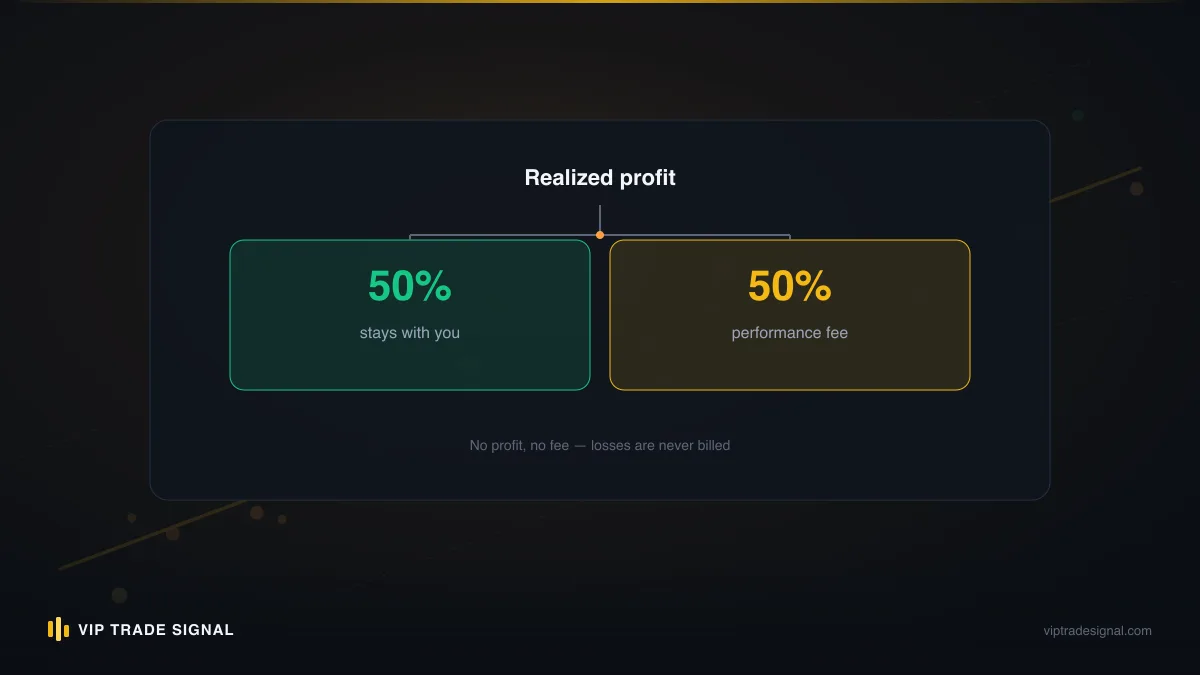
Strip away the marketing and the arrangement is simple. You have an account in drawdown. An operator trades it, or manages the existing positions on it, with the goal of recovering some or all of the loss. Their fee is a percentage of the profit they generate, and only that. If the recovery attempt produces nothing, they invoice nothing.
Three things define the model, and all three have to be present for the label to be honest:
- No upfront payment. Not a "setup fee", not a "risk assessment charge", not a refundable-in-theory deposit. Money moves from you to the operator only after profit exists.
- No time-based charges. A monthly retainer on a recovery account is upfront payment on an instalment plan. If they charge you for March regardless of what happened in March, it is not no win, no fee.
- The fee is a defined share of a defined win. A percentage, of a number both sides can point to on a statement. Vague language here is where the trouble starts, and we'll spend a good chunk of this article on precisely that.
You'll see the same idea sold under different names: performance fee only account management, success fee trading, profit share recovery service. Legal firms have run "no win, no fee" for decades on injury claims, and the trading version borrows the psychology deliberately. The psychology is fair enough. A trader who has just lost $7,000 is understandably allergic to spending more money on the problem.
One boundary worth drawing immediately: this article is about drawdown recovery on live positions, where the account still exists and the loss is floating or partially realised. It is not about "fund recovery" firms who promise to claw money back from scam brokers for an upfront fee. That industry is overwhelmingly a second scam layered on the first, and the tell is exactly the fee structure: they charge before doing anything. Different animal entirely. If someone stole your deposit, you need a chargeback and possibly a regulator, not a trader.
Why it beats upfront and monthly fees when your account is underwater
Think about what an upfront fee does to an account already in drawdown. Say you're the trader from the opening, $7,400 down on a $12,000 account, so roughly $4,600 in equity. An operator quotes you $800 upfront to "restructure and recover" the account. You are now betting $800 of money you can still touch on the competence of a stranger, at the exact moment your judgement is most compromised. If they fail, you've converted a $7,400 problem into an $8,200 one, and the operator's incentive to actually succeed evaporated the moment your payment cleared.
Monthly retainers are subtler but worse over time. A $200 monthly management fee on a recovery that takes eight months is $1,600 whether or not the recovery works. And the incentive it creates is quietly perverse: the operator earns more the longer the recovery takes. Nobody consciously slow-walks a recovery to farm retainer, or at least I'd like to believe that, but incentives don't need conscious intent to work on behaviour. They just need time.
The success-fee model inverts all of it. The operator eats their own costs, their own hours, their own screen time, until profit exists. A slow recovery costs them money. A failed recovery costs them everything they put in. Your downside for hiring them, in pure fee terms, is zero.
There is also a signalling effect that I think matters more than the maths. An operator who will only get paid from results is making a statement about their own expectancy. They are saying: we have run this enough times to know our hit rate covers our costs. A trader who charges upfront is not necessarily making the opposite statement. But they don't have to make any statement at all, and that should register.
To be fair to the other side of the argument, honest flat-fee operators do exist, and their pitch is not stupid: a fixed fee means they have no incentive to take excess risk in your account, because their payment doesn't scale with profit. Hold that thought. It is the seed of the second loophole, and we'll come back to it properly.
The incentive alignment, and where it leaks
The clean version of the story goes like this. Under a profit share, the operator makes money only when you make money. Your interests point the same direction. Alignment achieved, everyone shakes hands.
The clean version is about 80% true, and the missing 20% is where every abuse of this model lives. Because the operator's incentive is not actually "recover the client's account". The operator's incentive is "maximise the number the fee is calculated on, at minimum cost". Usually those are the same thing. There are exactly two situations where they diverge, and both are worth understanding in detail before you give anyone trade access to an account.
A success fee doesn't make an operator honest. It makes their dishonesty take one of two specific, predictable shapes — which means you can check for both before you sign anything.
The first divergence is about where profit is measured from. The second is about what risk was taken to produce it. Baseline manipulation and asymmetric gambling, respectively. Every horror story I have heard about performance-fee recovery, and I have heard a few over the years from traders who came to us after a bad experience elsewhere, falls into one of these two bins. Not sometimes. Every time.
Loophole one: baseline manipulation
A success fee is a percentage of profit. Profit is the difference between two numbers: where the account finished and where it started. The finishing number is hard to fake, because it's on your statement. The starting number, the baseline, is where a bad operator does their work.
Here is the classic move. Your account holds $4,600 in equity with $7,400 floating loss, on positions in, say, gold that are currently well offside. A dishonest operator "assesses" the account and quotes their baseline as current equity: $4,600. Then the market does what markets do, chops around, and gold retraces enough that your floating loss narrows to $4,000 without the operator doing anything of substance. Equity now reads $8,000. Under their definition, they have "recovered" $3,400 of profit, and at a 50% share they invoice you $1,700. For a retracement. That you would have gotten by leaving the account alone with the platform closed.
Variations on the theme:
- The moving baseline. The agreement says "profit from managed trades" without ever pinning a number, letting the operator decide after the fact which gains count.
- The equity-versus-balance shuffle. Baseline recorded against balance while fees are calculated on equity, or the reverse, whichever flatters the invoice. On an account with big floating positions the gap between those two numbers can be thousands of dollars.
- The deposit absorption. You top the account up mid-recovery with $1,000 of fresh margin, and the baseline mysteriously fails to adjust upward, so your own deposit gets counted as "recovered profit". This one is genuinely common and genuinely infuriating.
- The reset. After a losing month, the baseline quietly re-records at the new low, so the operator earns fees climbing back to ground they already lost. This is exactly what high-water marks exist to prevent in the fund world, and any operator who doesn't apply the same logic is choosing not to.
The fix is boring, which is how you know it's real: a jointly recorded baseline, in writing, before the first trade. Both parties look at the same account snapshot, the same timestamp, and write down the same number, with the equity-or-balance question answered explicitly. Deposits adjust it up. Withdrawals adjust it down. Fees are only ever calculated on the gap between current agreed measure and that recorded line, and the line never resets lower.
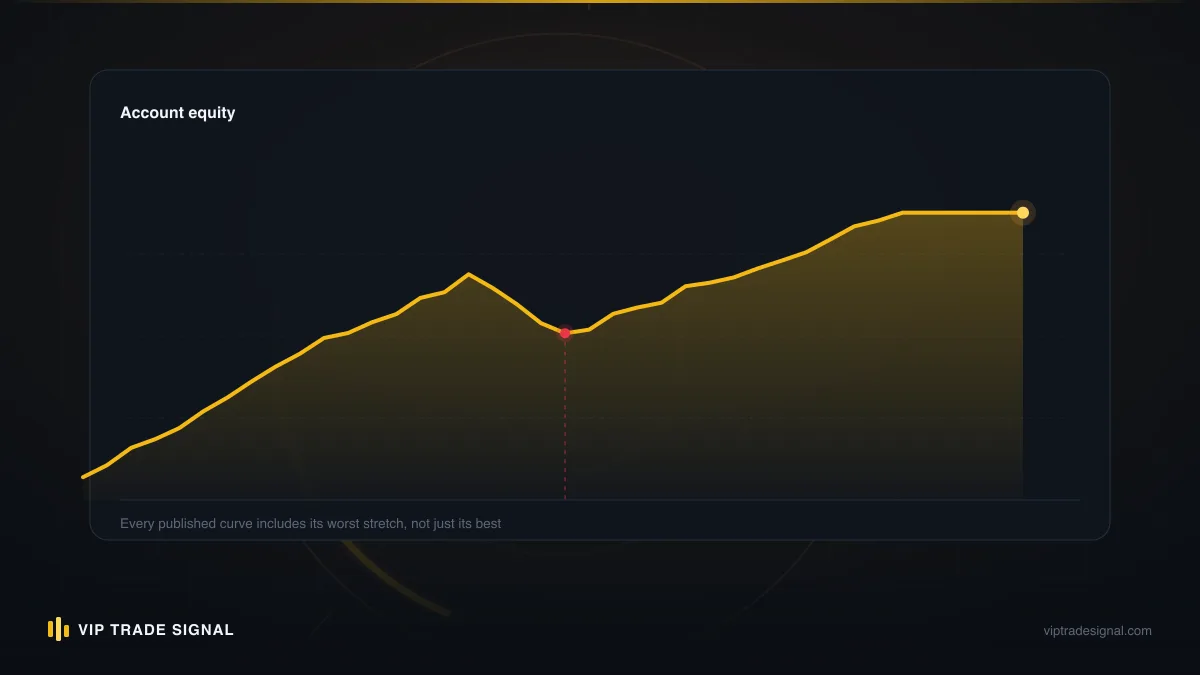
Notice what a properly recorded baseline does to the operator's economics on a deep drawdown. If your equity is $4,600 and the honest baseline for "recovered profit" is set with the drawdown fully accounted for, the operator works the entire climb through the loss for nothing. Their fee only starts once your money is back. That is a heavy commitment, and it is precisely why honest operators put boundaries on which accounts they'll take. Our own drawdown desk, for instance, works accounts floating roughly $5k to $10k down; deeper than that and the unpaid climb stops making commercial sense for anyone, shallower and you likely don't need us. An operator with no stated boundaries who'll take any account at any depth is either pricing the baseline dishonestly or planning to solve the problem with the second loophole.
Loophole two: gambling with your downside
Now the nastier one, because it can be done with a perfectly honest baseline.
A profit share is a call option on your account. The operator captures a percentage of the upside and, in raw fee terms, zero of the downside. If they double your equity they collect handsomely. If they blow the account to zero, they earn nothing, which sounds like punishment until you notice it's the same nothing they earn from playing it safe and merely failing. The asymmetry is structural: for the operator, the difference between a cautious failure and a catastrophic one is zero dollars. For you, it's everything left in the account.
So the temptation, for an operator with volume and no conscience, is to run recovery as a lottery portfolio. Take on twenty underwater accounts. Trade each one at vicious size, 5% or 10% risk per position, martingale into losers, the whole toolkit of things that occasionally produce spectacular equity spikes. Perhaps six accounts recover fast, and those six pay fees large enough to cover the operator's time on all twenty. The other fourteen get buried. Their owners are told the market was difficult, which, in fairness, it was, at 10% risk per trade the market is always difficult. We wrote at length about what oversized positions do to survival odds in our piece on overleveraging, and the arithmetic is not subtle: at that kind of sizing, a routine losing streak is terminal.
The cruel part is that the client often can't see it happening. An equity curve climbing on a martingale looks great right up until the session it doesn't, and a trader $7,000 down is emotionally primed to read any green day as proof the nightmare is ending.
What actually closes this loophole? Three things, and you want all of them, not one:
- Published, complete trade history. Not screenshots. Not a highlight reel. Every closed trade the operator takes, visible somewhere public, losses included, with lot sizes you can sanity-check against account size. An operator running the lottery model cannot publish a full history, because fourteen buried accounts leave marks. This is the single strongest filter available to you, and it's the reason our desk publishes every closed signal at /signals/history, red ones included. Ask for the equivalent from anyone you're vetting. Watch how they respond to the question. The response is data.
- Stated, checkable risk limits. A maximum risk per trade, a maximum open exposure, in the agreement, in numbers. Then verify against the live account, because you can: you keep investor or master access and can see every position's lot size the day it opens. If the agreement says 2% maximum and there's a position risking 8% on Tuesday, you don't need a lawyer, you need to revoke access.
- You keep the keys. The operator gets trading access only. Master password stays with you, withdrawal rights stay with you, and you can pull the plug in thirty seconds without asking permission. Any structure where the operator controls withdrawals or asks you to move money to their account is not a recovery service, whatever the fee model. It's custody, without the regulation that word normally implies.
Partial risk-reduction techniques matter here too. A recovery done well usually looks unheroic: exposure trimmed early, losers cut or reduced rather than defended, profits banked in stages. If you want a feel for what patient de-risking looks like in practice, the mechanics in our partial close walkthrough are close to what a sane recovery trade plan actually resembles. Nothing about it would make good marketing. That's rather the point.
What "win" means: defining recovered profit precisely
Time to get pedantic, because this is a contract question and pedantry is what contracts are for. Before anyone touches your account, the phrase "recovered profit" needs a definition tight enough that two people who dislike each other would still compute the same fee. That means answering, in writing:
Realized or floating? Fees should be charged on realized profit only, closed trades, banked gains. An operator charging on floating profit is charging you for money that can evaporate before the invoice is paid. This is not a small distinction on a gold account; an open XAU/USD position can swing hundreds of dollars in an afternoon.
Measured against what? The recorded baseline, adjusted for any deposits and withdrawals since recording. Nothing else. Not "since we started the current strategy", not "this month's performance".
Does the baseline behave like a high-water mark? It should. If the account dips below a level fees were already paid on, no new fees until the previous peak is regained. Otherwise you can pay twice for the same dollar of recovery, which sounds absurd until you've seen an invoice that does exactly that.
When is the fee due, and how is it paid? Sensible answer: on realized profit, at agreed intervals or milestones, paid by you from the account you control. The operator never self-serves from your balance. If they had withdrawal access to self-serve, refer back to loophole two with a shudder.
What happens to partial recovery? If you're $7,400 down and the operator recovers $4,000 then stalls, they earned their share of $4,000. "No win, no fee" does not mean "no complete win, no fee", and honestly it shouldn't; an operator who halves your drawdown did real work. But the percentage and the measurement should make partial outcomes trivially computable.
What about the advance? Some structures, ours among them, take a minimum advance ($200 in our case) that is credited against future performance fees rather than charged on top. I'll be straight about the tension: a purist would say any money before profit dilutes the model, and the purist has a point. The honest defence is that it filters out non-serious enquiries and covers the genuine cost of assessment, and that it is credited, meaning if fees never materialise past $200, that advance was the total cost of a failed recovery. You can decide whether that's acceptable. What matters is that it's disclosed as exactly what it is, not smuggled in as a "verification charge" after you've said yes. Anything an operator only mentions after your yes belongs in a different article, about a different kind of business.
If reading a definition of one contract term at this length felt tedious, good. Tedious is the texture of arrangements that don't blow up.
Worked example: a $6,000 recovery, fee by fee
Numbers make this concrete, so let's run one end to end. Meet a trader we'll call Dana. Illustrative, invented, generic; not a client, not a testimonial, and nothing here implies any particular recovery will succeed, because plenty don't.
Dana has an account that was $15,000. A bad six weeks in gold, mostly one oversized short she defended too long, left it with a balance of $8,600 and floating loss of $600 on a leftover position: equity $8,000, so $7,000 underwater. She signs with a success-fee operator on these terms: jointly recorded baseline, equity basis; fees at 50% of realized profit above the baseline; realized only; high-water mark applies; 2% maximum risk per trade; she keeps master access; full trade history published.
Recording the baseline. On day zero, both parties screenshot the account. Equity $8,000. That number, with a timestamp, goes into the agreement. The leftover floating position is noted. This takes ten minutes and removes about half the possible future arguments.
Month one. The operator closes the leftover loser immediately (small realized hit, equity dips to $7,940, which is below baseline, so the operator is now working from behind, unpaid). Then eleven trades over four weeks, small size, seven winners. Realized equity ends at $9,450.
Fee calculation: $9,450 minus the $8,000 baseline = $1,450 above the line. At 50%, Dana owes $725. She pays it from the account she controls. Note the operator absorbed the cost of cleaning up the leftover position; the climb from $7,940 back to $8,000 earned them nothing. That's the model behaving correctly.
Month two. Dana deposits $1,000 of fresh margin to give the account breathing room. The baseline adjusts upward to $9,000 the same day. This is the deposit-absorption trap not happening, and it's worth pausing on: without the adjustment, her own $1,000 would have been billable as "profit". The month goes badly regardless. Two stopped-out trades, realized equity ends at $10,050, which is only $1,050 over the adjusted baseline, less than the $1,450 high-water mark already paid on. Fee: zero. Not "reduced". Zero.
Month three. The operator finds cleaner conditions. Realized equity finishes at $12,400. Fee-eligible profit is measured from the high-water mark ($9,000 baseline + $1,450 previously paid-on = $10,450), so $12,400 minus $10,450 = $1,950 new profit. Dana pays $975.
| Realized equity | Fee-eligible profit | 50% fee due | |
|---|---|---|---|
| Baseline (day 0) | $8,000 | — | — |
| Month 1 | $9,450 | $1,450 | $725 |
| Deposit +$1,000, baseline → $9,000 | |||
| Month 2 | $10,050 | $0 (below HWM) | $0 |
| Month 3 | $12,400 | $1,950 | $975 |
| Totals | $3,400 | $1,700 |
Dana's account recovered $3,400 of real, realized ground (plus her own $1,000 deposit, correctly excluded), and she paid $1,700 for it. Is 50% a lot? Yes. It is the high end of the market, and I'd rather say so plainly than pretend otherwise; hedge fund performance fees run around 20%, though they also charge 2% management on top and won't answer the phone for a five-figure retail account. The retail recovery trade-off is: low minimums, no fixed fees at all, pay-as-you-go, and in exchange the success percentage is steep. Whether that trade is worth it depends on the alternative, which for Dana was staring at a $7,000 hole and hoping.
Now run the same three months with a dishonest baseline, recorded at $7,940 after the cleanup and never adjusted for the deposit, with fees on floating equity at month-end. Dana's bill lands somewhere near $2,700 for the identical trading. Every extra dollar comes from definitional games, not performance. Same trades. Same market. That's the entire case for pedantry in one comparison.
What an honest recovery looks like week to week
One more piece of texture before the pitch section, because expectations are half of this arrangement going well. Traders imagine recovery as a montage. It isn't. A responsibly traded recovery is one of the dullest things in retail trading, and the dullness is diagnostic.
Week one is usually subtraction, not addition. The existing mess gets triaged: oversized positions trimmed or closed, correlated exposure unwound, margin freed up. Equity often ticks slightly down in week one as floating losses get realized on the worst positions, and a client who hasn't been warned about that will panic on day four. You should be warned about it. Cutting a hopeless position is the first profitable decision of most recoveries, even though it books a loss, because it converts a bleeding account into a tradeable one.
Then comes the long middle, which on a $7,000 hole at sane risk is measured in months, not sessions. At 1% to 2% risk per trade on a $8,000-equity account, a good stretch banks a few hundred dollars a week and a bad stretch gives some of it back. The equity curve should look like a staircase with the occasional missing step. What it should never look like is a rocket. If your recovery account gains 30% in its first fortnight, you are not watching skill. You are watching risk, and risk collects eventually.
And through all of it, the communication rhythm matters as much as the trades. A weekly statement, fee math shown against the recorded baseline, losers discussed as plainly as winners. The operators who go quiet during losing weeks are telling you which loophole they'd reach for under pressure. Boring, frequent, numerically specific updates are what alignment actually looks like from the client's chair.
Our version: recorded baseline, flat 50%, published results
I'll keep this section short because the style of this blog is education first and the sales pitch lives elsewhere, but you deserve to know how the desk writing this article implements the model it's critiquing.
Our drawdown management service takes accounts floating roughly $5,000 to $10,000 down. The fee is a flat 50% of recovered profit above a baseline both sides record before anything is traded, with a $200 minimum advance credited against fees. You trade nothing away in control: it's your own MT4/MT5 account, you keep the master password, you keep withdrawal rights, and you can revoke access whenever you like. Everything we close on the signal side is public at /signals/history, wins and the losses that a real trading record always contains. And there is no recovery guarantee, ever, because gold does not owe anyone a retracement and any operator who guarantees one is lying to you in the first paragraph of the relationship. Full terms and the fee schedule are on the pricing page; if something there reads as ambiguous to you, that's a flaw in the page and we'd genuinely rather hear about it than have you sign confused.
The reason the structure looks the way it does is not virtue. It's that we sat down with the two loopholes above and designed against them specifically: the recorded baseline kills the measurement games, and published history plus client-held keys kills the lottery model. An operator can be forced into honesty by structure alone. That is a more reliable foundation than trusting anyone's character, ours included.
Ten questions to ask any success-fee operator
Print this, or keep it open in a tab, and put every question to any operator you're considering. Including us. Especially us, frankly; a desk that has written a whole article about the loopholes has no excuse for fumbling a single one.
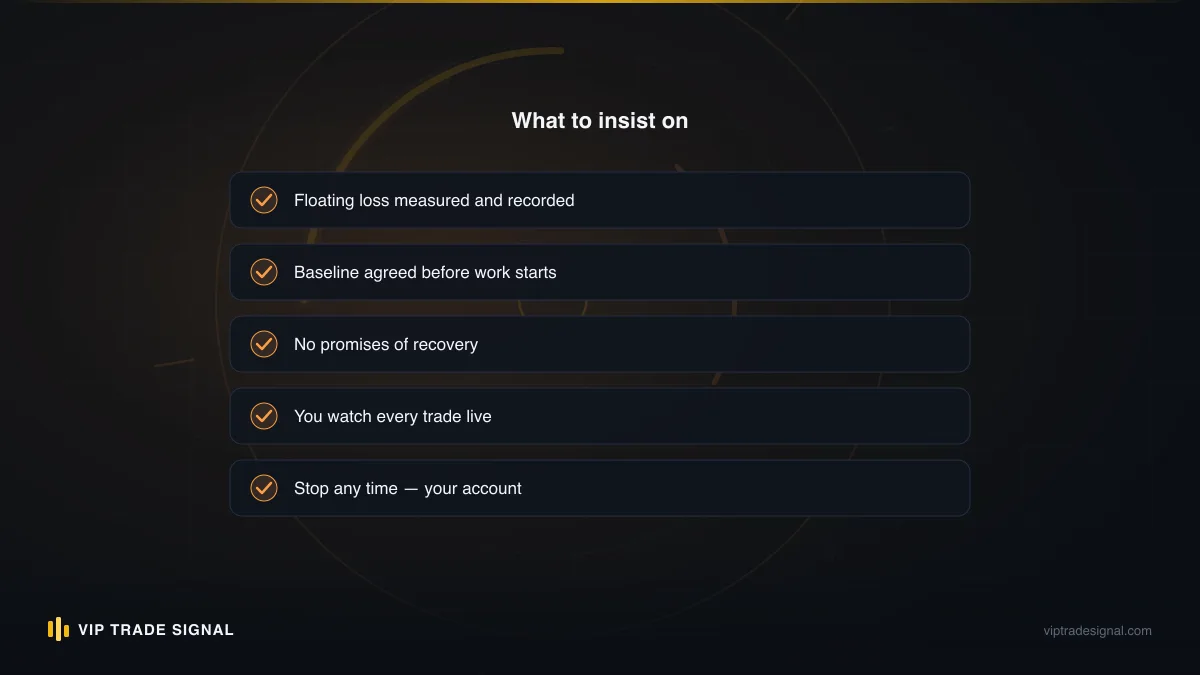
- What exact number is my baseline, and where is it recorded? You want a figure, a timestamp, equity-or-balance stated, in the written agreement. "We'll track it internally" is a no.
- How does the baseline adjust when I deposit or withdraw? The only correct answer is immediately and automatically, in the direction of the cash flow.
- Are fees on realized or floating profit? Realized. Anything else, walk.
- Is there a high-water mark? If they don't know what that means, they are too new at this to be trading recovery accounts.
- What is your maximum risk per trade and total exposure, in writing? Then check the live account against it, weekly, because you can.
- Can I see your complete closed-trade history, losses included? Complete. If the answer is a screenshot folder, that's a highlight reel, and highlight reels are what the lottery model produces by design.
- Who holds the master password and withdrawal rights? You. Non-negotiable. This single question eliminates most of the genuinely dangerous operators before lunch.
- What do I owe if you recover nothing? The answer should be a specific, small, disclosed number or zero. Watch for hedging.
- What happens on partial recovery, and can you show me the fee math on a made-up example? An honest operator can do the Dana table above from memory. A dishonest one will keep it vague, because vague is where their margin lives.
- Do you guarantee recovery? The correct answer is no, said without flinching. A yes is disqualifying on the spot, and I mean that literally: end the call. Markets don't offer guarantees to anyone, and a business built on pretending otherwise will be built on pretence elsewhere too.
Two or more wobbly answers and you're done. There are other operators. There is also always the option of no operator, which brings us to the honest final question.
When flat-fee or DIY beats profit share
A success-fee desk that only gets paid from your recovery should be able to tell you when you don't need one. So: three situations where profit-share recovery is the wrong tool.
The drawdown is small enough to self-manage. If you're $1,500 down on a $10,000 account, you do not need to give away half the climb back. You need a written plan: cut oversized positions, drop risk to 1% or below, and grind. The discipline traders build surviving prop firm limits translates directly here; prop firm drawdown rules are harsh, but they teach exactly the containment habits an underwater personal account needs. Half of recovery is just refusing to make the hole deeper.
You'd genuinely trade better with a fixed cost. If an account is large and the expected recovery is big, 50% of it may cost far more than a competent flat-fee arrangement, and some traders simply sleep better knowing the manager's pay can't scale with risk-taking. That's a legitimate preference. The flat-fee world has its own failure mode, getting paid regardless of outcome, but for large accounts the arithmetic can favour it, and pretending otherwise would be exactly the kind of one-sided comparison this blog exists to avoid.
The account is beyond recovery arithmetic. Sometimes the kindest thing anyone can tell a trader is that the remaining equity is too small, relative to the hole, for any responsible risk level to climb out in reasonable time. An account $9,000 down with $1,100 of equity left needs roughly a 9x return at conservative sizing to get home. Nobody honest takes that job on a success fee, because the only way to attempt it is loophole two. Realizing the loss, regrouping, and rebuilding from a clean balance is a defeat, but it's a survivable one, and survivable defeats are how trading careers continue.
Where this leaves you
No win, no fee is the fairest fee structure retail trading recovery has, and it is still only as fair as its two definitions: where profit is measured from, and what risk was allowed in producing it. Get those two things nailed down in writing, recorded baseline, realized-only fees, high-water mark, hard risk limits, your keys in your pocket, full history in the open, and the model does what it promises: an operator who wins only when you do. Leave either definition loose and you've bought a lottery ticket with your own account as the stake.
If your account is floating somewhere in that $5k-$10k hole and you want to see how our version of the structure holds up under the ten questions, the FAQ answers most of them and we'll answer the rest directly. And if you read all this and decide to manage the drawdown yourself instead, honestly, good. A trader who understands baselines and risk asymmetry well enough to reject a recovery service is most of the way to not needing one. That's not a loss for us. That's the education part of the blog doing its job.