There is a number in the top corner of your MT4 terminal that most traders never look at until the night it ruins them. It sits next to Balance and Equity, and on a calm account it reads something boring like 2,400%. Nobody checks it. Then a position goes wrong, then another, and suddenly it reads 190% and falling while its owner googles what it means at two in the morning.
That number is your margin level, and if you trade forex or gold on leverage, it is the single most honest gauge on your platform. Your margin level percentage in forex is not an opinion, not a projection, not a strategy metric. It is a live measurement of how far your account is from the moment your broker starts closing your trades for you. Balance can lie to you for weeks, because it ignores open losses entirely. Equity tells the truth but gives you no context. Margin level tells you the truth and the context: here is what you have, here is what your positions demand, and here is how much room is left between the two.
We run drawdown rescues for a living, and the first thing we compute on every intake, before we look at a single chart, is margin level and its trajectory. Not because it tells us whether the trades were good. It tells us how much time we have. An account at 800% has weeks to work with. An account at 130% might have hours. This article is that first-hour maths, written out properly: the formula, what each threshold actually feels like from inside the account, how to calculate your survival distance in pips, and what to do when the gauge is heading toward the red.
Margin level percentage in forex: the formula
Here it is. The whole thing:
Margin level = (Equity ÷ Used Margin) × 100
That's it. Two inputs and a percentage sign. Everything else in this article is just the consequences of that one division.
Equity is your balance plus or minus the floating profit and loss on your open positions, updated every tick. Used margin is the deposit your broker has ring-fenced as collateral for those positions. Divide the first by the second, multiply by a hundred, and you have your margin level.
A quick sanity check with round numbers. Say your equity is $5,000 and your open positions require $500 of margin. Five thousand divided by five hundred is ten, times a hundred is 1,000%. Your equity covers your margin requirement ten times over. Comfortable. Now imagine the same positions have gone against you and your equity has bled down to $750. Seven-fifty divided by five hundred is 1.5, so your margin level is 150%. Your equity now covers the requirement only one and a half times, and you are inside most brokers' margin call territory.
Notice what changed and what didn't. Used margin stayed at $500 the whole way down; margin requirements don't grow because you're losing (with one nasty exception for gold that we'll get to). What collapsed was equity. Margin level falls for exactly one of two reasons: your equity shrinks, or your used margin grows because you opened more positions. Usually, in a blow-up, it's both: the trader loses money and adds positions trying to average down, which attacks the fraction from both ends at once. The numerator falls while the denominator rises. That's why accounts don't drift into stop-out. They accelerate into it.
One more thing about the margin level formula before we move on: it is position-blind. It doesn't care whether you're long or short, whether your trades are brilliant or insane. It only measures the arithmetic relationship between what you have and what you've committed. Which is precisely why it's useful. It cannot be argued with.
Used margin, free margin, equity: the three inputs
The formula has two inputs, but to actually use it under pressure you need to understand three numbers and how they relate. Your platform shows all of them in the terminal window, usually in this order: Balance, Equity, Margin, Free Margin, Margin Level.
Balance is your realised money: deposits, withdrawals, closed trades. It is also, for a trader with open positions, close to meaningless. A balance of $10,000 with $4,000 of floating losses is not a $10,000 account. It's a $6,000 account wearing a $10,000 badge. Traders who watch balance instead of equity are the ones who get blindsided.
Equity is balance plus floating P/L. This is what you actually have, right now, at current market prices. If every position closed this second, equity is what would remain. Every serious margin calculation starts here.
Used margin (your platform may just call it Margin) is the collateral locked against your open positions. At 1:100 leverage, one standard lot of EUR/USD around 1.1000 locks up roughly $1,100. The money hasn't gone anywhere (it's still yours), but it's committed, the way a hotel pre-authorisation holds part of your card limit.
Free margin is equity minus used margin. So what is free margin in forex, in practical terms? It's your working room. It is the pool that absorbs floating losses, and it is also the pool from which any new position's margin must come. When free margin hits zero, two things are true at once: you cannot open anything new, and your equity exactly equals your used margin. Glance back at the formula and that is the definition of a 100% margin level. Free margin reaching zero and margin level reaching 100% are the same event wearing different clothes.
Picture it as a waterfall. Equity pours in at the top. The first pool it fills is used margin, because the broker's collateral requirement takes priority. Whatever spills over becomes free margin. When losses drain the waterfall, free margin empties first, because used margin is fixed. Your buffer dies before your collateral does. That ordering is the whole story of a margin call.
A subtlety that catches people: floating profit increases equity and therefore free margin. Traders sitting on a winning open trade often feel richer and open more positions against that unrealised profit. It's legal, the platform allows it, and it's how winning weeks turn into losing months, because the free margin propping up the new positions evaporates the moment the winner pulls back.
A worked example at 1:100 leverage
Abstract definitions don't save accounts. Arithmetic does. So let's build a full example and follow it down.
A trader we'll call Dan opens an account with $3,000 at 1:100 leverage. He sells 0.5 lots of XAU/USD, gold, at $3,300 per ounce. Half a lot of gold is 50 ounces, so the notional value of his position is 50 × 3,300 = $165,000. At 1:100 leverage his used margin is one per cent of that: $1,650.
Freeze the moment the trade opens. Balance: $3,000. Equity: $3,000 (no floating P/L yet, ignoring spread for cleanliness). Used margin: $1,650. Free margin: $3,000 − $1,650 = $1,350. Margin level: 3,000 ÷ 1,650 × 100 = 182%.
Read that again, because it's the punchline of the whole example. Dan hasn't lost a cent yet. The market hasn't moved. And he is already at 182% — inside the zone where many brokers send margin call warnings. One trade, placed at a size his account technically permits, has burned through most of his safety before the market has said a word. Leverage let him open the position; it did nothing to make the position survivable.
Now the market moves against him. Gold rises $10, to $3,310. On 50 ounces short, that's a $500 floating loss. Equity: $2,500. Free margin: $850. Margin level: 2,500 ÷ 1,650 × 100 = 151%.
Gold rises another $10. Equity: $2,000. Free margin: $350. Margin level: 121%.
Another $7. Equity: $1,650. Free margin: zero. Margin level: 100%. Dan's account is now frozen (more on what that means in a moment), and gold has moved a grand total of $27 against him. On a volatile day, gold covers $27 before your kettle boils.
If his broker stops out at 50% (many do; some use 20% or 100%; check yours in the account specifications and usually in the /faq of any honest service), the forced close comes when equity hits half of used margin: $825. That's another $16.50 of adverse movement, or $43.50 in total from entry. A $3,000 account, one half-lot gold trade, and the entire journey from "fine" to forcibly liquidated fits inside a single afternoon's range.
Run the same trade at 0.1 lots instead. Used margin: $330. Opening margin level: 3,000 ÷ 330 × 100 = 909%. The same $27 move costs $270 and leaves margin level at 827%. Barely a scratch. Same trader, same idea, same entry. The only difference is size, and size is the difference between a bad day and a dead account.
What 1,000%, 300%, 150% and 100% actually feel like
The formula gives you a number. Experience gives that number a temperature. Having watched a lot of accounts at every stage of this scale (including, early on, a couple of our own), here is what the zones actually feel like from inside.
Above 1,000%: full tank. Equity covers used margin ten times or more. Ordinary volatility barely registers; a normal losing trade moves the gauge a few dozen points and you'd have to actively try to get stopped out. This is where a sensibly sized account lives almost all the time. Our own signal sizing guidance keeps followers up here on purpose, because a signal service that requires its followers to run hot margin is selling them stress, not signals.
1,000% down to 300%: the descent. Still functional, but the account has a story. Either positions are oversized or a drawdown is running. The dangerous part of this zone is psychological rather than mathematical: 400% sounds enormous (four times covered!) so traders treat it as safe. But the drop from 1,000% to 400% and the drop from 400% to 150% can be caused by the same size of market move. The percentages are not linearly spaced against price. The gauge falls faster as it falls.
300% to 150%: the sweating zone. Now the number moves visibly with every tick, and the trader starts doing a thing we've seen on nearly every rescue intake: watching the margin level instead of the market. Decisions degrade. Stops get widened "to give it room". Take-profits get shortened to grab anything green. The account is now managing the trader, not the other way round.
150% down to 100%: margin call territory. Many brokers fire their formal warning somewhere in this band. Free margin is nearly gone, so there is no capacity to add, hedge properly, or absorb another leg down. Panic behaviour peaks here, and this is exactly where people reach for doubling-down schemes. If that temptation is whispering at you, read our piece on why martingale destroys accounts before you act on it; martingale's margin appetite is precisely what turns 140% into a stop-out.
100%: the freeze. Equity equals used margin exactly. The next section is entirely about this moment, because more myths surround it than any other number on the platform.
Below 100% to stop-out: borrowed time. The account survives only at the broker's tolerance, waiting for either a mercy bounce or the automated liquidator.
If a client rings us at 700%, we can talk calmly about structure and staged exits over days or weeks. At 130%, the first conversation is only about creating breathing room in the next few hours. Same formula, completely different problem.
What happens at 100%: the frozen account
So what happens when margin level hits 100 percent? Less than most traders fear, and more than they realise.
Here's what does not happen at 100% at most brokers: nothing closes. The stop-out, the forced liquidation, sits at a separate, lower threshold, commonly 50%, sometimes 20% or 30%, occasionally 100% itself at stricter or ESMA-regulated brokers. If your broker's stop-out is 50%, then 100% is not the execution. It's the sentencing.
What does happen is that your account freezes for new risk. Free margin is zero, so the platform will reject any order that requires fresh margin. You cannot open a new trade. You cannot average down. At many brokers you cannot even open the opposite-direction hedge you suddenly wish you had. The only lever left that you control is the close button on your existing positions.
And this freeze arrives at the worst psychological moment. The trader at 100% almost always has a plan: add one more position at the better price, or hedge the mess. The freeze deletes every plan except two: close something, or deposit money. That is by design. From the broker's side, 100% means your unencumbered funds are gone and every further tick against you is spent from collateral. They stop you from digging because the shovel is now made of their risk.
The margin call itself, these days, is not a phone call. It's a platform notification, an email, maybe your account line turning red in the terminal. Easy to miss. Easy to ignore. And crucially, it is a courtesy, not a contract. Brokers reserve the right to close positions early in fast markets, and gap moves can blow straight through both the call level and the stop-out level before any process fires in order. Traders who plan to "act when the margin call comes" are planning to start firefighting after the roof is already alight.
One misconception worth killing directly: hitting 100% does not mean your account balance is zero, and stop-out does not mean you've "lost everything". At a 50% stop-out with $1,650 of used margin, the liquidation begins with roughly $825 of equity still in the account. The stop-out exists to protect that remainder, mostly for the broker's sake, since negative balances are their problem in a gap, but the effect protects you too. Cold comfort when it's $825 of what was $3,000. But it is not zero, and what's left is what any honest recovery conversation starts from.
How many pips until stop-out: the survival calculation
Here is the calculation that turns margin level from a dashboard ornament into an actual instrument. At any moment, with open positions, you can compute exactly how far the market must move against you before the stop-out fires. We call it survival distance, and it takes about ninety seconds with a phone calculator.
Three steps:
- Find your stop-out equity. Multiply used margin by your broker's stop-out percentage. Used margin $1,650, stop-out 50% → stop-out equity = $825.
- Find your burnable equity. Current equity minus stop-out equity. Equity $2,400 → burnable = $1,575. This is the total floating loss you can still absorb.
- Divide by your per-pip (or per-dollar) loss rate. Add up what one pip against you costs across all open positions, and divide.
For forex pairs, one standard lot is roughly $10 per pip, 0.1 lots is $1. For gold, the cleaner unit is dollars of price movement: 1 lot (100 oz) loses $100 per $1 move; 0.5 lots loses $50; 0.1 lots loses $10.
So Dan, short 0.5 lots of gold with $2,400 equity and $1,650 used margin: burnable equity $1,575, loss rate $50 per dollar of gold upside, survival distance = 1,575 ÷ 50 = $31.50 of adverse movement. Gold's average daily range in recent years has frequently run $30-$60. Dan's entire remaining life expectancy is less than one ordinary day's range. Not a crash. Not a black swan. A Tuesday.
That is the sentence that reframes everything for people. "My margin level is 145%" is abstract. "A normal Tuesday kills my account" is not.
Here's how survival distance scales with position size on that same $2,400 of equity (gold, 50% stop-out, 1:100 leverage):
| Position size | Used margin (approx.) | Loss per $1 move | Survival distance |
|---|---|---|---|
| 0.1 lots | $330 | $10 | ~$224 of movement |
| 0.3 lots | $990 | $30 | ~$64 |
| 0.5 lots | $1,650 | $50 | ~$31 |
| 1.0 lots | $3,300 | n/a | cannot open: margin exceeds equity |
Note the shape of that table. Halving your size doesn't double your survival distance; it much more than doubles it, because smaller size simultaneously lowers your loss rate and your used margin, which lowers stop-out equity, which raises burnable equity. Both ends of the division improve. Position size is the only input in this whole system that works for you twice.
Run this on your own account tonight. If your survival distance is smaller than your instrument's average daily range, you are not trading a strategy. You're flipping a coin against the clock, and the maximum drawdown you can actually survive is a question you should answer before the market answers it for you.
Five ways to increase margin level (ranked by cost)
Sooner or later you'll be inside a live position with the gauge falling, wanting to know how to increase margin level in a forex account without simply capitulating. Look at the formula: equity over used margin. Raise the top, shrink the bottom, or both. Every fix is one of those two moves. Here are the five that exist, ranked from cheapest to most expensive in real terms. And note that "cheapest" and "least painful" are not the same list in the same order.
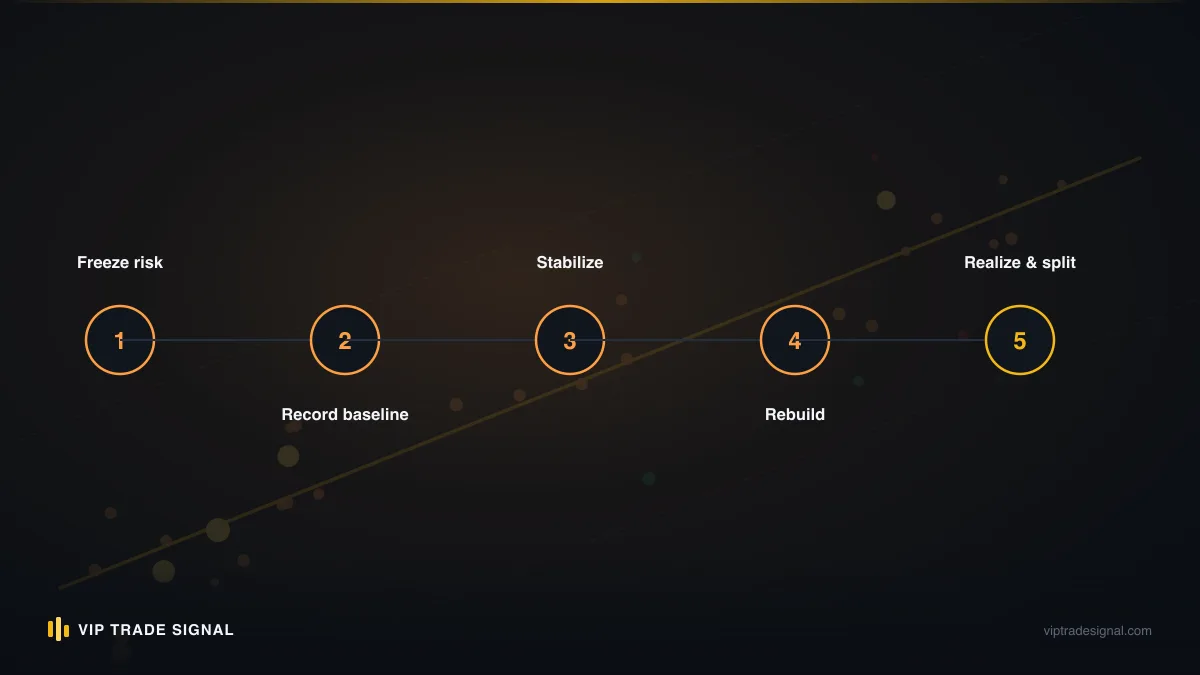
1. Close your worst position: cheapest, most painful. Closing a loser converts a floating loss into a realised one, which feels like defeat, and traders resist it for exactly that reason. But run the arithmetic: the floating loss has already been paid out of your equity; closing doesn't spend it again, it just admits it. What closing does change is used margin, which drops instantly by that position's requirement. Equity roughly unchanged, denominator smaller, margin level jumps. On a rescue intake with six open positions, closing the single ugliest one is very often the first concrete action we take, inside the first day.
2. Reduce size on what remains. Partial closes: cut the 0.5 lots to 0.3. Same mechanism at lower intensity: you keep a stake in the recovery thesis while cutting both your margin requirement and your ongoing loss rate. This is the workhorse move of professional drawdown management, because it buys survival distance without demanding a full surrender on any single idea.
3. Deposit funds: cheap-looking, quietly dangerous. New money raises equity directly, and the maths works immediately. The danger is entirely behavioural. A deposit that funds a structured plan (smaller sizes, defined exits, a written baseline) is a tool. A deposit that funds the same positions at the same sizes is a donation, and we've watched traders feed three top-ups into one losing structure inside a fortnight, each one buying a few more days of the same trajectory. Money into an unchanged structure just rents a later stop-out at a higher total cost.
4. Hedge the exposure. Opening the opposite position freezes your floating P/L so equity stops falling (some brokers also discount margin on hedged pairs; others charge both sides; check before you rely on it). It's genuinely useful as an emergency brake in the hands of someone with an exit plan for both legs. Without that plan, a hedge is just a loss in cold storage plus double the spread and swap costs, and unwinding it is a skill in itself. We use hedges on rescues occasionally. We unwind other people's failed hedges far more often.
5. Wait for the market to come back: free, and the most expensive item on this list. Hope costs nothing today and everything later. Sometimes the market does come back; survivorship makes sure you hear those stories loudly. The stopped-out majority are quieter. Waiting is a decision to keep your entire survival distance bet on direction, with the clock running.
The honest ranking for most accounts in trouble: some of 1, some of 2, and 3 only alongside a written plan. Four for specialists. Five for people who'd rather be lucky than solvent. And if the hole is already deep, roughly the $5k-$10k floating range, that structured plan is literally what our drawdown management service does for a living: 50% of recovered profit above a jointly recorded baseline, no recovery guarantees, because nobody honest can guarantee a market outcome.
Why gold positions crush margin level fastest
We are a gold-only shop, so believe us when we say this with affection: XAU/USD is the fastest margin-level killer in mainstream retail trading. Three separate mechanisms stack against you.
Contract size. One lot of gold is 100 ounces. With gold in the $3,300 region, that's about $330,000 of notional, nearly triple a standard lot of EUR/USD. At 1:100, that's roughly $3,300 of used margin per lot versus about $1,100 for the euro. Traders carry lot-size intuition over from currency pairs and open gold positions three times heavier than they realise. The denominator of the margin level formula starts obese.
Range. Gold thinks nothing of a $40 day, and news days can triple that. In pip-equivalent terms it routinely travels several times what a major currency pair covers. Bigger notional plus bigger range means your equity, the numerator, swings harder and faster than a forex-calibrated gut expects. Both ends of the fraction are working against the unwary at once.
The margin recalculation trap. Here's the nasty exception we flagged earlier. Gold margin is calculated from the current gold price, and at many brokers it's marked to market while your position is open. Say you're short from $3,300 and gold rallies to $3,450. Your used margin on one lot at 1:100 drifts from about $3,300 toward about $3,450, a 4-5% heavier requirement, at the precise moment your equity is being eaten by the same rally. The numerator falls while the denominator quietly rises. Margin level drops faster than the loss alone explains, and traders staring at the terminal can't work out why the maths keeps beating their estimates. Short positions in a rising market get squeezed from both directions. (Forex pairs do this too, but the effect is small; gold's volatility makes it material.)
Practical consequence: whatever margin level feels safe to you on currency pairs, demand more on gold. If 500% is your comfort line on EUR/USD, treat 800-1,000% as the equivalent comfort on XAU/USD. Our signals come with defined stops and sizing guidance for exactly this reason. Every closed one, wins and losses alike, sits publicly at /signals/history, and the losses are the fastest education in gold's range you'll find. Trading gold on leverage is genuinely high-risk; the same volatility that makes it worth trading is the volatility doing everything described in this section.
Setting margin level alerts
You will not watch the terminal every hour. You'll be asleep, or at your kid's birthday, and gold trades nearly 24 hours from Sydney open to New York close. The fix is deciding your thresholds now, calmly, and wiring alarms to them, because the version of you that exists at 160% and falling is a measurably worse decision-maker than the version reading this paragraph.
MT4 and MT5 have no native margin-level alert, which is a small scandal given how central the number is. Your realistic options:
- Price alerts as a proxy. Compute the price at which your account reaches each threshold (you already know how: it's the survival-distance calculation run backwards) and set standard price alerts there. Crude, needs redoing when positions change, works on every platform ever made.
- A watchdog EA or script. Plenty of free MetaTrader utilities poll `AccountMarginLevel` and fire a push notification at your chosen line. Ten minutes to install, and your phone buzzes wherever you are.
- Broker notifications. Some brokers email or push at their margin call level. Treat this as the backstop, never the plan. By the time the broker's own warning fires, you're already at their line, not yours.
Where to set the lines? Our defaults, adjust to taste:
- 500%: awareness. No action required. The account has left its normal range; find out why while it's still merely interesting.
- 300%: decision. Not "start thinking about it". Decide, per open position, what gets closed or trimmed if the slide continues, and write it down. The whole point of alarming at 300% is that decisions get made while they're still cheap.
- 200%: execution. The pre-written plan from 300% happens now. No renegotiating with yourself in the moment. If you told yourself the 0.5 gets cut to 0.2 at 200%, it gets cut at 200%, not at "let's just see the New York open".
Traders sometimes object that alarms this high are paranoid. Look back at the descent maths: the fall from 300% to 150% can be one bad session, and the gap between your alert and your action is measured in your own reaction time, which, at 3 a.m., is not what you think it is. An alarm at 200% that fires while you sleep gives you a groggy decision at 195%. An alarm at 120% gives you a funeral.
Reading margin level during a live drawdown
Everything so far treats margin level as a static snapshot. During a real drawdown it's a moving picture, and the movement carries information the snapshot doesn't.
The first-hour maths we run on every rescue intake goes like this, and you can run it on your own account in fifteen minutes:
- Current margin level. The snapshot. Sets the urgency tier: above 300% we're planning, 150-300% we're triaging, below 150% we're firefighting tonight.
- Trajectory. Where was it yesterday? Last Friday? An account at 220% that was 600% a week ago is a different patient from one that has sat at 220% for a month. The second has a static structural problem; the first is actively bleeding out.
- Survival distance versus daily range. The calculation from earlier, compared against what the instrument normally does in a day. This yields the only deadline that matters: how many ordinary days the account can survive if nothing improves.
- The exit sequence. Which position closes first, second, third, and at what margin level each trigger sits. Written down. Not because writing is magic, but because a sequenced list is the only thing a panicking human can execute reliably.
There's a pattern worth naming here, because you may recognise yourself in it. Somewhere in the sweating zone, traders stop watching price and start watching margin level itself, refreshing it, bargaining with it. This feels like vigilance. It's the opposite. Margin level is an output; you cannot trade it back up by staring at it. The only levers are the five from earlier, and four of them involve doing something to positions. When you catch yourself watching the gauge instead of the road, that is itself the signal that the account has passed beyond casual self-management.
And a hard word about what the falling gauge does to judgement, because we see the same film on almost every intake: the revenge add that "fixes everything if it just gets back to entry", doubling size to halve the required retracement, removing the stop because "it always comes back". Every one of those moves increases used margin or loss rate at the moment both are least affordable. If the hole is deep and the thinking has gone circular, a structured no-win-no-fee style recovery arrangement, where whoever manages the recovery only earns from profit above a recorded baseline, at least realigns the incentives with survival. That's the model we run, you keep the master password and the withdrawals either way, and no arrangement on earth makes recovery certain. Anyone who says otherwise is selling something worse than a losing trade.
The gauge was never the problem
Let's land this somewhere useful, because there's a trap in everything above: the belief that mastering margin level mechanics will save an account that is structurally oversized. It won't. Margin level is a fuel gauge. Learning to read the fuel gauge with great precision does not put petrol in the car — it just tells you, accurately, when you'll be walking.
Every stop-out we have ever dissected (and between rescues and our own early years, that's a lot of post-mortems) traces back through the falling percentage to the same origin: position size that was too big for the equity behind it, opened at a moment when the margin level looked "fine". The gauge reported the danger from the very first tick. Remember Dan at 182% before the market moved. The information was all there. Nobody was reading it.
So here's the checklist we'd actually put in front of you, in order:
- Find your broker's stop-out level tonight. Not roughly. Exactly: 50%, 20%, 100%, whatever it is. It's in your account specifications, and if you can't find it, ask support; ours is answered plainly in the FAQ because a number this important shouldn't require detective work.
- Run the survival-distance calculation on your current positions. Burnable equity divided by loss rate. Compare it to your instrument's average daily range. If survival is less than two or three ordinary days of range, cut size this week, not after the next win.
- Set the three alarms. 500% awareness, 300% decision, 200% execution, and higher across the board if you trade gold.
- Write your exit sequence while you're calm. Which position dies first, and at what level. The plan you write at 900% is worth ten of the plans you'll improvise at 140%.
- Recheck after every new position. Opening a trade changes both your used margin and your loss rate; every alarm price and every survival number moves with it.
None of that requires our help, or anyone's. It's an evening with a calculator. But if you're reading this from inside the sweating zone, gauge falling and sleep already lost, the honest version of "get help" is a second pair of hands with no emotional position in your trades, paid only from what actually gets recovered above a baseline you both record. That's the arrangement we offer, and even then the first thing we'll do isn't clever. It's this article's arithmetic, run on your account, followed by the unglamorous work of making the number go up slowly.
The traders who last aren't the ones with the best entries. They're the ones whose margin level never became the most interesting number on the screen.